Gamma function Gamma(z)
Anchor (Master): Euler 1729 letter to Goldbach; Legendre 1809 *Traite des fonctions elliptiques* (Gamma notation); Gauss 1812 *Disquisitiones generales circa seriem infinitam*; Weierstrass 1856 *Theorie der analytischen Facultaeten*; Whittaker-Watson *Modern Analysis* Ch. 12; Remmert *Classical Topics in Complex Function Theory* Ch. 2
Intuition [Beginner]
The factorial only makes sense for whole numbers . But many formulas in mathematics and physics need a "factorial" evaluated at fractional or even complex inputs. The Gamma function is the answer: a single smooth curve that passes through every factorial value and extends the idea to all numbers (except zero and the negative integers).
The connection is beautifully direct. For positive whole numbers , the Gamma function satisfies . So , , , , , and so on. Between these integer points, the function is smooth and positive. It grows fast as increases, just like the factorial does.
Why does this concept exist? Interpolation problems in the 18th century demanded a function agreeing with the factorial at positive integers while making sense at non-integer inputs. The Gamma function is the unique "nice" solution — unique, that is, once you require logarithmic convexity (the log of the function curves upward).
Visual [Beginner]
A plot of for real from to . The curve is positive and rising steeply for , passing through the factorial values at . To the left of , the function alternates sign and blows up at each non-positive integer , producing a series of vertical asymptotes.
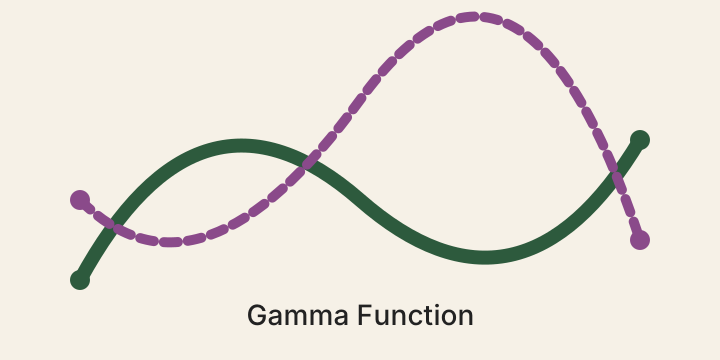
The poles at are the price of extending the factorial beyond its natural domain: the function simply cannot be made finite there.
Worked example [Beginner]
Compute and using the functional equation.
Step 1. For , the Gamma-factorial relationship gives .
Step 2. For the half-integer, use the known value . Apply the functional equation twice: . Then .
Step 3. Verify consistency: and . Each step multiplies by a number that is half an integer bigger than one.
What this tells us: the functional equation lets you walk up from to evaluate Gamma at any positive half-integer, just as the factorial recurrence builds from .
Check your understanding [Beginner]
Formal definition [Intermediate+]
Let with . The Gamma function is defined by the Euler integral of the second kind:
Convergence of this improper integral for follows from two estimates. Near , the integrand behaves like , which is integrable when . For large , the exponential dominates any power , giving integrability on for all . The integral therefore converges absolutely for , and differentiation under the integral sign shows is holomorphic on this half-plane. [Stein-Shakarchi Ch. 6 §1]
The Gamma function extends to a meromorphic function on all of with simple poles at and no zeros. The residue at is . This extension is constructed via the functional equation, the Weierstrass product, or the Hankel contour integral (see Master tier).
Definition (Beta function). For and , the Beta function is
The Beta-Gamma relation connects the two.
Counterexamples to common slips
- is wrong. The correct relation is for positive integers . The off-by-one is the single most common error with the Gamma function. In particular, , not (they agree here, but ).
- The integral does not converge for all . For , the integral near diverges. The function must be extended analytically (via the functional equation) beyond the half-plane of convergence.
- is not entire. Despite being defined by an integral, the Gamma function has poles at non-positive integers. It is meromorphic, not holomorphic, on .
Key theorem with proof [Intermediate+]
Theorem (Functional equation). For all where both sides are defined,
In particular, for positive integers , this yields by induction starting from .
Proof. Start from the integral definition, valid for :
Integrate by parts with and . Then and . The integration-by-parts formula gives
The boundary term vanishes at because the exponential dominates any power, and at because forces . The remaining integral is exactly , so
For the integer specialisation, compute . Then , and . By induction, for every positive integer .
Bridge. The functional equation builds toward 06.01.04 analytic continuation, where it appears again as the engine that extends from the half-plane to a meromorphic function on all of : for , define , then iterate. The foundational reason the Gamma function is central to complex analysis and mathematical physics is that it is exactly the analytic object encoding factorial growth, and this bridge connects discrete combinatorics to continuous analysis. The pattern generalises through the Beta function (a two-parameter extension), Stirling's approximation (asymptotic control for large arguments), and the reflection formula (relating to via the sine function). Putting these together identifies the Gamma function as the universal interpolant of the factorial, with the functional equation as its structural engine.
Exercises [Intermediate+]
Advanced results [Master]
Weierstrass product. The reciprocal is an entire function with simple zeros at and no other zeros. Weierstrass 1856 [Weierstrass 1856] gave the product representation
where is the Euler-Mascheroni constant. The product converges uniformly on compact subsets of and provides the canonical entire-function factorisation of . The Weierstrass product identifies as the unique meromorphic function with the prescribed pole structure satisfying the normalisation and the functional equation.
Euler's reflection formula. For ,
Euler obtained this in the 1740s via the infinite product for ; the contour-integration proof (Exercise 7) uses the keyhole contour and the residue at . The reflection formula establishes that and determine each other, and that encodes exactly the pole structure of . Specialising yields , hence .
Stirling's approximation. For with ,
The leading term is Stirling 1730; the full asymptotic expansion in inverse powers of involves the Bernoulli numbers via the expansion of . The Stirling series is an asymptotic series (it diverges for every fixed when taken to infinitely many terms) that gives remarkably accurate approximations even for moderate .
Analytic continuation via Hankel contour. The integral converges only for , but the Hankel contour representation
(where is a contour starting at , circling the origin counterclockwise, and returning to ) converges for all and provides the entire-function representation of directly. This is the construction that appears in 06.01.04 analytic continuation as a paradigmatic example of extending a function beyond its original domain of definition.
Gauss multiplication formula. For any positive integer and ,
Gauss 1812 [Gauss 1812] established this in his study of hypergeometric series. The case is the Legendre duplication formula , a direct consequence of the Beta-Gamma relation.
Poles and residues. The Gamma function has simple poles at with . The order of growth is as in any fixed strip away from the negative real axis (Stirling control). The residue theorem applied to around confirms the residue.
Synthesis. The Gamma function occupies a singular position in complex analysis and mathematical physics, and the synthesis runs in four directions.
First, the analytic-continuation architecture: the Gamma function is the canonical example of extending a function beyond its natural domain. The integral representation converges for ; the functional equation pushes it to minus a pole at zero; iteration covers all of . This is exactly the continuation pattern that appears again in 06.01.04 for general analytic functions, and the foundational reason the Gamma function serves as the textbook example of meromorphic continuation in every complex-analysis course. The bridge is between the discrete recurrence and the continuous functional equation .
Second, the special-function network: the Gamma function connects to the Riemann zeta function via (the functional equation of ), to the hypergeometric function via the Gauss formula (which requires Gamma to state its convergence parameters), and to the elliptic integrals via the Beta function (itself a quotient of Gamma values). The central insight is that every special function of classical analysis ultimately involves Gamma values, and putting these together identifies Gamma as the hub of the special-function lattice.
Third, the asymptotic-methods pillar: Stirling's approximation is the template for the Laplace method, the saddle-point method, and the general theory of asymptotic expansions. The pattern recurs in the asymptotics of Bessel functions, Airy functions, and the partition function (Hardy-Ramanujan 1918, which uses the transformation properties of the Dedekind eta function — itself expressible via Gamma). The bridge is that Stirling's method generalises to every asymptotic problem involving exponential growth with a polynomial correction.
Fourth, the product representation and value-distribution theory: the Weierstrass product for is the simplest non-polynomial example of the Hadamard factorisation theorem (an entire function of order one factorises by its zeros). The pattern recurs in the product for , the Blaschke product for bounded holomorphic functions on the disc, and the Selberg trace formula. This is exactly the structure that identifies the Gamma function as the prototypical meromorphic function of finite order.
Full proof set [Master]
Proposition (Weierstrass product for ). The function is entire with simple zeros at and satisfies for all .
Proof. Convergence: for each factor , the estimate for small gives . Since , the product converges uniformly on compact subsets by the Weierstrass -test for products. Each factor is entire and non-vanishing (the only zero of at is cancelled by never vanishing — wait, the zero of at is precisely the zero of that factor). The factor contributes the zero at . So is entire with simple zeros exactly at .
To identify , verify the functional equation. Write :
Using and telescoping the product: . Shifting the index in the denominator and examining the partial products through terms gives
which tends to as by the Euler limit formula . Hence , i.e., , matching . Since and both satisfy the same functional equation with the same normalisation, .
Proposition (Legendre duplication formula). For all where both sides are defined,
Proof. Apply the Gauss multiplication formula with . The product appears in the left side of Gauss's formula
Alternatively, derive directly from the Beta function: by the Beta-Gamma relation. On the other hand, . The substitution transforms the integral to . Equating the two expressions for and using gives the duplication formula.
Proposition (Residues at poles). The Gamma function has a simple pole at for each with residue .
Proof. From the functional equation iterated times: . At , the numerator has a simple pole with residue (from near ). The denominator evaluated at gives . Therefore
Each pole is simple because the numerator is holomorphic near (once the functional equation has shifted the argument to with near zero) and the denominator has a simple zero.
Connections [Master]
Analytic continuation
06.01.04. The Gamma function is the paradigmatic example of analytic continuation beyond a half-plane of convergence. The integral converges only for , yet the functional equation extends meromorphically to all of with poles at non-positive integers. This pattern provides the template for understanding continuation of more general functions defined by integrals with parameter-dependent convergence.Meromorphic functions and residues
06.01.05. The Gamma function is a canonical meromorphic function on with infinitely many poles accumulating only at infinity. Its pole structure — simple poles at with residues — is the standard example of a meromorphic function whose poles are arranged in an arithmetic progression, and the reflection formula connects its pole structure to the zeros of .Cauchy integral formula and contour integration
06.01.02. The reflection formula (Exercise 7) is proved by the keyhole contour, a direct application of the Cauchy residue theorem. The Hankel contour integral for is a second contour-integration construction. Both demonstrate the power of the Cauchy integral formula for evaluating real integrals and constructing analytic functions, reinforcing the residue theorem as the central computational tool of complex analysis.Argument principle and Rouche's theorem
06.01.13. Stirling's approximation gives asymptotic control on for large , which combined with the argument principle yields the distribution of Gamma's poles. The argument principle counts the poles of inside a large contour (all poles up to ), and the asymptotic Stirling estimate bounds the logarithmic derivative , controlling the argument variation.Riemann zeta function
21.03.01. The Gamma function is the closely related companion to the zeta function: the completed zeta function uses as the archimedean Euler factor, and the functional equation acquires its symmetric form only after the Gamma factor is included. The half-plane integral representation and meromorphic extension via are the analytic-continuation template that Riemann's 1859 paper applies to .
Historical & philosophical context [Master]
Euler 1729 [Euler 1729], in a letter to Goldbach dated 13 October, introduced the function interpolating the factorial via the infinite product (the Euler limit formula, later rederived by Gauss). Euler's motivation was interpolation: finding a smooth function that takes the values at positive integers and makes sense at intermediate values. The integral representation followed in Euler's 1783 De integralibus multiplicibus.
Legendre 1809 [Legendre 1809] introduced the symbol and the shift convention (rather than ), in his Traite des fonctions elliptiques et des integrales euleriennes. Legendre's notation, though the off-by-one from the factorial is a perpetual source of minor confusion, became the universal standard. Gauss 1812 [Gauss 1812], in his Disquisitiones generales circa seriem infinitam on the hypergeometric function, used the Gamma function systematically and proved the multiplication formula, establishing as an indispensable tool in special-function theory.
Weierstrass 1856 [Weierstrass 1856] gave the product representation for , situating the Gamma function within his general theory of entire functions and their factorisation. The modern treatment, emphasising the meromorphic structure on and the connection to value-distribution theory, crystallised with the work of Hankel (1864, the contour integral), Mittag-Leffler (the pole-expansion theorem generalising the Gamma pole structure), and the synthesis in Whittaker-Watson Modern Analysis (1902, Ch. 12) [Whittaker-Watson].
Bibliography [Master]
@article{Euler1729,
  author = {Euler, Leonhard},
  title = {Letter to Goldbach, 13 October 1729},
  journal = {Correspondance math\'ematique et physique},
  year = {1729},
  note = {First definition of the Gamma function via infinite product}
}

@book{Legendre1809,
  author = {Legendre, Adrien-Marie},
  title = {Trait\'e des fonctions elliptiques et des int\'egrales eul\'eriennes},
  publisher = {Huzard-Courcier, Paris},
  year = {1809},
  volume = {2},
  note = {Introduction of the Gamma symbol and integral representation}
}

@article{Gauss1812,
  author = {Gauss, Carl Friedrich},
  title = {Disquisitiones generales circa seriem infinitam $1 + \frac{\alpha\beta}{1\cdot\gamma}x + \cdots$},
  journal = {Commentationes societatis regiae scientiarum Gottingensis recentiores},
  volume = {2},
  year = {1812},
  pages = {3--46},
  note = {Multiplication formula and systematic use of Gamma in hypergeometric theory}
}

@article{Weierstrass1856,
  author = {Weierstrass, Karl},
  title = {Theorie der analytischen Facult\"aten},
  journal = {Journal f\"ur die reine und angewandte Mathematik},
  volume = {51},
  year = {1856},
  pages = {1--60},
  note = {Weierstrass product representation for $1/\Gamma(z)$}
}

@book{WhittakerWatson1902,
  author = {Whittaker, E. T. and Watson, G. N.},
  title = {A Course of Modern Analysis},
  publisher = {Cambridge University Press},
  year = {1902},
  note = {Chapter 12: the Gamma function and related functions}
}

@book{SteinShakarchi2003,
  author = {Stein, Elias M. and Shakarchi, Rami},
  title = {Complex Analysis},
  publisher = {Princeton University Press},
  year = {2003},
  volume = {II},
  note = {Princeton Lectures in Analysis, Chapter 6}
}

@book{Remmert1998,
  author = {Remmert, Reinhold},
  title = {Classical Topics in Complex Function Theory},
  publisher = {Springer},
  year = {1998},
  note = {Chapter 2: the Gamma function, with detailed historical development}
}