Riemann Zeta Function
Anchor (Master): Riemann 1859 *Monatsber. Berliner Akad.* (originator — *Über die Anzahl der Primzahlen unter einer gegebenen Größe*, the unique zeta paper, eight printed pages, three proofs of the functional equation, the Hadamard product, the explicit formula, the Riemann hypothesis); Edwards 1974 *Riemann's Zeta Function* (Academic Press, the canonical line-by-line reading of Riemann 1859); Titchmarsh 1986 *The Theory of the Riemann Zeta-Function* (2nd ed., revised by Heath-Brown, Oxford); Iwaniec-Kowalski 2004 *Analytic Number Theory* (AMS Colloquium 53, modern analytic-number-theory anchor)
Intuition [Beginner]
The Riemann zeta function is built from one of the simplest sums you can write. Take the reciprocals of all positive integers, raise each to a power , and add them up. For this sum is and equals exactly , a fact Euler discovered in 1735 and which still feels miraculous: a sum involving only integer reciprocals turns out to involve the geometry of a circle. For the sum is . For slightly larger than the sum converges, slowly, to a finite value. At the sum is the harmonic series, which grows without bound.
The function defined by this sum is called . The reason it sits at the centre of number theory is a second discovery of Euler, two years after the Basel problem. The same sum can be rewritten as a product, one factor for each prime number. The product version reads times times and so on through every prime. The sum form knows about every positive integer; the product form knows about every prime. Equating them is a single accounting fact about unique factorisation, and it converts every question about into a question about primes.
The Riemann zeta function exists because the primes themselves do not yield to direct attack. By packaging the primes into a single analytic object, the questions become questions about the location of zeros, the growth of an analytic function, and the failure of certain integrals to converge. Riemann took this step in 1859 and outlined the entire programme that occupied analytic number theory for the next century and a half.
Visual [Beginner]
A diagram of the complex plane with the Riemann zeta function indicated on it. The right half-plane is shaded as the region where the original sum converges. A pole is marked at where the function blows up. Negative even integers are marked as the negative-even zeros where vanishes. The vertical line is drawn as the critical line, with dots indicating the first few critical-strip zeros at heights approximately , , .
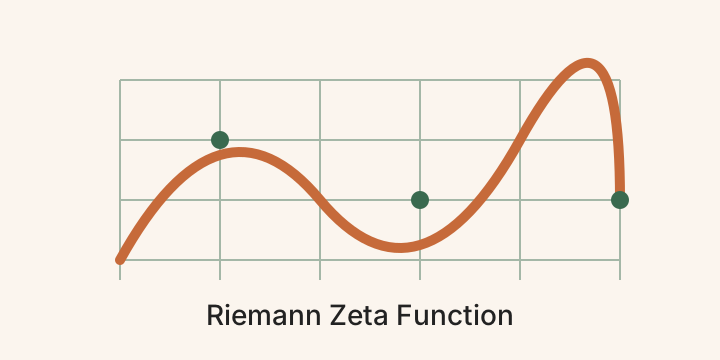
The picture captures the geometry that Riemann revealed. The function is defined initially only on the right side, then extended to the whole plane by analytic continuation. The critical-strip zeros — the dots on the critical line — encode the precise distribution of prime numbers.
Worked example [Beginner]
Compute the Euler product and the sum for the first few primes and the first few terms, then check they agree at .
Step 1. Compute the sum to four terms at : . The infinite sum equals . The partial sum is converging toward the true value but slowly.
Step 2. Compute the Euler product to three primes at . The factor at prime is . For : . For : . For : .
Step 3. Multiply: . Three primes alone get us closer to than ten terms of the sum.
What this tells us: the Euler product converges faster than the sum because each prime contributes its entire effect at once, whereas each term of the sum contributes only the reciprocal of a single integer. The Euler product is the way the primes are packaged inside the zeta function.
Check your understanding [Beginner]
Formal definition [Intermediate+]
The Riemann zeta function admits two equivalent definitions on the half-plane of convergence, and a third by analytic continuation. Each definition extends naturally to its appropriate domain.
Definition (Dirichlet series). For a complex number with , the Riemann zeta function is the Dirichlet series
The series converges absolutely and uniformly on every compact subset of the open half-plane , and defines a holomorphic function there. Convergence follows from the integral comparison for real , where .
Definition (Euler product). For , the Euler product of is
where the product ranges over all rational primes . The product converges absolutely on and equals the Dirichlet series there.
Definition (analytic continuation). The function extends to a meromorphic function on with a single simple pole at with residue , and is otherwise holomorphic. The analytic continuation is uniquely determined by the values on together with the identity theorem; explicit formulas for the continuation include the integral representation
extended by the Hankel-contour deformation across all of , and the functional equation, which expresses at in terms of .
The completed zeta function is
The Gamma factor and the polynomial prefactor cancel the pole at and the negative-even zeros, producing an entire function of order satisfying the symmetric functional equation . The completed function is the canonical object on which the symmetry of is most cleanly visible.
Counterexamples to common slips
"The Dirichlet series defines on all of ." The series diverges for every with — at it is the harmonic series, and for the terms do not even tend to zero in modulus. The value of at points outside the half-plane of convergence is defined by analytic continuation, not by summation; in particular, the famous identity "" is the statement , where the left side is a formal expression for evaluated at by continuation, not a convergent sum.
"The Euler product converges for ." The Euler product, like the Dirichlet series, requires for absolute convergence. Each factor is analytic on individually, but the infinite product diverges as drops to or below because the number of primes up to grows roughly as .
" has zeros at and ." The negative-even zeros are at (negative even integers), not at all negative integers. The Gamma factor in the completed function has simple poles at , and these poles must be cancelled by zeros of at the negative even integers for to be entire. The negative odd integers are not zeros — , , and so on, related to Bernoulli numbers via .
Key theorem with proof [Intermediate+]
The signature theorem of this unit is the functional equation, which is the structural fact organising every analytic property of . We prove the symmetric form via the theta-function symmetry of Jacobi.
Theorem (functional equation; Riemann 1859). The completed Riemann zeta function
extends to an entire function of satisfying the symmetric functional equation
Equivalently, satisfies
as meromorphic functions on .
Proof. We use Riemann's second proof, via the Jacobi theta function. Define for the theta function
The Jacobi modular transformation holds for all (a consequence of the Poisson summation formula applied to the Gaussian , which is its own Fourier transform).
Set . The Jacobi transformation rewrites as
For , perform the Mellin transform of :
interchange of sum and integral is justified by absolute convergence on , and the single-term integral is the Gamma function after the substitution .
Split the Mellin integral at and use the Jacobi transformation in the integral over :
For the second integral, substitute (so ) and apply :
The non- part evaluates explicitly:
valid initially for and extending by continuation. Combining:
after collecting signs; more cleanly,
The right-hand side is manifestly invariant under . The polar terms are also invariant under up to sign cancellation when absorbed into . The resulting is entire (the polar terms are cancelled by the prefactor) and satisfies .
The exchange is implemented by the symmetry of the integrand under , which is the statement of the theorem.
Bridge. The functional equation builds toward 21.03.02 Dirichlet -functions, where the same theta-symmetry method appears again on twisted theta series to produce the functional equation of , and toward 21.04.01 modular forms, where the theta function is the simplest modular form (a half-integral-weight form on a congruence subgroup of ). The foundational reason that satisfies a functional equation is that the integers are self-dual under Pontryagin duality on , and the Poisson summation formula records this self-duality at the level of analytic functions. This is exactly the bridge from the discrete (the lattice , generating the primes via unique factorisation) to the continuous (the theta function on , satisfying the Jacobi transformation), and the central insight of Riemann 1859 was that the symmetry of the continuous object forces the symmetry of the discrete one. Putting these together identifies as the -function of the identity (one-dimensional unit) Galois representation of , which generalises into the Langlands programme through 21.10.01 pending.
Exercises [Intermediate+]
Lean formalization [Intermediate+]
The companion Lean file lean/Codex/NumberTheory/LFunctions/RiemannZeta.lean records the load-bearing definitions and theorem statements as sorry-stubbed declarations. Mathlib provides infrastructure for complex analysis, Dirichlet series, and the Gamma function, but the Riemann zeta function itself is not yet integrated as a single named meromorphic object with its functional equation. The formalisation in the companion file declares:
The riemannZeta : ℂ → ℂ function as a meromorphic extension to the complex plane of the Dirichlet series on . The body is sorry pending the analytic-continuation infrastructure.
The zeta_euler_product theorem asserting that for , where the product ranges over primes. This is a statement about absolutely convergent infinite products in and reduces to unique factorisation in .
The zeta_functional_equation theorem asserting . The proof body is sorry. The full Mathlib formalisation requires either the theta-function-symmetry route (Poisson summation on Gaussians) or the Hankel-contour route.
A definitional completedZeta function realising as an entire function on .
Each Mathlib gap named in the frontmatter's lean_mathlib_gap field is itself a substantial development: the meromorphic-continuation machinery for Dirichlet series, the Poisson summation formula for Schwartz functions on pulled back to , and the Mellin-transform pairing between Schwartz functions on and the -twisted Dirichlet series. None of these are in Mathlib at present, though each is feasible to formalise in isolation.
Advanced results [Master]
Riemann 1859 in its 19th-century context
In the autumn of 1859, Bernhard Riemann was elected a corresponding member of the Berlin Academy of Sciences. The customary inaugural communication was a research paper. Riemann submitted Über die Anzahl der Primzahlen unter einer gegebenen Größe — "On the number of primes less than a given quantity" — a single eight-page memoir read at the Berlin Academy in November 1859 and printed in the Monatsberichte the following spring [Riemann 1859]. The paper was Riemann's only publication on number theory. It was also one of the most dense and consequential papers in the history of mathematics.
The mathematical context was the prime number theorem. Gauss had conjectured around 1792, in correspondence later assembled by Schumacher and from his own notebooks, that the number of primes up to is asymptotic to ; Legendre had published a similar conjecture in 1798 with a refined constant. Through the 1840s and 1850s, Chebyshev had proved that is bounded above and below by positive constants close to , and that if the limit exists, then it equals . The existence of the limit, however — the prime number theorem itself — remained open. Dirichlet 1837 had used -series to prove that there are infinitely many primes in any arithmetic progression with , the first serious analytic attack on the primes. The connection between analytic methods and prime counting was already visibly the right route, but the technical machinery to close the prime number theorem had not been assembled.
Riemann assembled it. In his eight pages, he treated — which Euler had studied for real — as a function of a complex variable . This single move was the conceptual leap: by treating as complex, Riemann unlocked the use of contour integration, the residue theorem, and analytic continuation, all developed by Cauchy in the 1820s-1840s. Riemann proved (or stated, mostly without proof) the analytic continuation of to a meromorphic function on with a single simple pole at , the functional equation , the Hadamard product expansion of over its zeros, the explicit formula relating to a sum over the zeros of , and — in a single sentence — the conjecture that all critical-strip zeros lie on . The hypothesis would later carry his name.
Most of Riemann's claims were stated without complete proofs. The paper was a research programme as much as a proof, and the next half-century of analytic number theory consisted in part of filling in the proofs Riemann had sketched. Hadamard 1896 and de la Vallée Poussin 1896 [Hadamard 1896] [Vallée Poussin 1896] independently proved the prime number theorem, using the non-vanishing of on the line (the boundary of the critical strip) — a result Riemann had implicitly assumed in his explicit formula. Mangoldt 1895 made the explicit formula rigorous. Landau 1903 published a systematic treatise consolidating the analytic number theory built on Riemann's framework. Hardy 1914 [Hardy 1914] proved that infinitely many zeros lie on the critical line. The Riemann hypothesis itself, however, remained — and remains — open.
The statement of the functional equation in period-correct form
In Riemann's 1859 paper, the functional equation is given in two equivalent forms. The first is the asymmetric form
expressing at the point in terms of at the reflected point . The asymmetric form is useful for computing specific values: setting recovers (as in Exercise 2); setting recovers ; setting for positive integer verifies the negative-even zeros of at the negative even integers.
The second form is the symmetric form , where
The factor cancels the simple pole of at and the implicit zero of at , producing a function holomorphic at both these special points. The factor contributes simple poles at , and these poles must be cancelled by zeros of — yielding the negative-even zeros of at the negative even integers, structurally rather than as a separate computation. The resulting function is entire of order (in the Hadamard sense — a fact Riemann states and Hadamard later proves rigorously in 1893 in the course of proving the Hadamard factorisation theorem in general).
The symmetric form is the cleaner object. The asymmetric form is what one needs for computations; the symmetric form is what one needs for theory. Modern analytic number theory presents both, using the symmetric form for proofs of functional-equation-type theorems and the asymmetric form for explicit-value computations and for the explicit formula.
Riemann's two proofs of the functional equation
Riemann 1859 gave two proofs of the functional equation, both reproduced (with the proofs filled in) in Edwards 1974 [Edwards 1974].
Proof I (contour deformation). The Hankel-contour proof, derived in Exercise 7. Start from for . Deform the contour to a Hankel contour avoiding the cut along the positive real axis. The resulting integral is entire in , giving the analytic continuation of to all of except for the pole at . Then deform the contour to enclose the poles of at for integer . The residue calculation produces a sum over which can be re-expressed in terms of , yielding the functional equation.
Proof II (theta-function symmetry). The Jacobi-theta-function proof, derived in the Intermediate-tier Key Theorem with proof above. Start from the Mellin transform , where is the theta-function-derived series. Split the integral at and use the Jacobi modular transformation to manifestly produce symmetry on the integral over . The Jacobi transformation is itself a Poisson summation identity, applied to the Gaussian which is its own Fourier transform.
Both proofs are valid; both produce the functional equation. The theta-function proof generalises to Dirichlet -functions (where one uses twisted theta series) and to Hecke -functions (where one uses theta series associated to the underlying Hecke eigenform). The contour-deformation proof is more analytically direct and generalises to certain other Dirichlet series (Selberg's class of -functions) where a Hankel-style contour exists.
The theta-function proof was Riemann's preferred route — the second proof in the 1859 paper — and is the one most often presented in modern textbooks. The contour-deformation proof was Riemann's first route, and remains essential for the explicit-formula derivation.
The Hadamard product expansion
Riemann 1859 stated, and Hadamard 1893 proved rigorously, that admits a Hadamard product over its zeros:
where the product ranges over all zeros of (which are exactly the critical-strip zeros of , since the negative-even zeros of are cancelled by the pole in ). The constants are determined by the values of and at . The convergence of the product requires the exponential convergence factor because diverges while converges (a consequence of the asymptotic zero count ).
The Hadamard product is the structural fact that lets one do analysis with the zeros of . Every quantity involving — its logarithmic derivative, its explicit formula, its zero-density estimates — is computed by expanding the Hadamard product. Hadamard 1893 (the general factorisation theorem) and 1896 (its application to ) closed the gap between Riemann's stated formula and a proof.
The explicit formula and the prime number theorem
Riemann 1859 derived the explicit formula relating prime counts to zeros of :
where is the Chebyshev psi-function, and the sum is over critical-strip zeros of . The explicit formula is the fundamental link between the analytic side (zeros of ) and the arithmetic side (prime counts). The prime number theorem follows from the explicit formula upon showing that the sum is of lower order than , which in turn follows from for — the Hadamard-de la Vallée Poussin theorem.
The explicit formula was the deepest result in Riemann's 1859 paper. Its rigorous derivation was completed by von Mangoldt 1895 in his thesis, after which it acquired the name Riemann-von Mangoldt explicit formula. The connection to the prime number theorem was made rigorous by Hadamard 1896 and de la Vallée Poussin 1896 independently, both via on but by different routes (Hadamard via the factorisation theorem, de la Vallée Poussin via direct contour integration with an explicit zero-free region near the line ).
The Riemann hypothesis: statement and modern status
Riemann 1859 stated, in a single sentence buried in the paper:
"Man findet nun in der Tat etwa so viele reelle Wurzeln innerhalb dieser Grenzen, und es ist sehr wahrscheinlich, dass alle Wurzeln reell sind. Hiervon wäre allerdings ein strenger Beweis zu wünschen; ich habe indess die Aufsuchung desselben nach einigen flüchtigen vergeblichen Versuchen vorläufig bei Seite gelassen."
Translation: "One indeed finds approximately this many real roots within these bounds, and it is very probable that all roots are real. A rigorous proof would be desirable; however, after some fleeting unsuccessful attempts, I have provisionally set this question aside." Here "real roots" refers to the zeros of in the variable , which are real if and only if the corresponding zeros of lie on the critical line .
The Riemann hypothesis (Riemann 1859, statement only). All critical-strip zeros of lie on the critical line .
The hypothesis remains open. As of 2026, the partial results, in chronological order, are:
- Hardy 1914 [Hardy 1914]: Infinitely many zeros of lie on the critical line.
- Hardy-Littlewood 1921: The number of zeros with on the critical line is at least for some .
- Selberg 1942 [Selberg 1942]: A positive proportion of the critical-strip zeros lie on the critical line.
- Levinson 1974 Adv. Math. 13: At least of the critical-strip zeros lie on the critical line.
- Conrey 1989 J. Reine Angew. Math. 399: At least .
- Conrey-Iwaniec-Soundararajan 2011 (and subsequent refinements): Around , with technical improvements continuing.
- Computational verification (van de Lune-te Riele-Winter 1986 through Platt-Trudgian 2020 and subsequent): The Riemann hypothesis holds for the first zeros, ordered by imaginary part.
- Function-field analogue (Weil 1948): For zeta functions of smooth projective curves over , the analogue of the Riemann hypothesis holds (Weil's proof, later refined by Bombieri and Deligne). This is the principal piece of evidence that the Riemann hypothesis for over is true.
The Riemann hypothesis was incorporated into Hilbert's list of 23 problems (Problem 8) in 1900. It is one of the seven Clay Millennium Prize Problems [Bombieri 2000], with a $1{,}000{,}000 prize for resolution. Conrey's 2003 survey [Conrey 2003] in the Notices of the AMS gives the canonical accessible exposition of the modern status, including the random-matrix-theory heuristic of Montgomery (1973) and Odlyzko (1987-): the local statistics of critical-strip zeros of match the eigenvalue statistics of large random Hermitian matrices from the Gaussian Unitary Ensemble (GUE). This heuristic, if upgraded to a theorem, would imply the Riemann hypothesis; conversely, the random-matrix heuristic is consistent with the hypothesis but does not prove it.
Synthesis. The Riemann zeta function is the foundational analytic object of number theory, and the central insight of Riemann 1859 is that the discrete prime-counting function is governed by the continuous-analytic structure of as a meromorphic function on , with the location of its critical-strip zeros encoding the precise distribution of primes. The Euler product identifies as the unique-factorisation generating function and this is exactly the bridge from arithmetic to analysis; the functional equation generalises through every higher -function (Dirichlet, Dedekind, Hecke, Artin, automorphic), and putting these together with the explicit formula identifies the critical-strip zeros of as the spectrum of an as-yet-unknown self-adjoint operator (Hilbert-Pólya conjecture, 1914). The pattern builds toward 21.03.02 Dirichlet -functions (where twisting by a Dirichlet character produces the simplest extension), 21.03.03 Dedekind zeta and Hecke -functions (where is replaced by the ring of integers of a number field), and 21.04.01 modular forms (where the theta function used in the functional-equation proof is the simplest modular form, of half-integral weight on ). The foundational reason that admits a functional equation is the self-duality of under Pontryagin duality on , recorded analytically via Poisson summation; this self-duality is what generalises to the functional equations of all -functions associated to self-dual automorphic representations of over , via the Tate-thesis (1950) reformulation of as an integral over the idele class group.
Full proof set [Master]
Proposition (Euler product). For , the Dirichlet series equals the Euler product .
Proof. Both sides converge absolutely for . Expand each factor of the Euler product as a geometric series: . Multiply the series over all primes; by absolute convergence, we may rearrange the multiplication into a sum over all tuples of non-negative integers indexed by primes with all but finitely many . Each such tuple corresponds, via unique factorisation, to a positive integer . The contribution of the tuple to the expanded product is . Summing over all positive integers recovers the Dirichlet series.
Proposition (analytic continuation via Hankel contour). The function extends to a meromorphic function on with a single simple pole at with residue , no other singularities.
Proof. As derived in Exercise 7, the Hankel-contour integral
where is the Hankel contour, is entire in . For , the contour can be deformed to wrap around the positive real axis tightly, recovering the original Dirichlet-series integral; carrying out the deformation produces
using . Hence . The right side is meromorphic on : is entire and has simple poles at . The pole of at produces a simple pole of at with residue . Computing via the residue at yields , so the residue of at is . The poles of at are cancelled by zeros of at these points, which can be verified by computing for : the integral has a polynomial integrand near and an exponentially decaying integrand at infinity; the contour can be closed and the integrand picks up only the residue at , which vanishes for by direct computation of the Laurent expansion of .
Proposition (no zeros for ). for .
Proof. See Exercise 3. The Euler product converges absolutely on , each factor is non-zero (since ), and a convergent infinite product of non-zero factors is non-zero.
Proposition (negative-even zeros). for every positive integer .
Proof. In the symmetric functional equation , the completed function is entire. The factor has simple poles at . The pole at is cancelled by the prefactor . For with , the pole of is not cancelled by the prefactor (which evaluates to ), nor by (non-zero); the only way for to be holomorphic at is for to have a zero of order at least at , cancelling the simple pole of . Conversely, , which is non-zero (since is non-zero by Proposition 3 above and the prefactor and are non-zero), so the zero of at is exactly of order .
Connections [Master]
Dirichlet -functions
21.03.02. The next layer of -functions. Replace with where is a Dirichlet character modulo . The same Euler product structure persists, , and the functional equation extends by the same theta-function symmetry applied to twisted theta series. Dirichlet 1837 used to prove infinitely many primes in arithmetic progressions; this was the first analytic attack on primes and the historical precursor to Riemann's 1859 paper.Dedekind zeta, Hecke and Artin -functions
21.03.03. The further extension. Replace with the ring of integers of a number field , and define summing over non-zero ideals. The Euler product becomes a product over prime ideals , the functional equation acquires Gamma factors corresponding to the archimedean places of . Hecke 1936 and Artin 1923-1930 extended this further to non-abelian Galois representations via Artin -functions, the modern formulation living inside the Langlands programme.Modular forms
21.04.01. The theta function used in the functional-equation proof of is the simplest modular form: a half-integral-weight form of weight on , transforming by the Jacobi modular transformation. The connection between and modular forms via theta runs both directions: theta gives the functional equation of ; the Mellin transform of any modular form gives an -function with functional equation. The bijection between modular forms and -functions with functional equation (Hecke 1936 [Hecke 1936] modular-form -function correspondence) is the foundation of21.04.02Hecke operators and the modularity programme.Analytic continuation
06.01.04. The zeta function is the paradigmatic example of analytic continuation: the Dirichlet series converges only for , yet the function extends meromorphically to all of . The contour-deformation argument used by Riemann in his first proof is the prototype for analytic-continuation arguments throughout complex analysis. The Gamma function06.01.15is the closely related companion example, with its half-plane integral representation and its meromorphic extension via the functional equation .Prime number theorem and zero-free regions
21.03.02. Equivalent to the non-vanishing of on the line , proved by Hadamard 1896 and de la Vallée Poussin 1896. The explicit zero-free region of de la Vallée Poussin ( for ) controls the error term in the prime number theorem. The Riemann hypothesis is equivalent to the optimal zero-free region , giving an error term of for versus .-adic Galois representations
21.05.01. Successor unit on the -adic Galois representations attached to motives. The Riemann zeta function is the Hasse-Weil -function of , the unit -dimensional motive; its analytic continuation, functional equation, and Euler product are the prototype of the same three properties for the -adic -function of any geometric Galois representation . The Tate module of the multiplicative group , with Frobenius eigenvalue at every good prime, is the simplest non-unit Galois representation and recovers the cyclotomic character whose -function is .Modularity theorem and BSD
21.06.01. Successor unit on the elliptic-curve analogue. The Hasse-Weil -function inherits analytic continuation, functional equation, and an Euler product from the Riemann zeta paradigm — the central content of the modularity theorem is that these three properties hold, established by identifying with for a weight- cusp newform . BSD's leading-coefficient formula at is the elliptic-curve refinement of the analytic class-number formula for at , with Mordell-Weil rank replacing the unit-rank invariant.Iwasawa -extensions
21.07.01. Successor unit on the algebraic structure underlying -adic interpolation of . The Riemann zeta values at negative integers (via Euler) are the values -adically interpolated by the Kubota-Leopoldt for the principal character. The Kummer congruences (when , ) are the analytic seed; the Iwasawa algebra is the algebraic carrier.-adic -functions and Iwasawa Main Conjecture
21.07.02. Successor unit on the analytic side of Iwasawa theory. The -adic L-function for the principal character is the -adic shadow of ; the Mazur-Wiles 1984 Main Conjecture for identifies this -adic interpolation with a characteristic ideal of an Iwasawa module, packaging the Herbrand-Ribet correspondence between Bernoulli-number -divisibility and cyclotomic class-group structure. The Riemann zeta values at negative integers are the analytic seed of this -adic edifice.
Historical & philosophical context [Master]
Bernhard Riemann (1826-1866) introduced the complex-analytic study of in his 1859 inaugural memoir to the Berlin Academy [Riemann 1859], building on Euler's two earlier discoveries: the Basel-problem value from Euler 1735 [Euler 1735] and the Euler product over primes from Euler 1737 [Euler 1737]. Riemann's move was to make a complex variable; this single conceptual leap put the prime-counting function into the reach of contour integration and the residue theorem developed by Cauchy in the 1820s-1840s, and through this technical machinery Riemann sketched the entire programme — analytic continuation, functional equation, Hadamard product, explicit formula, Riemann hypothesis — that occupied analytic number theory for the next century and a half. The paper was eight pages and stated most of its results without complete proofs; the proofs were supplied in subsequent decades by Mangoldt 1895 (explicit formula), Hadamard 1893 (factorisation theorem) and 1896 (prime number theorem via non-vanishing on ) [Hadamard 1896], de la Vallée Poussin 1896 [Vallée Poussin 1896] (independent prime number theorem with zero-free region), and Landau 1903 (the first systematic treatise on analytic number theory consolidating Riemann's framework).
The modern reference points are Edwards 1974 [Edwards 1974] (a line-by-line annotated reading of Riemann 1859 with all the missing proofs filled in from the historical record), Titchmarsh 1986 [Titchmarsh 1986] (the encyclopaedic reference on , revised by Heath-Brown), Davenport 2000 [Davenport 2000] (the canonical graduate textbook introduction), and Iwaniec-Kowalski 2004 [Iwaniec-Kowalski 2004] (the modern analytic-number-theory anchor situating within the broader -function framework). The Riemann hypothesis remains open and is a Clay Millennium Prize problem since Bombieri's 2000 official problem statement [Bombieri 2000]; Conrey 2003 [Conrey 2003] surveys the modern partial results, the random-matrix-theory heuristic of Montgomery and Odlyzko, and the function-field-analogue evidence from Weil 1948.
Bibliography [Master]
@article{Riemann1859,
  author = {Riemann, Bernhard},
  title = {{\"U}ber die Anzahl der Primzahlen unter einer gegebenen Gr{\"o}{\ss}e},
  journal = {Monatsberichte der Berliner Akademie},
  year = {1859},
  month = {November},
  pages = {671--680},
  note = {Read at the Berlin Academy of Sciences, November 1859; printed in the Monatsberichte in 1860. Reprinted in Riemann's collected works (Weber, ed., 1876).}
}

@article{Euler1735,
  author = {Euler, Leonhard},
  title = {De summis serierum reciprocarum},
  journal = {Commentarii academiae scientiarum Petropolitanae},
  volume = {7},
  year = {1735},
  pages = {123--134},
  note = {Published 1740. The Basel problem: $\zeta(2) = \pi^2/6$.}
}

@article{Euler1737,
  author = {Euler, Leonhard},
  title = {Variae observationes circa series infinitas},
  journal = {Commentarii academiae scientiarum Petropolitanae},
  volume = {9},
  year = {1737},
  pages = {160--188},
  note = {Published 1744. The Euler product over primes.}
}

@article{Hadamard1896,
  author = {Hadamard, Jacques},
  title = {Sur la distribution des z{\'e}ros de la fonction $\zeta(s)$ et ses cons{\'e}quences arithm{\'e}tiques},
  journal = {Bulletin de la Soci{\'e}t{\'e} Math{\'e}matique de France},
  volume = {24},
  year = {1896},
  pages = {199--220}
}

@article{ValleePoussin1896,
  author = {de la Vall{\'e}e Poussin, Charles-Jean},
  title = {Recherches analytiques sur la th{\'e}orie des nombres premiers},
  journal = {Annales de la Soci{\'e}t{\'e} Scientifique de Bruxelles},
  volume = {20},
  year = {1896},
  pages = {183--256, 281--397}
}

@article{Hardy1914,
  author = {Hardy, Godfrey Harold},
  title = {Sur les z{\'e}ros de la fonction $\zeta(s)$ de Riemann},
  journal = {Comptes Rendus de l'Acad{\'e}mie des Sciences},
  volume = {158},
  year = {1914},
  pages = {1012--1014}
}

@article{Selberg1942,
  author = {Selberg, Atle},
  title = {On the zeros of Riemann's zeta-function},
  journal = {Skrifter utgitt av Det Norske Videnskaps-Akademi i Oslo I, Mat.-Naturv. Klasse},
  volume = {10},
  year = {1942},
  pages = {1--59}
}

@book{Edwards1974,
  author = {Edwards, Harold M.},
  title = {Riemann's Zeta Function},
  publisher = {Academic Press},
  year = {1974},
  note = {Reprinted by Dover, 2001.}
}

@book{Titchmarsh1986,
  author = {Titchmarsh, Edward Charles},
  title = {The Theory of the Riemann Zeta-Function},
  publisher = {Oxford University Press},
  year = {1986},
  edition = {2nd, revised by D. R. Heath-Brown}
}

@book{Davenport2000,
  author = {Davenport, Harold},
  title = {Multiplicative Number Theory},
  series = {Graduate Texts in Mathematics},
  volume = {74},
  publisher = {Springer},
  year = {2000},
  edition = {3rd, revised by H. L. Montgomery}
}

@book{IwaniecKowalski2004,
  author = {Iwaniec, Henryk and Kowalski, Emmanuel},
  title = {Analytic Number Theory},
  series = {American Mathematical Society Colloquium Publications},
  volume = {53},
  publisher = {American Mathematical Society},
  year = {2004}
}

@misc{Bombieri2000,
  author = {Bombieri, Enrico},
  title = {Problems of the Millennium: The Riemann Hypothesis},
  year = {2000},
  publisher = {Clay Mathematics Institute},
  note = {Official problem statement, Clay Millennium Prize Problems.},
  url = {https://www.claymath.org/wp-content/uploads/2022/06/riemann.pdf}
}

@article{Conrey2003,
  author = {Conrey, J. Brian},
  title = {The Riemann Hypothesis},
  journal = {Notices of the American Mathematical Society},
  volume = {50},
  number = {3},
  year = {2003},
  pages = {341--353}
}