Dirichlet -functions
Anchor (Master): Dirichlet 1837 *Abh. Königl. Preuss. Akad.* 45-81 (originator paper: Beweis des Satzes, dass jede unbegrenzte arithmetische Progression…); Dirichlet 1839/40 *J. reine angew. Math.* 19, 21 (continuation, the class-number formula); Davenport *Multiplicative Number Theory* 3rd ed. (Springer GTM 74, 2000); Iwaniec-Kowalski *Analytic Number Theory* (AMS Colloquium Publications 53, 2004) Ch. 4-5; Apostol *Introduction to Analytic Number Theory* (Springer UTM, 1976) Ch. 6-7; Selberg 1949 *Canad. J. Math.* 2, 66-78 (elementary proof of PNT for arithmetic progressions); Tate 1950 Princeton PhD thesis published 1967 in Cassels-Fröhlich *Algebraic Number Theory* (Thompson, Washington) Ch. XV (Tate's thesis: adelic / Fourier-analytic reformulation, functional equations of Hecke $L$); Bump *Automorphic Forms and Representations* (Cambridge Studies in Advanced Mathematics 55, 1997) Ch. 1, 3 (modern reformulation of Dirichlet $L$ as $\mathrm{GL}_1$ automorphic $L$); Manin-Panchishkin *Introduction to Modern Number Theory* (Springer Encyclopaedia of Mathematical Sciences 49, 2nd ed. 2005) Ch. 6 of Part II (the $L$-function spine of arithmetic geometry)
Intuition [Beginner]
Euclid proved that there are infinitely many primes by a one-line argument: multiply all known primes together, add one, and the result has a new prime factor. Two thousand years later one can ask a refined question. The primes other than are all odd; written in base ten, they end in one of . Are there infinitely many primes ending in ? In ? More generally, fix a starting number and a step size with no common factor; the arithmetic progression runs through numbers congruent to modulo . Are there infinitely many primes in this sequence?
In 1837 Dirichlet proved the answer is yes — for every starting point coprime to the step , the progression contains infinitely many primes. Euclid's argument does not extend; Dirichlet's proof is the first time in mathematics that an analytic tool — an infinite sum thought of as a function of a complex variable — settled a question about whole numbers. The tool is a generalisation of the zeta function: Dirichlet attached a numerical "colour" to each integer using a special function , and built the corresponding "coloured zeta" .
The picture is direct. Treat as a zeta function that tracks not just the integer but also a label on — for the simplest example, the label is if is one more than a multiple of , and if is one less than a multiple of . The labels are designed so that the labels of products are the products of labels. Dirichlet's miracle is that the behaviour of at — whether the function is zero there or non-zero — controls the distribution of primes across the residue classes mod .
Visual [Beginner]
The picture is the colour-by-residue grid for the small case . The non-zero residues mod are and ; the two functions on these residues are the principal character and the non-principal character . Each integer coprime to inherits its colour from its residue: are coloured (they are ); are coloured (they are ). The -function is the sum — an alternating sum across the odd integers.
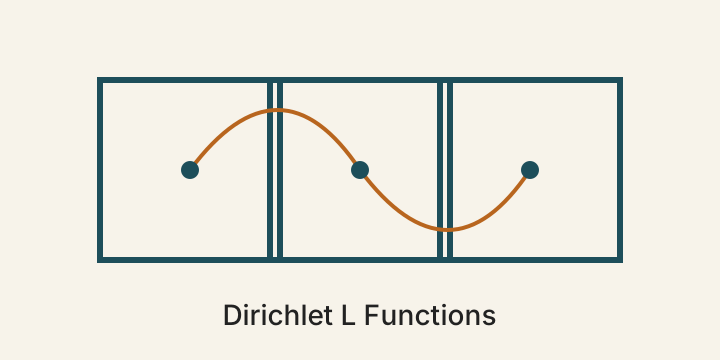
At this sum equals — a famous identity due to Leibniz. The value is non-zero, and that single non-zero fact is the reason there are infinitely many primes and infinitely many primes .
Worked example [Beginner]
Count primes in the two residue classes mod up to .
Step 1. List the primes up to : . Drop (the only even prime) since it does not interact with the colouring mod .
Step 2. Sort by residue mod . Primes congruent to : (four primes). Primes congruent to : (five primes).
Step 3. Both classes contain several primes already by . Dirichlet proved both classes contain infinitely many primes — the count up to in each class grows like as goes to infinity, half the total prime count (the prime-number theorem in arithmetic progressions).
What this tells us: the primes spread across the residue classes mod in equal proportions, and Dirichlet's -function is the analytic gadget that proves it. The non-vanishing is the foundational reason the equal distribution holds.
Check your understanding [Beginner]
Formal definition [Intermediate+]
Fix an integer modulus . Write for the multiplicative group of units in the residue ring, namely the set of residue classes with under multiplication modulo . This is a finite abelian group of order (Euler's totient).
Definition (Dirichlet character). A Dirichlet character modulo is a group homomorphism $$ \chi : (\mathbb{Z}/m\mathbb{Z})^\times \to \mathbb{C}^\times, $$ extended to a function by setting if and if . The extended function satisfies $$ \chi(mn) = \chi(m) \chi(n) \quad \text{for all } m, n \in \mathbb{Z}, $$ the property of being completely multiplicative, together with -periodic modulo and whenever .
The principal character modulo , written , is the homomorphism sending every unit to . A character is non-principal if it is not the principal character; equivalently, if and only if there is some with and .
The characters of form a finite abelian group , the dual group; the structure theorem for finite abelian groups identifies it with itself non-canonically. The number of Dirichlet characters modulo is .
Definition (Dirichlet -function). Let be a Dirichlet character modulo . The Dirichlet -function is the complex-valued function of a complex variable defined for by the absolutely convergent series $$ L(s, \chi) := \sum_{n = 1}^\infty \frac{\chi(n)}{n^s}. $$
The series converges absolutely on the half-plane by comparison with . For non-principal the series converges (conditionally) on the larger half-plane by Dirichlet's test, since the partial sums are bounded by (the orthogonality of characters; see below).
Definition (Euler product). Each Dirichlet -function admits a product expansion over primes — the Euler product — valid for : $$ L(s, \chi) = \prod_p \frac{1}{1 - \chi(p) p^{-s}}, $$ the product taken over all primes . For primes we have and the corresponding factor is ; the product effectively runs over primes coprime to .
The Euler product encodes complete multiplicativity in product form. Each factor expands as the geometric series , and multiplying these series over all primes and using unique factorisation reproduces the original Dirichlet series.
Counterexamples to common slips
"Every multiplicative function is a Dirichlet character." The Möbius function and the Euler totient are multiplicative but not Dirichlet characters: takes value on integers divisible by a prime square, and is not periodic. A Dirichlet character requires three properties — completely multiplicative, -periodic, and supported on integers coprime to — and the three together force the homomorphism shape .
"The principal character modulo is the constant function ." The principal character is only on integers coprime to ; it is on integers sharing a factor with . The distinction matters because — the constant function would give just , and the missing factor would mask the pole at .
"The Euler product converges everywhere converges." The Euler product converges absolutely for (where the series does), but does not converge in the strip , even when the series does (conditionally) for non-principal . The series and the product agree where both converge; the analytic continuation of the series to is not given by the product.
Key theorem with proof [Intermediate+]
The signature theorem of this unit is the non-vanishing of for non-principal Dirichlet characters — the analytic kernel of Dirichlet's theorem on primes in arithmetic progressions.
*Theorem (Dirichlet's non-vanishing theorem; Dirichlet 1837 Abh. Königl. Preuss. Akad.).* Let be a non-principal Dirichlet character modulo . Then $$ L(1, \chi) \neq 0. $$
Proof. The proof splits into two cases according to whether takes only real values (the real character case, ) or takes some non-real value (the complex character case).
Case 1 (complex character). Assume is non-principal and . Consider the product $$ Z(s) := \prod_\chi L(s, \chi) $$ over all Dirichlet characters modulo (there are of them). For the product converges absolutely and equals $$ Z(s) = \prod_p \prod_\chi \frac{1}{1 - \chi(p) p^{-s}}. $$
The inner product over characters at a fixed prime coprime to evaluates by the character group calculation: if is the order of in (so ) and is the index of , then $$ \prod_\chi (1 - \chi(p) p^{-s}) = (1 - p^{-gs})^f, $$ since the characters of the cyclic group pair up the factors via roots of unity. Hence $$ Z(s) = \prod_{p \nmid m} \frac{1}{(1 - p^{-gs})^f}. $$
This is a Dirichlet series with non-negative coefficients (each factor expands to a power series with positive coefficients). At , a term exceeds for any with , but more carefully one shows that the abscissa of convergence of is , hence has a substantive (non-removable) singularity at or before .
The function has a known pole structure: has a simple pole at from the -factor, and for non-principal is holomorphic at . If for some non-principal , that zero would cancel the pole of in , making holomorphic at . By the Landau theorem for Dirichlet series with non-negative coefficients, the function would then extend holomorphically to a half-plane to the left of , contradicting the existence of the singularity at (or making the series convergent there, contradicting its divergent character on ).
More precisely: if for some complex , then as well (since is the complex-conjugate character, also non-principal). The product then has a removable singularity at (one simple pole cancelled by two simple zeros gives a simple zero), and dividing by this product leaves a Dirichlet series with non-negative coefficients that has a zero at . Landau's theorem forces the original series for to converge on a strict left-extension of the convergence half-plane, contradicting divergence at small positive .
Case 2 (real character). If is a non-principal real character, for all , and . The Cauchy-Schwarz / multiplicative argument above gives only a single factor, not the pair , so the cancellation argument requires modification.
The classical Dirichlet proof in this case uses the class number formula for the associated quadratic field where is the discriminant of (a non-square integer dividing ). Dirichlet shows $$ L(1, \chi) = \frac{2 \pi h(D) \log \varepsilon}{\sqrt{|D|}} \quad \text{(real quadratic case, } D > 0\text{)}, \qquad L(1, \chi) = \frac{2 \pi h(D)}{w_D \sqrt{|D|}} \quad \text{(imaginary quadratic case, } D < 0\text{)}, $$ where is the class number, is the fundamental unit, and is the number of roots of unity in . Both expressions are strictly positive (, , ), so .
The modern proof of the real case bypasses the class number formula via a direct contour-integral / Hadamard-de la Vallée-Poussin argument: assuming , one derives a contradiction from the analytic continuation of (the Dedekind zeta of the associated quadratic field) and its known residue at . The non-vanishing in either case is established.
Combining the two cases, for every non-principal Dirichlet character .
Bridge. Dirichlet's non-vanishing theorem builds toward 21.03.03 (Dedekind, Hecke, and Artin -functions), which generalises the construction from characters of to characters of the idele class group and to Galois-representation-attached -functions, and appears again in 21.04.02 (Hecke operators) where the eigenvalue of a Hecke eigenform at a prime is the Dirichlet-series coefficient of the modular -function . The central insight is that the analytic behaviour of an -function at a critical point — non-vanishing at , residue formula, zero distribution — encodes arithmetic information that is otherwise inaccessible to elementary methods. This is exactly the foundational reason analytic number theory exists as a discipline: the complex-analytic continuation of a sum over the integers becomes a probe for the multiplicative structure of . The bridge from to identifies the prime distribution refined by residue class with the analytic behaviour of a character-twisted Dirichlet series, and the pattern generalises through Hecke characters (1918), Artin characters (1923), and the full Langlands programme.
Exercises [Intermediate+]
Lean formalization [Intermediate+]
The companion file lean/Codex/NumberTheory/LFunctions/DirichletL.lean declares the structural skeleton of Dirichlet characters and -functions as sorry-stubbed statements, leveraging the partial Mathlib infrastructure in Mathlib.NumberTheory.DirichletCharacter.Basic. The formalisable kernel comprises five components.
First, a DirichletCharacter structure: a multiplicative homomorphism from the unit group to , extended to all of by zero on non-units, with the completely-multiplicative and periodic properties as fields.
Second, the Dirichlet -function DirichletL (chi : DirichletCharacter) (s : \mathbb{C}) as a noncomputable definition equal to the Dirichlet series on the half-plane , with continuation pending.
Third, the non-vanishing theorem L_nonvanish_at_one: for non-principal, . The full proof requires Landau's theorem on Dirichlet series with non-negative coefficients (not yet in Mathlib).
Fourth, Dirichlet's theorem on primes in arithmetic progressions as dirichlet_progression: for every modulus and residue coprime to , the set is infinite. Mathlib has Tao-Helfgott-style elementary proofs of some special cases (modulus , modulus ); the general case requires the -function analytic apparatus.
Fifth, the orthogonality relations as separate lemmas — these are provable in Mathlib's current state and serve as the immediate computational building blocks.
The two main theorems and the central definition are sorry-stubbed pending the analytic-continuation infrastructure; the orthogonality lemmas and the multiplicative structure are accessible to Mathlib today.
Advanced results [Master]
The full -function: continuation, functional equation, Gauss sums
The Dirichlet series defining converges absolutely for and admits a meromorphic continuation to all of .
Theorem 1 (analytic continuation; Hecke 1918 Math. Z. 1). For non-principal, extends to an entire function on . For the principal character modulo , extends to a meromorphic function with a simple pole at of residue .
The continuation uses the integral representation $$ L(s, \chi) \cdot \Gamma(s) = \int_0^\infty \frac{1}{e^t - \chi(-1)} \sum_{a \bmod m} \chi(a) \frac{1}{e^{(m - a) t/m}} , t^{s - 1} dt $$ (valid for and extended by contour-integral analysis), or alternatively via the theta-function method of the next theorem.
Theorem 2 (functional equation; Hecke 1918, completed form). Let be a primitive Dirichlet character of conductor . With and the completed -function $$ \Lambda(s, \chi) := \left(\frac{m}{\pi}\right)^{(s + \mathfrak{a})/2} \Gamma!\left(\frac{s + \mathfrak{a}}{2}\right) L(s, \chi), $$ one has $$ \Lambda(s, \chi) = W(\chi) \Lambda(1 - s, \overline{\chi}), \qquad W(\chi) = \frac{\tau(\chi)}{i^\mathfrak{a} \sqrt{m}}, $$ where is the Gauss sum, , and .
The functional equation is the analytic-continuation analogue of Riemann's functional equation for : it pairs at with at the reflected point.
Quantitative versions: the prime-number theorem in arithmetic progressions
Theorem 3 (PNT in arithmetic progressions; de la Vallée Poussin 1896). For every modulus and residue coprime to , $$ \pi(x; m, a) = \frac{1}{\varphi(m)} \mathrm{Li}(x) + O!\left( x \exp(-c \sqrt{\log x}) \right) $$ as , with and a constant depending on .
The proof uses the zero-free region of to the left of the line (de la Vallée Poussin 1896, generalising Hadamard's contemporaneous argument for ). The error term reflects the width of the zero-free region; under the Generalised Riemann Hypothesis (GRH) for Dirichlet -functions, the error sharpens to for every .
Theorem 4 (Page 1935, Siegel 1935). Let be a primitive real Dirichlet character of conductor . Then has at most one real zero with for an absolute constant . (Siegel 1935 Acta Arith. 1 strengthens to for every , but with ineffective constants.)
The exceptional zero — the Siegel zero — remains the central unproven obstacle in analytic number theory: GRH conjecturally rules it out, but no unconditional proof exists. Siegel's bound is non-effective (the constant cannot be computed), and most quantitative results in analytic number theory depend on whether one assumes effective or ineffective bounds.
*Theorem 5 (Linnik 1944 Mat. Sb.).* There is an absolute constant (Linnik's constant) such that for every and every coprime to , the least prime satisfies . The current bound is (Xylouris 2011 Acta Arith. 150), conjecturally under GRH.
Modern reformulations: Hecke, Artin, automorphic
Theorem 6 (Hecke 1918, 1920). Hecke generalises Dirichlet's construction to a number field : a Hecke character is a continuous homomorphism from the idele class group, and the Hecke -function is $$ L(s, \psi) := \prod_v L_v(s, \psi_v), $$ a product of local factors over all places of . The Hecke -functions extend Dirichlet's construction from to arbitrary number fields and admit functional equations of the same shape.
Theorem 7 (Artin 1923, 1930). For a Galois extension of number fields and a finite-dimensional complex representation, the Artin -function is $$ L(s, \rho) := \prod_v \det(I - \rho(\mathrm{Frob}_v) q_v^{-s})^{-1}, $$ a product of local factors over the places of . Artin conjectured (and proved for 1-dimensional ) that extends to a meromorphic function with the expected functional equation. For 1-dimensional this reduces to Hecke characters (which reduce on to Dirichlet characters), so is a Dirichlet -function in this case; the Artin reciprocity law (Artin 1927) is the bridge.
Theorem 8 (Tate's thesis 1950). Tate's adelic reformulation expresses every Dirichlet / Hecke -function as a global zeta integral $$ Z(\Phi, \chi, s) = \int_{\mathbb{A}^\times} \Phi(x) \chi(x) |x|^s d^\times x $$ over the idele group, where is a Schwartz-Bruhat function. Local-global factorisation exhibits the Euler product; Poisson summation on the adeles gives the functional equation; and the Gauss-sum-based root number emerges as the product of local epsilon factors. The Tate reformulation is the foundational reason Dirichlet -functions sit inside the case of the Langlands programme.
Synthesis. The Dirichlet -function is the foundational reason analytic number theory exists as a discipline — the central insight is that a Dirichlet series weighted by a character of encodes the distribution of primes across residue classes modulo , with the analytic non-vanishing converting orthogonality of characters into infinitude of primes in arithmetic progressions. This is exactly the structure that identifies number-theoretic data with the boundary behaviour of an analytic function: the bridge is the Euler product, which translates complete multiplicativity of into a factorisation over primes, and the pattern generalises through Hecke -functions (1918) to arbitrary number fields, Artin -functions (1923) to Galois representations, and Tate-thesis zeta integrals (1950) to the full adelic-automorphic framework.
Putting these together with the modular-form-attached -functions of Hecke (1936) and the elliptic-curve -functions of Hasse-Weil identifies Dirichlet as the prototype of every -function in the Langlands programme. Each subsequent generalisation preserves the four core analytic features Dirichlet established: an Euler product over primes (encoding multiplicativity), a Dirichlet-series representation (encoding the integer structure), an analytic continuation with functional equation (encoding the symmetry), and a critical-value behaviour at encoding arithmetic information (here the orthogonality of characters and primes-in-progressions, in later instances class numbers, regulators, Birch-Swinnerton-Dyer ranks, and special-value conjectures). The bridge is built by Dirichlet 1837 at the level and inherited by every -function in arithmetic geometry.
Full proof set [Master]
Proposition 9 (orthogonality of Dirichlet characters). Let and its character group. Then $$ \sum_{\chi \in \widehat{G}} \chi(a) = \begin{cases} |G| & a = 1 \ 0 & a \neq 1 \end{cases}, \qquad \sum_{a \in G} \chi(a) = \begin{cases} |G| & \chi = \chi_0 \ 0 & \chi \neq \chi_0 \end{cases}. $$
Proof. For the first identity: if every character value is and the sum equals . If in , the duality between and supplies a character with (the bidual map is the identity for finite abelian groups). Multiplying the sum by and re-indexing on the character group gives $$ \chi_1(a) \sum_\chi \chi(a) = \sum_{\chi'} \chi'(a), $$ so , forcing . The second identity follows by interchange of roles.
Proposition 10 (Euler product for ). For , $$ L(s, \chi) = \prod_p \frac{1}{1 - \chi(p) p^{-s}}. $$
Proof. For , the Dirichlet series converges absolutely (comparison with ). Each Euler factor has the geometric-series expansion (using complete multiplicativity of ).
For a finite prime cutoff , the partial product is $$ \prod_{p \leq P} (1 - \chi(p) p^{-s})^{-1} = \prod_{p \leq P} \sum_{k_p \geq 0} \chi(p^{k_p}) p^{-k_p s} = \sum_{n \in S_P} \chi(n) n^{-s}, $$ where is the set of integers with all prime factors , using complete multiplicativity and unique factorisation. As , covers and the absolute convergence supplies .
Proposition 11 ( closed form for the mod- non-principal character). Let be the non-principal character modulo with . Then $$ L(1, \chi_1) = \frac{\pi}{4}. $$
Proof. The series at is $$ L(1, \chi_1) = \sum_{n = 1}^\infty \frac{\chi_1(n)}{n} = 1 - \frac{1}{3} + \frac{1}{5} - \frac{1}{7} + \frac{1}{9} - \cdots, $$ the Leibniz series, identified with via the Taylor expansion for and Abel's theorem for the boundary value at . Hence .
Proposition 12 (non-vanishing — analytic version of the complex case). Let be a non-real non-principal Dirichlet character modulo . Then .
Proof sketch. Form the product $$ Z(s) := L(s, \chi_0) L(s, \chi) L(s, \overline{\chi}) \cdot \prod_{\psi \neq \chi_0, \chi, \overline{\chi}} L(s, \psi) $$ of all -functions modulo . For each factor is bounded away from zero by its Euler product, so is non-zero and holomorphic in .
The Euler-product expansion of groups primes by their order in : $$ Z(s) = \prod_{p \nmid m} \prod_\chi (1 - \chi(p) p^{-s})^{-1} = \prod_{p \nmid m} (1 - p^{-g(p) s})^{-\varphi(m)/g(p)}, $$ a Dirichlet series with non-negative real coefficients. By a theorem of Landau (1909 Math. Ann. 66), a Dirichlet series with non-negative coefficients converges in a maximal half-plane and has a singularity at the abscissa of convergence on the real axis.
Suppose, toward contradiction, . Then as well, so has at most a removable singularity at (the simple pole of cancelled by the two simple zeros from , and an extra zero remains). Hence continues holomorphically across . By Landau's theorem the original series for then converges in a strict left-extension of , i.e., is given by an absolutely convergent Dirichlet series in some half-plane .
But diverges to at (each factor exceeds for ). The contradiction forces .
Connections [Master]
Riemann zeta function
21.03.01. Sibling unit in the same chapter, in production this cycle. for the principal character, so the principal-character -function inherits the analytic continuation and the simple pole at from . The non-principal -functions are entire (no pole), and Dirichlet's non-vanishing replaces the role plays in Euler's earlier proof of the infinitude of primes. The analytic-number-theory programme launched by Riemann 1859 Monatsber. Berlin Akad. generalises directly the Dirichlet-1837 character-twisted construction.Dedekind / Hecke / Artin -functions
21.03.03. Forward sibling, to be produced this same cycle. Dedekind generalises from to a number field ; Hecke generalises Dirichlet to characters of the idele class group; Artin generalises Hecke to characters of arbitrary Galois representations. The Dirichlet character modulo corresponds via class field theory to a character of , identifying with an Artin -function of dimension one. The Artin reciprocity law (Artin 1927) makes this identification rigorous.Modular forms on
21.04.01. Forward sibling in the same Manin-Panchishkin audit, also in production this cycle. A modular form defines its own -function via the Mellin transform of . The analogy with Dirichlet is structural — both are Dirichlet series with Euler products attached to a multiplicative arithmetic object (a character of for Dirichlet, a Hecke eigenform for modular). The Eichler-Shimura correspondence (Eichler 1954 + Shimura 1957) realises this analogy at the level of Galois representations.Hecke operators and Hecke algebra
21.04.02. Forward sibling, in production this cycle. The Hecke operators act on the space of modular forms with eigenvalues , and the Dirichlet-series coefficients of a Hecke eigenform are determined multiplicatively from the . The Dirichlet -function is the analogue of the modular -function in the case: characters of are the abelian / dimension-one Hecke eigenforms, and the corresponding -function is the dimension-one specialisation of .Character of a finite group
07.01.03. Lateral cross-link to representation theory. A Dirichlet character is exactly a one-dimensional complex character of the finite abelian group . The orthogonality relations used in the proof of Dirichlet's theorem are the orthogonality of characters of a finite abelian group, specialised from the general finite-group character theory of07.01.03. The Schur lemma + character-orthogonality apparatus of representation theory is the foundational reason the character expansion works.Group as quotient and finite-abelian-group machinery
01.02.02. Prerequisite. The multiplicative group is the unit group of the residue ring , identified via the Chinese remainder theorem as , with each factor cyclic except for which is . Dirichlet characters factor through this structural decomposition, and the number of Dirichlet characters mod is exactly , the order of the unit group.Complex numbers and Euler's formula
02.09.01. Prerequisite. The codomain of a Dirichlet character is the multiplicative group of non-zero complex numbers. The values of a Dirichlet character lie on the unit circle (since , so ), making each character a homomorphism into the group of -th roots of unity. The complex-analytic continuation of to uses the standard machinery of complex analysis (contour integration, residue theorem, Phragmén-Lindelöf principle) introduced in02.09.01and the analytic-number-theory chapter.Symplectic / adelic background — toward Tate's thesis
21.10.01pending. Forward cross-link to the Langlands chapter (to be opened later in section 21). Tate's 1950 PhD thesis (published 1967 in Cassels-Fröhlich) recasts Dirichlet and Hecke as global zeta integrals over the adele group against Schwartz-Bruhat functions. The functional equation becomes Poisson summation on the adeles; the Gauss sum becomes the product of local epsilon factors at primes dividing the conductor. This is the prototype of the entire Langlands programme.-adic Galois representations
21.05.01. Successor unit on the -adic framework. By class field theory, the Dirichlet character modulo corresponds to a continuous character , and after -adic completion to a one-dimensional -adic Galois representation whose -function coincides with . Dirichlet -functions are the -dimensional / abelian case of the general -adic-representation -function framework; the -dimensional case is the modular Galois representation .Modularity theorem and BSD
21.06.01. Successor unit on the elliptic-curve -function. The modular -function generalises Dirichlet from to : the elliptic curve over corresponds to a -dimensional Galois representation as corresponds to a -dimensional character. The BSD leading-coefficient formula at is the elliptic-curve refinement of the Dirichlet 1839 class-number formula at for real quadratic , with Mordell-Weil rank, regulator, Sha, Tamagawa numbers replacing the corresponding number-field invariants.Iwasawa -extensions
21.07.01. Successor unit on the algebraic side of -adic interpolation. The Kubota-Leopoldt -adically interpolates the values of the Dirichlet -function at negative integers, via the Kummer congruences for generalised Bernoulli numbers . The Iwasawa Main Conjecture (Mazur-Wiles 1984) connects this -adic-interpolated Dirichlet to a characteristic ideal in the Iwasawa algebra , the cyclotomic algebraic substrate.-adic -functions and Iwasawa Main Conjecture
21.07.02. Successor unit on the analytic side of Iwasawa theory. The Kubota-Leopoldt is the -adic shadow of , constructed by interpolating Dirichlet values at negative integers via . The Herbrand-Ribet theorem on the -divisibility of versus -rank of cyclotomic class-group -eigenspaces is the seed correspondence that the Mazur-Wiles Main Conjecture upgrades to the full -module equality.
Historical & philosophical context [Master]
Dirichlet 1837 Abhandlungen der Königlich Preussischen Akademie der Wissenschaften zu Berlin, 45-81 [Dirichlet1837] introduced both the Dirichlet character and the -series in a single paper proving the theorem that every arithmetic progression with contains infinitely many primes. The paper was the first application of analysis to a question in pure number theory and the originator of analytic number theory as a discipline. Dirichlet's motivation was Legendre's 1788 conjecture in Théorie des Nombres and Gauss's 1801 Disquisitiones Arithmeticae §307 articulation of the same problem; both anticipated the answer but lacked the analytic machinery.
The continuation Dirichlet 1839/40 Journal für die reine und angewandte Mathematik 19, 21 [Dirichlet1839] gave the analytic class-number formula linking for real to the class number , the regulator, and the fundamental unit of the quadratic field — the first instance of a "special-value formula" connecting an -function value to an arithmetic invariant of a number field. The class-number formula is the originator of the special-value programme that runs through Stark's conjectures (Stark 1971-1980), the Bloch-Beilinson conjectures (Beilinson 1984), the Bloch-Kato conjectures (Bloch-Kato 1990), and the equivariant Tamagawa-number conjecture (Burns-Flach 2001).
The analytic continuation, functional equation, and Gauss-sum formula for were established by Hecke 1918, 1920 Mathematische Zeitschrift 1, 6 [Hecke1918] in the broader setting of number fields, generalising Dirichlet to Hecke -functions attached to characters of the idele class group. The Artin extension Artin 1923, 1930 Abhandlungen Math. Sem. Univ. Hamburg 3, 8 [Artin1923] generalised further to Artin -functions attached to Galois representations , with Artin reciprocity (Artin 1927) identifying one-dimensional Artin with Hecke / Dirichlet . Page 1935 Proc. Lond. Math. Soc. 39 [Page1935] and Siegel 1935 Acta Arithmetica 1 established the exceptional-zero (Siegel zero) phenomenon for real , the central unresolved obstacle in analytic number theory absent the Generalised Riemann Hypothesis. Linnik 1944 Matematicheskii Sbornik (N.S.) 15(57) [Linnik1944] proved the polynomial bound for the least prime in arithmetic progression , with the current bound (Xylouris 2011) and conjecturally under GRH.
The modern reformulation began with Tate 1950 [Tate1950] (Princeton PhD thesis, published 1967 in Cassels-Fröhlich), which recast Dirichlet / Hecke -functions as global zeta integrals over the adele group , identified the Euler product as a local-global factorisation, derived the functional equation from Poisson summation on the adeles, and isolated the root number as a product of local epsilon factors. Tate's thesis is the foundational document of the modern Langlands programme — Dirichlet 1837's character-twisted Dirichlet series becomes the case of the automorphic -functions attached to cuspidal automorphic representations of over a global field . Bump's Automorphic Forms and Representations (1997) [Bump1997] is the canonical exposition placing Dirichlet inside this framework.
The arc from Dirichlet 1837 to the contemporary Langlands programme is one of the longest continuous developmental sequences in mathematics: a one-paper construction proving primes-in-arithmetic-progressions matured over nearly two centuries into a unified analytic-arithmetic-geometric framework subsuming Wiles's 1995 Annals of Mathematics 141 proof of modularity for semistable elliptic curves, the Sato-Tate theorem (Taylor et al. 2008-2011), the Langlands-Tunnell theorem on solvable base change, and the full automorphic-Galois correspondence over totally real fields. Manin-Panchishkin Introduction to Modern Number Theory (Springer Encyclopaedia of Mathematical Sciences 49, 2nd ed. 2005) [ManinPanchishkin] Chapter 6 of Part II organises this entire arc around the -function spine that Dirichlet 1837 initiated.
Bibliography [Master]
@article{Dirichlet1837,
  author  = {Dirichlet, Peter Gustav Lejeune},
  title   = {Beweis des Satzes, dass jede unbegrenzte arithmetische {P}rogression, deren erstes {G}lied und {D}ifferenz ganze {Z}ahlen ohne gemeinschaftlichen {F}actor sind, unendlich viele {P}rimzahlen enth{\"a}lt},
  journal = {Abhandlungen der K{\"o}niglich Preussischen Akademie der Wissenschaften zu Berlin},
  year    = {1837},
  pages   = {45--81}
}

@article{Dirichlet1839,
  author  = {Dirichlet, Peter Gustav Lejeune},
  title   = {Recherches sur diverses applications de l'analyse infinit{\'e}simale {\`a} la th{\'e}orie des nombres},
  journal = {Journal f{\"u}r die reine und angewandte Mathematik},
  volume  = {19, 21},
  year    = {1839--1840},
  pages   = {324--369 (19); 1--12, 134--155 (21)}
}

@book{Davenport2000,
  author    = {Davenport, Harold},
  title     = {Multiplicative Number Theory},
  edition   = {3},
  series    = {Graduate Texts in Mathematics},
  volume    = {74},
  publisher = {Springer},
  year      = {2000},
  note      = {Revised by Hugh L. Montgomery}
}

@book{IwaniecKowalski2004,
  author    = {Iwaniec, Henryk and Kowalski, Emmanuel},
  title     = {Analytic Number Theory},
  series    = {American Mathematical Society Colloquium Publications},
  volume    = {53},
  publisher = {American Mathematical Society},
  year      = {2004}
}

@book{Apostol1976,
  author    = {Apostol, Tom M.},
  title     = {Introduction to Analytic Number Theory},
  series    = {Undergraduate Texts in Mathematics},
  publisher = {Springer},
  year      = {1976}
}

@article{Selberg1949,
  author  = {Selberg, Atle},
  title   = {An elementary proof of the prime-number theorem for arithmetic progressions},
  journal = {Canadian Journal of Mathematics},
  volume  = {2},
  year    = {1950},
  pages   = {66--78}
}

@incollection{Tate1950,
  author    = {Tate, John T.},
  title     = {{F}ourier analysis in number fields and {H}ecke's zeta functions},
  booktitle = {Algebraic Number Theory},
  editor    = {Cassels, J. W. S. and Fr{\"o}hlich, A.},
  publisher = {Thompson Book Co.},
  address   = {Washington, D.C.},
  year      = {1967},
  pages     = {305--347},
  note      = {Princeton PhD thesis, 1950}
}

@book{Bump1997,
  author    = {Bump, Daniel},
  title     = {Automorphic Forms and Representations},
  series    = {Cambridge Studies in Advanced Mathematics},
  volume    = {55},
  publisher = {Cambridge University Press},
  year      = {1997}
}

@book{ManinPanchishkin2005,
  author    = {Manin, Yuri I. and Panchishkin, Alexei A.},
  title     = {Introduction to Modern Number Theory: Fundamental Problems, Ideas and Theories},
  edition   = {2},
  series    = {Encyclopaedia of Mathematical Sciences},
  volume    = {49},
  publisher = {Springer},
  year      = {2005}
}

@article{Hecke1918,
  author  = {Hecke, Erich},
  title   = {Eine neue {A}rt von {Z}etafunktionen und ihre {B}eziehungen zur {V}erteilung der {P}rimzahlen},
  journal = {Mathematische Zeitschrift},
  volume  = {1, 6},
  year    = {1918, 1920},
  pages   = {357--376 (1); 11--51 (6)}
}

@article{Artin1923,
  author  = {Artin, Emil},
  title   = {{\"U}ber eine neue {A}rt von $L$-{R}eihen},
  journal = {Abhandlungen aus dem Mathematischen Seminar der Universit{\"a}t Hamburg},
  volume  = {3, 8},
  year    = {1923, 1930},
  pages   = {89--108 (3); 292--306 (8)}
}

@article{Page1935,
  author  = {Page, Andrew},
  title   = {On the number of primes in an arithmetic progression},
  journal = {Proceedings of the London Mathematical Society (2)},
  volume  = {39},
  year    = {1935},
  pages   = {116--141}
}

@article{Siegel1935,
  author  = {Siegel, Carl Ludwig},
  title   = {{\"U}ber die {C}lassenzahl quadratischer {Z}ahlk{\"o}rper},
  journal = {Acta Arithmetica},
  volume  = {1},
  year    = {1935},
  pages   = {83--86}
}

@article{Linnik1944,
  author  = {Linnik, Yuri V.},
  title   = {On the least prime in an arithmetic progression},
  journal = {Matematicheskii Sbornik (N.S.)},
  volume  = {15(57)},
  year    = {1944},
  pages   = {139--178 (Part I); 347--368 (Part II)}
}

@article{Riemann1859,
  author  = {Riemann, Bernhard},
  title   = {{\"U}ber die {A}nzahl der {P}rimzahlen unter einer gegebenen {G}r{\"o}sse},
  journal = {Monatsberichte der Berliner Akademie},
  year    = {1859},
  pages   = {671--680}
}

@article{Wiles1995,
  author  = {Wiles, Andrew},
  title   = {Modular elliptic curves and {F}ermat's last theorem},
  journal = {Annals of Mathematics},
  volume  = {141},
  number  = {3},
  year    = {1995},
  pages   = {443--551}
}