Complex numbers and Euler's formula
Anchor (Master): Euler 1748 Introductio in analysin infinitorum (originator of Euler's formula); Gauss 1831 Gottingische gelehrte Anzeigen (complex plane authority); Riemann 1851 Grundlagen (Riemann surfaces)
Intuition [Beginner]
A complex number is a point in the plane. The horizontal position is a regular number (the real part) and the vertical position is a regular number times a special symbol , where . So means the point three units right and two units up.
Euler's formula says that . In plain language: if you walk angle around a circle of radius in the plane, the point you reach has coordinates . Raising to an imaginary power traces out the circle.
This concept exists because many patterns in mathematics connect exponential growth with rotation. Sound waves, electrical signals, and quantum-mechanical amplitudes all use this link. Without complex numbers, these connections remain hidden.
Visual [Beginner]
The picture shows the unit circle in the plane. A point sits on the circle at angle from the positive horizontal axis. Its horizontal distance from the centre is labelled and its vertical distance is . An arrow from the origin to the point represents .
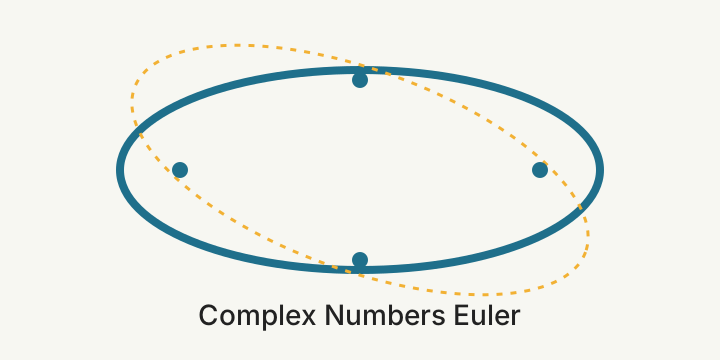
As increases from to , the point traces the full circle, returning to the starting position. Euler's formula turns multiplication by into rotation by angle .
Worked example [Beginner]
Compute .
Step 1. By Euler's formula, .
Step 2. The cosine of is . The sine of is .
Step 3. Therefore . Adding to both sides gives .
What this tells us: the five most important constants in mathematics — , , , , — are connected by a single equation.
Check your understanding [Beginner]
Formal definition [Intermediate+]
A complex number is an expression where and . The set of complex numbers is .
The real part is and the imaginary part is . The complex conjugate is . The modulus is . The argument is the angle such that , defined up to multiples of .
Definition (Complex exponential). For , the complex exponential is
Setting gives Euler's formula .
Counterexamples to common slips [Intermediate+]
The argument is not single-valued. For any non-zero , there are infinitely many valid arguments: and give the same for every integer . The principal value is a convention, not an intrinsic property.
is not injective on . Unlike the real exponential , the complex exponential satisfies for all . This periodicity is the source of the complex logarithm's multivaluedness.
, not . The modulus of is , independent of . The factor in carries the modulus.
Key theorem with proof [Intermediate+]
Theorem (Euler's formula). For all ,
Proof. Define three functions of : , , . Compute the derivative of :
This follows from the power-series definition and term-by-term differentiation, which is valid because the series converges absolutely.
Now consider . Differentiating:
Since on , the function is constant. At : . Therefore for all .
To extract cosine and sine, separate into real and imaginary parts. Write where and are real-valued. Then , giving and . At : , . The unique solution of this system with these initial conditions is and .
Corollary (de Moivre's formula). For and :
Proof. By Euler's formula, . Then by Euler's formula again.
Bridge. Euler's formula is the foundational reason that rotation in the plane and exponential growth are the same operation in the complex domain, and this is exactly the bridge between trigonometry and the exponential function. The central insight is that encodes a quarter-turn, so encodes a turn by angle . This result builds toward 02.04.04 where the Fourier expansion uses to decompose periodic functions, and appears again in the Gamma function reflection formula where connects Euler's formula to the Gamma function's analytic continuation. The pattern generalises to complex analysis, where is the first entire function and the exponential map appears in the universal cover of .
Exercises [Intermediate+]
Advanced results [Master]
Theorem 1 (Euler's formula via power series). The identity follows from the Taylor series , , , and the relation .
Theorem 2 (The th roots of unity form a cyclic group). The set forms a cyclic group of order under multiplication, generated by .
The roots of unity are equally spaced on the unit circle, dividing it into equal arcs. For prime, every non-identity element generates the group.
Theorem 3 (Complex logarithm). The complex logarithm is multivalued: for . The principal branch is holomorphic on .
The branch cut on the negative real axis is the price of single-valuedness. Different branches are related by , and the multivalued logarithm encodes the topology of as a space with fundamental group .
Theorem 4 (Riemann surface of ). The equation defines a two-sheeted covering of . As traverses a loop around the origin, changes sign. The Riemann surface is topologically a plane (the map is a homeomorphism from the surface to ).
Theorem 5 (Fundamental theorem of algebra via Liouville). Every non-constant polynomial has a root in . The proof by Liouville's theorem: if has no zero, then is entire and bounded, hence constant — contradicting that is non-constant.
Theorem 6 (Exponential map as a covering). The map is a surjective holomorphic map with kernel . It is the universal covering of , and the fundamental group is identified with the deck transformation group generated by .
Synthesis. Euler's formula is the foundational reason that the complex exponential, trigonometric functions, and rotations in the plane are unified into a single object. The central insight is that is the algebraic encoding of a quarter-turn, and this is exactly the structure that identifies multiplication by with rotation by angle . Putting these together with de Moivre's formula and the roots of unity, the algebra of polynomial equations over becomes transparent: every root of unity is a power of a single generator, and the cyclic group structure appears again in the topology of the punctured plane as the fundamental group . The bridge is from algebra () to geometry (rotation) to topology (covering space), and the pattern generalises to the Riemann surface of where the same cyclic-group structure governs the branching. The exponential covering map builds toward 02.01.07 where fibrations and covering spaces are studied in full generality, and appears again in 02.11.08 where the Fourier transform decomposes functions into their frequency components via .
Full proof set [Master]
Proposition 1 (Euler's formula via power series). For all , .
Proof. Expand the exponential:
Split into even and odd powers. For : . For : . Therefore:
Both series converge absolutely for all (ratio test with limit ), so the rearrangement is justified.
Proposition 2 (The Riemann surface of is simply connected). The surface is homeomorphic to .
Proof. Define by . This is well-defined since holds. Define by . Then and , so and are mutually inverse. Both are continuous (coordinate functions are polynomials). Hence as topological spaces. Since is simply connected, is simply connected.
Connections [Master]
Fundamental theorems of calculus
02.04.04. Euler's formula is proved by differentiating and verifying that . This derivative computation relies on the term-by-term differentiation of power series, which is justified by the uniform convergence guaranteed by the FTC framework. The exponential function is itself defined via the integral , connecting Euler's formula back to the fundamental theorem.Hilbert space and Fourier analysis
02.11.08. The Fourier basis functions for are orthogonal in , and every square-integrable periodic function decomposes as . Euler's formula is the starting point: it provides the exponential functions whose orthogonality drives the entire Fourier theory.Fibration
02.01.07. The exponential map is a covering map with fibre , which is the simplest example of a fibre bundle with discrete fibre. The multivaluedness of the complex logarithm is the analytic manifestation of the non-simply-connected topology of , and the universal cover provided by resolves the ambiguity.Dirichlet -functions
21.03.02. The codomain of a Dirichlet character is the multiplicative group of non-zero complex numbers of the present unit, and the values of a Dirichlet character lie on the unit circle (since for ), making each character a homomorphism into the group of -th roots of unity. The complex-analytic continuation of to uses the standard complex-analysis machinery — contour integration, residue theorem, Phragmén-Lindelöf principle — built on the foundations introduced here.
Historical & philosophical context [Master]
Euler 1748, in his Introductio in analysin infinitorum [Euler1748], derived the formula by equating the power series of the exponential with the alternating series of cosine and sine. The identity appeared in this context as a special case, unifying the five fundamental constants. Euler treated complex numbers as formal objects; the geometric interpretation of as a plane came later.
Gauss 1831, in a review in the Gottingische gelehrte Anzeigen [Gauss1831], gave the first authoritative justification of the complex plane as a geometric object, establishing that complex numbers correspond to points in and that their algebraic operations have geometric meanings (addition is translation, multiplication by is scaling by and rotation by ). Riemann 1851, in his inaugural dissertation [Riemann1851], introduced Riemann surfaces to handle multivalued functions like and , showing that the branch points and sheets of these surfaces encode the topological structure of the complex plane minus a point.
Bibliography [Master]
@book{Euler1748,
  author    = {Euler, Leonhard},
  title     = {Introductio in analysin infinitorum},
  publisher = {Marcum-Michaelem Bousquet},
  year      = {1748}
}

@article{Gauss1831,
  author  = {Gauss, Carl Friedrich},
  title   = {Anzeige der Theoria residuorum biquadraticorum, Commentatio secunda},
  journal = {G\"ottingische gelehrte Anzeigen},
  year    = {1831}
}

@phdthesis{Riemann1851,
  author = {Riemann, Bernhard},
  title  = {Grundlagen f\"ur eine allgemeine Theorie der Functionen einer ver\"anderlichen complexen Gr\"osse},
  school = {G\"ottingen},
  year   = {1851}
}

@book{Ahlfors1979,
  author    = {Ahlfors, Lars V.},
  title     = {Complex Analysis},
  publisher = {McGraw-Hill},
  edition   = {3},
  year      = {1979}
}

@book{Apostol1967,
  author    = {Apostol, Tom M.},
  title     = {Calculus, Vol. 1},
  publisher = {Wiley},
  year      = {1967}
}

@book{Needham1997,
  author    = {Needham, Tristan},
  title     = {Visual Complex Analysis},
  publisher = {Oxford University Press},
  year      = {1997}
}