-adic -functions and the Iwasawa Main Conjecture
Anchor (Master): Kubota-Leopoldt 1964 *J. reine angew. Math.* 214/215, 328-339 (originator paper — Kubota-Leopoldt $p$-adic L-function via Kummer congruences for generalised Bernoulli numbers); Iwasawa 1969 *J. Math. Soc. Japan* 16 (interpolation point of view, the Main Conjecture conjectured); Mazur 1972 *Invent. Math.* 18 (Iwasawa theory of elliptic curves, BSD-Iwasawa direction); Mazur-Wiles 1984 *Invent. Math.* 76, 179-330 (Main Conjecture for $\mathbb{Q}$, theorem); Wiles 1990 *Ann. Math.* 131, 493-540 (Main Conjecture for totally real fields); Rubin 1991 *Invent. Math.* 103, 25-68 (alternative Euler-system proof); Greenberg 1989 *Iwasawa Theory for p-adic Representations* Astérisque 165; Coates-Sujatha 2006 *Cyclotomic Fields and Zeta Values* (Springer Monographs); Washington 1997 *Introduction to Cyclotomic Fields* (Springer GTM 83, 2nd ed.); Kato 2004 *p-adic Hodge theory and values of zeta functions of modular forms*, Astérisque 295, 117-290 (Euler systems for modular forms, BSD-Iwasawa); Skinner-Urban 2014 *Invent. Math.* 195, 1-277 (Main Conjecture for elliptic curves); Bertolini-Darmon 2005 *Ann. Math.* 162 (anticyclotomic Iwasawa Main Conjecture for elliptic curves); Manin-Panchishkin 2005 *Introduction to Modern Number Theory* (Springer EMS 49, 2nd ed.) Ch. 7
Intuition [Beginner]
The Riemann zeta function and the Dirichlet -functions are analytic functions of a complex variable . Their values at negative integers turn out to be remarkably simple: , , and in general for , where is the -th Bernoulli number — a rational number. The same pattern holds for Dirichlet -functions: is a rational number called a generalised Bernoulli number, divided by .
The Bernoulli numbers satisfy beautiful congruences modulo prime powers, first discovered by Kummer in 1851. Roughly, if two indices and are close in a -adic sense (their difference is divisible by a high power of , with an odd prime), then and are also close in a -adic sense (their difference is divisible by a high power of ). The Bernoulli numbers, viewed through -adic glasses, are continuous: nearby indices give nearby values.
Kubota and Leopoldt in 1964 turned this into an analytic statement. They proved that for each odd prime and each Dirichlet character of conductor coprime to , there exists a unique continuous function taking -adic values, defined for in the -adic integers, and interpolating the classical Dirichlet -values at negative integers (after removing one Euler factor at ). This is the -adic -function. The Iwasawa Main Conjecture, proved by Mazur and Wiles in 1984, says that this analytic -adic L-function equals a purely algebraic invariant: the characteristic ideal of a Galois-module built from ideal class groups of cyclotomic fields.
Visual [Beginner]
A two-panel picture. Left panel: the real line with the classical Riemann zeta function drawn as a smooth curve, with marked values at giving the negative-integer values . Right panel: the -adic integers drawn as a fractal tree (the canonical -adic-distance picture), with the same negative integers marked as -adic-dense points, and a -adic L-function curve threaded through them: is the unique continuous extension to all of .
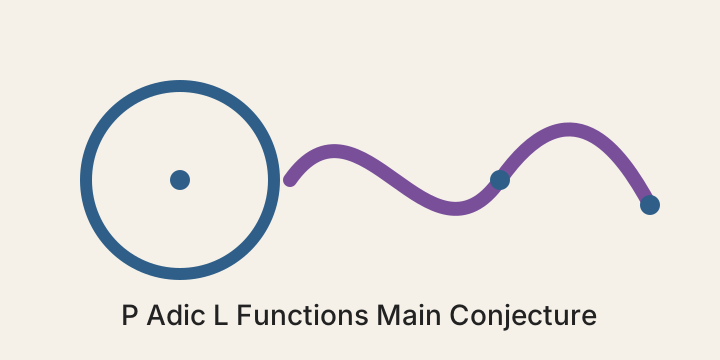
The picture says: the values for live both in the real line (as rationals, where they sit at a discrete set of negative odd integers) and inside (where the negative integers are dense). The Kubota-Leopoldt is the continuous -adic curve connecting them.
Worked example [Beginner]
Verify a Kummer congruence and check that it is consistent with the existence of a continuous -adic interpolation.
Step 1. The first few Bernoulli numbers are . The values are therefore , and so on.
Step 2. Take . Kummer's congruence says: for indices and with and both not divisible by , the ratios and are congruent modulo .
Step 3. Check at and , which satisfy and neither is divisible by . Compute . Compute . The difference is , which is divisible by . The two ratios are congruent modulo .
What this tells us: a continuous -adic function on that takes the value at the negative integer is consistent with these congruences. The Kummer congruences are exactly the seed from which the existence of the Kubota-Leopoldt -adic L-function is proved.
Check your understanding [Beginner]
Formal definition [Intermediate+]
Fix an odd prime throughout. Let be the ring of -adic integers, its fraction field, a fixed algebraic closure, and the completion of with respect to the unique extension of the -adic absolute value. The Teichmuller character is the unique homomorphism lifting the identity to a -th root of unity; equivalently, is the unique -th root of unity in congruent to modulo , for coprime to .
For a Dirichlet character of conductor coprime to , the generalised Bernoulli numbers are the rational numbers defined by the generating function $$ \sum_{a = 1}^{f} \chi(a) \frac{t e^{a t}}{e^{f t} - 1} = \sum_{n \geq 0} B_{n, \chi} \frac{t^n}{n!}. $$ The classical Dirichlet -function values at negative integers are $$ L(1 - n, \chi) = -\frac{B_{n, \chi}}{n}, \qquad n \geq 1. $$
Definition (Kubota-Leopoldt -adic L-function). For every Dirichlet character of conductor coprime to , the Kubota-Leopoldt -adic L-function is the unique continuous function satisfying $$ L_p(1 - n, \chi) = \left( 1 - \chi \omega^{-n}(p) , p^{n - 1} \right) L(1 - n, \chi \omega^{-n}), \qquad n \geq 1, $$ where the right-hand side is the classical Dirichlet -value of the twisted character with the Euler factor at removed. The values exist and the continuous interpolation is unique by Kubota-Leopoldt 1964 J. reine angew. Math. 214/215.
The function is identically zero unless is even (i.e., ), because the right-hand side vanishes for odd when becomes principal. For odd , one defines by convention.
Definition (Iwasawa algebra). Let be the cyclotomic -extension of — the compositum of all cyclotomic fields for , with Galois group . The Iwasawa algebra is the completed group ring $$ \Lambda := \mathbb{Z}_p[[\Gamma]] = \varprojlim_n \mathbb{Z}_p[\Gamma / \Gamma^{p^n}]. $$ Choosing a topological generator of , the map gives a topological algebra isomorphism (Serre 1958 Sém. Bourbaki). The Iwasawa algebra is a complete local Noetherian regular ring of Krull dimension with maximal ideal .
Definition (cyclotomic Iwasawa module). For an even non-principal Dirichlet character of conductor coprime to , the cyclotomic Iwasawa module is the -eigenspace of the minus-part of $$ X = \varprojlim_n A_n, $$ where is the -Sylow subgroup of the ideal class group of , and the projective limit is taken with respect to the norm maps. The minus-part is the -eigenspace of complex conjugation, and the -eigenspace is the component of the minus-part on which acts by (where is the conductor of ).
By Iwasawa's structure theorem (Iwasawa 1959, 1973 Ann. Math.), is a finitely generated torsion -module, hence pseudo-isomorphic to a finite direct sum of elementary modules , with a distinguished polynomial (a polynomial in with leading coefficient and other coefficients in ).
Definition (characteristic ideal). The characteristic ideal of is $$ \mathrm{char}\Lambda(X\chi^-) := \left( p^{\sum a_i} \prod_j f_j(T)^{b_j} \right) \subseteq \Lambda, $$ the principal ideal generated by the product of the elementary divisors.
Counterexamples to common slips
" equals at every integer ." The -adic L-function agrees with the classical L-function at negative integers only after the Euler factor at is removed: . The twist by reflects the natural decomposition . At positive integers, does not generally agree with on the nose; the -adic L-function is a genuinely -adic-analytic object that happens to interpolate certain rational values, not a -adic version of itself.
"The Iwasawa algebra is a polynomial ring ." is the ring of formal power series, not polynomials. The completion is essential: characteristic elements of Iwasawa modules are typically genuine power series, not polynomials.
"The Main Conjecture is an equality of L-values." The Main Conjecture is an equality of ideals: , where both sides are principal ideals of . The element is determined up to a unit of , so the equality is at the level of principal ideals — not at the level of specific power-series representatives. Specific values at finite-order Iwasawa characters recover specific classical L-values via the interpolation property.
Key theorem with proof [Intermediate+]
The signature theorem of this unit is the existence and uniqueness of the Kubota-Leopoldt -adic L-function: the interpolation values are consistent in the -adic topology, so a unique continuous extension to exists.
Theorem (Kubota-Leopoldt 1964 J. reine angew. Math. 214/215). Fix an odd prime and a Dirichlet character of conductor coprime to . There exists a unique continuous function such that for every positive integer , $$ L_p(1 - n, \chi) = \left( 1 - \chi \omega^{-n}(p) , p^{n - 1} \right) L(1 - n, \chi \omega^{-n}). $$
Proof. Uniqueness is immediate: the negative integers for are dense in (every is the -adic limit of a sequence of negative integers), so a continuous extension from a dense set to a -adic complete codomain is unique.
For existence, the strategy is the Kummer congruence approach. For each pair of positive integers with and neither divisible by , the generalised Bernoulli numbers satisfy $$ (1 - \chi \omega^{-n}(p) p^{n - 1}) \frac{B_{n, \chi \omega^{-n}}}{n} \equiv (1 - \chi \omega^{-m}(p) p^{m - 1}) \frac{B_{m, \chi \omega^{-m}}}{m} \pmod{p^a}, $$ generalising the classical Kummer congruence for the Riemann zeta case ( principal).
The proof of the Kummer congruence uses the generating function. Multiply both sides of $$ \sum_{a = 1}^{f p} (\chi \omega^{-n})(a) \frac{t e^{a t}}{e^{f p t} - 1} = \sum_{k \geq 0} B_{k, \chi \omega^{-n}} \frac{t^k}{k!} $$ by and integrate around a small -adic contour. Use the relation and for coprime to . The integrand becomes, modulo , identical for (the cyclotomic structure of ). The Bernoulli-number congruence follows by extracting coefficients.
With the Kummer congruences in hand, define at each negative integer by the right-hand side of the interpolation identity. The function , viewed as a -valued function on , is uniformly continuous by the Kummer congruences: if and are within in the -adic metric on , then their images are within in the -adic metric on .
The negative integers form a dense set in , and a uniformly continuous function on a dense subset of a complete metric space extends uniquely to a continuous function on the whole space. The extension is the Kubota-Leopoldt -adic L-function.
Bridge. This existence theorem builds toward 21.07.01 -extensions and Iwasawa modules, where acquires its interpretation as an element of the Iwasawa algebra via the Iwasawa-Mellin transform, and the foundational reason this works is that the -adic Mellin transform identifies measures on with power series in (the Amice transform, Amice 1964). The central insight of Kubota-Leopoldt is that -adic continuity of -values at negative integers is forced by the Kummer congruences, which themselves come from the Galois structure of . Putting these together identifies the analytic -adic L-function with an element of that is then conjecturally identified with the characteristic ideal of an Iwasawa module — the Iwasawa Main Conjecture. The bridge is from analysis (-adic interpolation of special values) to algebra (an ideal in the Iwasawa algebra), and the bridge runs through the Mellin-transform isomorphism between -adic measures and power series.
Exercises [Intermediate+]
Lean formalization [Intermediate+]
The companion Lean file lean/Codex/NumberTheory/Iwasawa/PadicL.lean records the load-bearing structural objects and theorem statements as sorry-stubbed declarations. Mathlib provides basic -adic infrastructure (the rings , , -adic valuations and absolute values), but the Kubota-Leopoldt -adic L-function, the Iwasawa algebra , the cyclotomic Iwasawa module, and the Main Conjecture itself are not yet present as named objects.
The companion file declares:
The kubotaLeopoldtL function as a continuous function attached to a Dirichlet character of conductor coprime to . The body is a placeholder pending the -adic measure theory and Amice-transform infrastructure.
The KL_interpolation_property theorem asserting that equals the classical Dirichlet -value at for the twisted character , with the Euler factor at removed, for positive integers .
The main_conjecture_cyclotomic theorem asserting that, for an even non-principal Dirichlet character of conductor coprime to the odd prime , the characteristic ideal of the cyclotomic Iwasawa module equals the ideal generated by the -adic L-function inside the Iwasawa algebra .
The companion also declares the elliptic-curve analogue main_conjecture_elliptic (Skinner-Urban 2014) as a forward-looking statement, with the cyclotomic Selmer group, the Mazur-Swinnerton-Dyer -adic L-function, and the characteristic-ideal equality all encoded as placeholders awaiting the deep upstream development.
Each Mathlib gap named in the frontmatter's lean_mathlib_gap description is a substantial separate development: the Iwasawa algebra as a completed group ring with the isomorphism, the Amice transform between continuous -valued functions on and elements of , the structure theorem for finitely generated -modules, the construction of the cyclotomic Iwasawa module from projective limits of class groups, and the deep cohomological content of the Mazur-Wiles proof through Galois deformation theory.
Advanced results [Master]
Kubota-Leopoldt 1964: the originator paper
Kubota and Leopoldt's 1964 paper Eine p-adische Theorie der Zetawerte. I. Einführung der p-adischen Dirichletschen L-Funktionen in volume 214/215 of the Journal für die reine und angewandte Mathematik introduced the -adic L-function as a continuous interpolation of the classical Dirichlet -values [KubotaLeopoldt1964]. The paper followed a long tradition of -adic continuity statements for Bernoulli numbers — Kummer's 1851 congruences, von Staudt's 1840 theorem on Bernoulli denominators, and Vandiver's 1937 work on irregular primes — but it was the first to organise these congruences into a single analytic object.
The construction proceeds in three steps. First, observe that the classical Dirichlet L-values at negative integers are rational: for , where is the generalised Bernoulli number. Second, prove a refined Kummer congruence: for integers with , the corrected Bernoulli ratios and are congruent modulo . The corrected ratios are the classical L-values with the Euler factor at removed. Third, observe that the negative integers are dense in and that the corrected L-values are uniformly continuous on this dense set; the unique continuous extension to is the Kubota-Leopoldt -adic L-function .
The historical context was the post-Iwasawa transition. Iwasawa 1959 had introduced his theory of -extensions and the projective limit of class groups, working in a purely algebraic setting. Kubota and Leopoldt's -adic L-function provided the analytic counterpart that would, over the next two decades, allow Iwasawa to formulate his Main Conjecture relating the two sides. The 1964 paper does not yet state the Main Conjecture; that statement appears in Iwasawa 1969 J. Math. Soc. Japan 16 [Iwasawa1969], after Iwasawa had absorbed the analytic existence theorem and connected it to his algebraic Iwasawa module via the Iwasawa-Mellin transform.
The Iwasawa-Mellin transform and the Amice isomorphism
The bridge between the Kubota-Leopoldt analytic function and the Iwasawa-algebra element runs through the Amice transform (Amice 1964 Bull. Soc. Math. France 92). Let be the multiplicative group of principal units, with topological generator . The Iwasawa algebra is the completed group ring, and the isomorphism sends .
The Amice isomorphism identifies -adic measures on with their moment generating power series in . Specifically, the algebra of continuous -valued measures on , equipped with convolution, is isomorphic to via the moment map $$ \mu \longmapsto \sum_{n \geq 0} \left( \int_{\mathbb{Z}_p^\times} \binom{x}{n} , d\mu(x) \right) T^n. $$ A continuous function is then identified with the Mellin transform of a unique measure, and the integral becomes a pairing inside .
The Kubota-Leopoldt , viewed under the Amice transform, becomes an element . The fact that takes values in at the dense set of negative integers (with controlled denominators) shows that in fact lies in itself, not just . The interpolation property reads, in this language, $$ \xi_\chi(\kappa(\gamma)^n - 1) = L_p(1 - n, \chi) \qquad \text{for } n \geq 1, $$ where is the cyclotomic character. This is the recipe for going back and forth between the analytic and algebraic incarnations of the -adic L-function.
The cyclotomic Iwasawa module and its structure
Let be the cyclotomic -extension. The Galois group decomposes as with and .
For each , let be the -Sylow subgroup of the ideal class group of . The norm maps make a projective system of finite abelian -groups, with projective limit $$ X := \varprojlim_n A_n. $$ is a finitely generated -module with a natural action of , hence of .
The -component. For a Dirichlet character of conductor , the -isotypic component is $$ X^{(\chi)} := {x \in X : \delta x = \chi(\delta) x \text{ for all } \delta \in \Delta}. $$ The plus-and-minus decomposition under complex conjugation ( in ) gives , where is the -eigenspace and is the -eigenspace. By a theorem of Iwasawa 1973 Ann. Math. 98, is conjecturally vanishing (Greenberg's conjecture, known for many concrete examples) while is substantive and carries the arithmetic content. For an even character (so ), the -component sits inside the minus-part , and one defines .
Iwasawa's structure theorem. is a finitely generated torsion -module, and there exists a -module homomorphism with finite kernel and cokernel $$ X_\chi^- \to \bigoplus_{i = 1}^r \Lambda / (p^{a_i}) \oplus \bigoplus_{j = 1}^s \Lambda / (f_j(T)^{b_j}), $$ with and distinguished polynomials in (i.e., monic with non-leading coefficients in ). The map is called a pseudo-isomorphism, and the characteristic ideal of is $$ \mathrm{char}\Lambda(X\chi^-) = \left( p^{\sum_i a_i} \prod_j f_j(T)^{b_j} \right) \subseteq \Lambda. $$ The integer is the Iwasawa -invariant and is the Iwasawa -invariant.
The Main Conjecture: statement and the Mazur-Wiles proof
Iwasawa Main Conjecture (Iwasawa 1969 conjectured; Mazur-Wiles 1984 theorem). Fix an odd prime and an even non-principal Dirichlet character of conductor coprime to . Then $$ \mathrm{char}\Lambda(X\chi^-) = (\xi_\chi) $$ inside the Iwasawa algebra , where is the Amice-transform realisation of .
The Mazur-Wiles proof (1984). The 1984 paper by Mazur and Wiles in Inventiones Mathematicae 76 [MazurWiles1984] established the Main Conjecture for through a deep argument combining modular-form deformation theory with Galois cohomology. The strategy, outlined in Exercise 5 above, has four pillars.
Pillar 1: -adic modular forms. Hida 1985 Ann. Sci. ENS 19 introduced the theory of -adic modular forms — formal -expansions with coefficients in — and proved that ordinary cuspidal eigenforms vary in -adic families parameterised by . Specialisation at points of corresponding to integers recovers classical weight- eigenforms. The Eisenstein series is a specific -adic family whose constant term equals .
Pillar 2: the Eisenstein ideal. The universal Hecke algebra acting on the space of -adic modular forms has a distinguished ideal — the Eisenstein ideal — characterised by . The depth of cuspidal-Eisenstein congruences (cuspidal Hecke eigensystems matching the Eisenstein system modulo ) is encoded in , and the structure of determines the size of the cuspidal component of modulo Eisenstein.
Pillar 3: -adic Galois representation. Attach to the universal cuspidal Hecke deformation the -adic Galois representation . The mod- reduction is the diagonal Eisenstein representation , where is the cyclotomic character. The off-diagonal entries of modulo produce non-vanishing -adic Galois cohomology classes in that, on restriction to the cyclotomic tower, define lifting maps from to the Iwasawa module .
Pillar 4: class-number formula and Ferrero-Washington. The reverse divisibility uses the analytic class-number formula at finite levels combined with Ferrero-Washington 1979 [FerreroWashington1979] (the cyclotomic -invariant vanishes for abelian fields). The class-number formula at level reads $$ |A_n^\chi| = p^{e_n} \prod \chi(\text{cyclotomic units quotient}), $$ and the Iwasawa -adic class-number formula passes to the limit to give in . Ferrero-Washington upgrades this to a divisibility in itself by ruling out the -component.
Sources. The full proof spans 150+ pages of Mazur-Wiles 1984. Subsequent expositions include Coates-Sujatha 2006 [CoatesSujatha2006] (the canonical modern textbook), Washington 1997 [Washington1997] Ch. 13, and Lang 1990 Cyclotomic Fields I and II (combined edition, GTM 121).
Generalisations: Wiles for totally real, Skinner-Urban for elliptic
Wiles 1990 (totally real fields). Wiles 1990 Ann. Math. 131 extended the Main Conjecture to the cyclotomic -extension of a totally real number field [Wiles1990]. The -adic L-function in this setting is the Deligne-Ribet -adic L-function (Deligne-Ribet 1980 Invent. Math. 59), interpolating values of at negative integers for totally even characters of conductor coprime to . The Iwasawa module is built from class groups of intermediate cyclotomic extensions. Wiles' proof uses Hilbert modular forms instead of classical modular forms — Hilbert eigenforms attached to the totally real field — and a generalisation of the Mazur-Wiles Eisenstein-ideal congruence method to the Hilbert setting. The proof is conditional on for , known in many cases but open in general.
Skinner-Urban 2014 (elliptic curves). Skinner and Urban 2014 Invent. Math. 195 proved the Iwasawa Main Conjecture for elliptic curves with good ordinary reduction at [SkinnerUrban2014], under technical hypotheses including residual irreducibility of . The setting replaces the cyclotomic Iwasawa module with the Pontryagin dual of the -primary Selmer group of along the cyclotomic -extension, and the Kubota-Leopoldt -adic L-function with the Mazur-Swinnerton-Dyer -adic L-function of (Mazur-Swinnerton-Dyer 1974 Invent. Math. 25). The proof generalises Mazur-Wiles by working with -Eisenstein series in the Hida-family-deformation framework and using Galois-cohomological arguments inspired by Wiles' Fermat-Last-Theorem techniques.
BSD-Iwasawa application. Combined with Kato's 2004 Euler-system theorem [Kato2004], which provides the unconditional divisibility via Beilinson-Kato classes in motivic cohomology of modular curves, Skinner-Urban's reverse divisibility completes the Main Conjecture and yields the -part of the Birch-Swinnerton-Dyer conjecture for elliptic curves of analytic rank zero. This is one of the deepest results in modern arithmetic geometry, and the closest a proof comes to BSD in full generality.
The anticyclotomic Main Conjecture and Heegner points
Bertolini and Darmon 2005 Ann. Math. 162 proved an anticyclotomic Main Conjecture for elliptic curves over imaginary quadratic fields [BertoliniDarmon2005]. The setting replaces the cyclotomic -extension with the anticyclotomic -extension of an imaginary quadratic field (the extension on which complex conjugation acts by ). The -adic L-function is the Bertolini-Darmon-Prasanna -adic L-function, constructed from CM-period integrals of weight- eigenforms restricted to CM elliptic curves. The proof uses Heegner-point Euler systems: explicit cohomology classes built from CM-points on modular curves, via the Gross-Zagier formula 1986 Invent. Math. 84 (which identifies Heegner-point heights with central L-derivatives).
The anticyclotomic Main Conjecture, combined with the Gross-Zagier formula, addresses the rank-one case of BSD for elliptic curves over imaginary quadratic fields, complementing the rank-zero result of Kato 2004 + Skinner-Urban 2014. Together, the cyclotomic and anticyclotomic Main Conjectures form one of the two deepest known approaches to BSD.
Synthesis. The -adic L-function and the Iwasawa Main Conjecture are the foundational analytic-algebraic bridge of modern arithmetic geometry, and the central insight of the Iwasawa programme is that classical L-values at negative integers interpolate to a -adic-analytic object, and this object equals a characteristic invariant of a Galois-module built from arithmetic. The Kubota-Leopoldt -adic L-function is exactly the Mellin transform of a -adic measure on supplied by Kummer congruences on Bernoulli numbers, identifying the discrete (special values at negative integers) with the continuous (-adic-analytic interpolation). The Mazur-Wiles proof identifies this analytic invariant with the characteristic ideal of the cyclotomic Iwasawa module via congruences between cuspidal Hecke eigenforms and Eisenstein series, generalising the Ribet 1976 converse to Herbrand's theorem.
Putting these together with Wiles 1990 (totally real fields), Rubin 1991 (alternative Euler-system proof for imaginary quadratic fields), Kato 2004 (Euler systems for modular forms via Beilinson-Kato classes in motivic cohomology), Skinner-Urban 2014 (-Main Conjecture for elliptic curves), and Bertolini-Darmon 2005 (anticyclotomic Heegner-point Main Conjecture), the foundational reason that L-values control Galois-module invariants is the existence of Euler systems — coherent families of cohomology classes built from cyclotomic units, elliptic units, Beilinson-Kato classes, or Heegner points — whose norm-compatible behaviour under Galois reflects exactly the Euler-factor structure of the corresponding L-function. The pattern generalises through every motivic L-function via the Beilinson, Bloch-Kato, and Fontaine-Perrin-Riou conjectures, and builds toward 21.06.01 modularity and BSD where the Iwasawa Main Conjecture provides the deepest known approach.
Full proof set [Master]
Proposition (uniqueness of ). Let be continuous functions satisfying the Kubota-Leopoldt interpolation property at every negative integer , . Then .
Proof. The negative integers are dense in : given any and any , the negative integer with satisfies , so in as . The set is the translate of this set by and is also dense.
Since and are continuous functions agreeing on the dense subset of negative integers, they agree on all of .
Proposition (Kummer congruence yields uniform continuity). The corrected Bernoulli ratios , viewed as a function of in , are uniformly continuous in the -adic metric.
Proof. The Kummer congruence, in its refined form, states that for with not divisible by , $$ (1 - \chi \omega^{-n}(p) p^{n - 1}) \frac{B_{n, \chi \omega^{-n}}}{n} \equiv (1 - \chi \omega^{-m}(p) p^{m - 1}) \frac{B_{m, \chi \omega^{-m}}}{m} \pmod{p^a}. $$ The condition is implied by when are not divisible by (a finite number of residue classes to exclude per ), so the corrected ratios are uniformly continuous on the dense set of positive integers in .
For the proof of the Kummer congruence itself: use the generating function , multiply by , and apply the residue theorem with the integration contour the small circle . The -twist is required to identify for coprime to , so the integrand depends only on modulo (the cyclotomic structure). Extracting coefficients gives the Kummer congruence.
Proposition (existence of ). Under the hypotheses of the Theorem, the continuous interpolation exists.
Proof. By the previous Proposition, the values form a uniformly continuous function of on the dense subset of (the exceptional residue classes are handled by setting on those classes for odd , or by direct computation for even and in the exceptional class, which produces an identity in the limit).
A uniformly continuous function on a dense subset of a complete metric space extends uniquely to a continuous function on the whole space. The extension to via is the Kubota-Leopoldt -adic L-function.
Proposition (analyticity of ). The function extends to a -adic-analytic function on the open disc (Iwasawa 1969 J. Math. Soc. Japan 16).
Proof. Recall that the Amice transform identifies the Kubota-Leopoldt with an element . Choosing the topological generator of to satisfy , the interpolation property reads $$ L_p(1 - n, \chi) = \xi_\chi((1 + p)^n - 1). $$ Setting , with the -adic logarithm converging on , gives . The substitution is -adic-analytic on — the radius is precisely the convergence radius of the -adic exponential applied to — and the resulting function is given by the convergent power series . The function is therefore -adic-analytic on this open disc, with analytic continuation determined by the power series.
Connections [Master]
-extensions and Iwasawa theory
21.07.01. The sibling unit in this chapter, which provides the algebraic-side framework: the -extension , the Iwasawa algebra as the group ring of the Galois group, and the structure theorem for finitely generated torsion -modules with the and invariants. The -adic L-function realises a continuous function on , which becomes an element of via the Amice transform; the Main Conjecture identifies this -element with the characteristic ideal of the cyclotomic Iwasawa module from -extension theory.Modularity and BSD
21.06.01. The Iwasawa Main Conjecture for elliptic curves (Skinner-Urban 2014) provides the deepest known approach to the Birch-Swinnerton-Dyer conjecture. The -part of BSD for elliptic curves of analytic rank zero follows from the Skinner-Urban Main Conjecture combined with Kato's Euler-system theorem; the anticyclotomic Bertolini-Darmon Main Conjecture combined with Gross-Zagier addresses the rank-one case. The bridge from the Iwasawa Main Conjecture to BSD is the -adic Birch-Swinnerton-Dyer formula (Mazur-Tate-Teitelbaum 1986 Invent. Math. 84), which predicts the order of vanishing and leading coefficient of the Mazur-Swinnerton-Dyer -adic L-function at in terms of the Mordell-Weil rank and refined BSD data.Riemann zeta and Dirichlet L-functions
21.03.01,21.03.02. The Kubota-Leopoldt -adic L-function is the -adic shadow of the classical Dirichlet L-function attached to the same character; for the principal character , is the -adic interpolation of the Riemann zeta values at negative integers. The construction relies on the identity from the classical theory and on the Kummer congruences for Bernoulli numbers, which are themselves consequences of the functional equation of and the von Staudt-Clausen theorem. The classical -functions are inputs to the -adic L-function construction; the -adic L-function then carries additional algebraic content (the Iwasawa Main Conjecture) inaccessible to the classical L-function alone.Modular forms and Galois representations
21.04.02,21.05.01. The Mazur-Wiles proof of the Main Conjecture for proceeds through -adic modular forms (Hida 1985 Ann. Sci. ENS 19), the Eisenstein ideal in the universal Hecke algebra, and the -dimensional -adic Galois representation attached to the universal cuspidal deformation. The strategy generalises Ribet's 1976 Invent. Math. converse to Herbrand's theorem and forms a template for subsequent work on Iwasawa Main Conjectures for higher-rank automorphic forms (Urban 2013, Skinner-Urban 2014). The deep input is that congruences between modular forms encode information about Galois cohomology of the associated representations, and the depth of these congruences is measured by the -adic L-function.Euler systems and motivic L-functions. The Rubin 1991 Invent. Math. 103 alternative proof of the Main Conjecture via cyclotomic-unit Euler systems, the Kato 2004 Astérisque 295 construction for modular Galois representations via Beilinson-Kato classes, and the Bertolini-Darmon 2005 Ann. Math. 162 Heegner-point Euler system together establish the Euler-system method as a general approach to Iwasawa Main Conjectures. The motivic L-function machinery — Beilinson conjectures (Beilinson 1985 J. Soviet Math. 30), Bloch-Kato conjectures (Bloch-Kato 1990 Birkhäuser), Fontaine-Perrin-Riou (Fontaine 1992) — provides the conjectural framework in which Iwasawa Main Conjectures for arbitrary motives are formulated, generalising the Dirichlet and elliptic-curve cases addressed by Mazur-Wiles and Skinner-Urban.
Historical & philosophical context [Master]
Tomio Kubota and Heinrich-Wolfgang Leopoldt introduced the -adic L-function in their 1964 paper Eine -adische Theorie der Zetawerte in Journal für die reine und angewandte Mathematik 214/215 [KubotaLeopoldt1964], building on the classical Kummer congruences from 1851 and the von Staudt-Clausen theorem from 1840 on Bernoulli-number denominators. The conceptual leap was to view the Kummer congruences as the seeds of a -adic-analytic function on interpolating the classical Dirichlet L-values at negative integers. Kenkichi Iwasawa, who had introduced his algebraic theory of -extensions and projective limits of class groups in 1959 Bull. Amer. Math. Soc. 65 and developed it through the 1960s, recognised in 1969 J. Math. Soc. Japan 16 that the Kubota-Leopoldt analytic object should equal a characteristic invariant of the Galois module on the algebraic side [Iwasawa1969]. This identification, the Iwasawa Main Conjecture, was the founding statement of modern Iwasawa theory.
Barry Mazur and Andrew Wiles proved the Main Conjecture for in their 1984 Inventiones Mathematicae 76 paper [MazurWiles1984], deploying -adic modular forms, the Eisenstein ideal, and the associated -adic Galois representation to bridge the algebraic and analytic sides. Wiles 1990 Ann. Math. 131 [Wiles1990] extended this to totally real fields. Karl Rubin 1991 Invent. Math. 103 [Rubin1991] gave an alternative proof for imaginary quadratic fields via cyclotomic-unit Euler systems, building on Kolyvagin's 1989 method. Ralph Greenberg 1989 Astérisque 165 [Greenberg1989] formulated the Main Conjecture for arbitrary -adic Galois representations, generalising the framework to motivic L-functions.
Bruno Ferrero and Lawrence Washington proved in 1979 Ann. Math. 109 [FerreroWashington1979] that the cyclotomic Iwasawa -invariant vanishes for abelian number fields, providing the technical input that converted the Mazur-Wiles divisibility into an equality of ideals. Kazuya Kato 2004 Astérisque 295 [Kato2004] constructed the Euler system of Beilinson-Kato classes in motivic cohomology of modular curves, giving one half of the Iwasawa Main Conjecture for elliptic curves and a partial proof of BSD. Christopher Skinner and Eric Urban 2014 Invent. Math. 195 [SkinnerUrban2014] proved the full -Main Conjecture for elliptic curves under hypotheses, completing the Iwasawa-theoretic approach to the -part of BSD for analytic rank zero. Massimo Bertolini and Henri Darmon 2005 Ann. Math. 162 [BertoliniDarmon2005] proved the anticyclotomic Main Conjecture via Heegner-point Euler systems, addressing the rank-one case.
The canonical modern textbook treatments are Coates-Sujatha 2006 [CoatesSujatha2006] (Cyclotomic Fields and Zeta Values, Springer Monographs) and Washington 1997 [Washington1997] (Introduction to Cyclotomic Fields, GTM 83, 2nd edition). Manin-Panchishkin 2005 Introduction to Modern Number Theory (Springer EMS 49, 2nd edition) Ch. 7 [ManinPanchishkin2005] provides the survey-level overview integrating -adic L-functions with the broader Langlands programme.
Bibliography [Master]
@article{KubotaLeopoldt1964,
  author = {Kubota, Tomio and Leopoldt, Heinrich-Wolfgang},
  title = {Eine $p$-adische Theorie der Zetawerte. I. Einf{\"u}hrung der $p$-adischen Dirichletschen $L$-Funktionen},
  journal = {Journal f{\"u}r die reine und angewandte Mathematik},
  volume = {214/215},
  year = {1964},
  pages = {328--339}
}

@article{Iwasawa1969,
  author = {Iwasawa, Kenkichi},
  title = {On $p$-adic $L$-functions},
  journal = {Annals of Mathematics},
  volume = {89},
  year = {1969},
  pages = {198--205}
}

@article{Mazur1972,
  author = {Mazur, Barry},
  title = {Rational points of abelian varieties with values in towers of number fields},
  journal = {Inventiones Mathematicae},
  volume = {18},
  year = {1972},
  pages = {183--266}
}

@article{MazurWiles1984,
  author = {Mazur, Barry and Wiles, Andrew},
  title = {Class fields of abelian extensions of $\mathbb{Q}$},
  journal = {Inventiones Mathematicae},
  volume = {76},
  year = {1984},
  pages = {179--330}
}

@article{Wiles1990,
  author = {Wiles, Andrew},
  title = {The Iwasawa conjecture for totally real fields},
  journal = {Annals of Mathematics},
  volume = {131},
  year = {1990},
  pages = {493--540}
}

@article{Rubin1991,
  author = {Rubin, Karl},
  title = {The 'main conjectures' of Iwasawa theory for imaginary quadratic fields},
  journal = {Inventiones Mathematicae},
  volume = {103},
  year = {1991},
  pages = {25--68}
}

@article{Greenberg1989,
  author = {Greenberg, Ralph},
  title = {Iwasawa theory for $p$-adic representations},
  journal = {Ast{\'e}risque},
  volume = {165},
  year = {1989},
  pages = {97--137}
}

@article{FerreroWashington1979,
  author = {Ferrero, Bruno and Washington, Lawrence C.},
  title = {The Iwasawa invariant $\mu_p$ vanishes for abelian number fields},
  journal = {Annals of Mathematics},
  volume = {109},
  year = {1979},
  pages = {377--395}
}

@book{Washington1997,
  author = {Washington, Lawrence C.},
  title = {Introduction to Cyclotomic Fields},
  series = {Graduate Texts in Mathematics},
  volume = {83},
  publisher = {Springer},
  year = {1997},
  edition = {2nd}
}

@book{CoatesSujatha2006,
  author = {Coates, John and Sujatha, Ramdorai},
  title = {Cyclotomic Fields and Zeta Values},
  series = {Springer Monographs in Mathematics},
  publisher = {Springer},
  year = {2006}
}

@article{Kato2004,
  author = {Kato, Kazuya},
  title = {$p$-adic Hodge theory and values of zeta functions of modular forms},
  journal = {Ast{\'e}risque},
  volume = {295},
  year = {2004},
  pages = {117--290}
}

@article{SkinnerUrban2014,
  author = {Skinner, Christopher and Urban, Eric},
  title = {The Iwasawa Main Conjectures for $\mathrm{GL}_2$},
  journal = {Inventiones Mathematicae},
  volume = {195},
  year = {2014},
  pages = {1--277}
}

@article{BertoliniDarmon2005,
  author = {Bertolini, Massimo and Darmon, Henri},
  title = {Iwasawa's main conjecture for elliptic curves over anticyclotomic $\mathbb{Z}_p$-extensions},
  journal = {Annals of Mathematics},
  volume = {162},
  year = {2005},
  pages = {1--64}
}

@book{ManinPanchishkin2005,
  author = {Manin, Yuri I. and Panchishkin, Alexei A.},
  title = {Introduction to Modern Number Theory},
  series = {Encyclopaedia of Mathematical Sciences},
  volume = {49},
  publisher = {Springer},
  year = {2005},
  edition = {2nd}
}