Hecke Operators and Hecke Algebra
Anchor (Master): Hecke 1936 *Math. Ann.* 112, 664-699 and Hecke 1937 *Math. Ann.* 114, 1-28 (originator pair); Petersson 1939 *Math. Ann.* 116 (Petersson inner product, self-adjointness); Atkin-Lehner 1970 *Math. Ann.* 185 (new and old forms, multiplicity-one); Shimura *Introduction to the Arithmetic Theory of Automorphic Functions* (Princeton 1971) Ch. 3; Deligne-Serre 1974 *Ann. Sci. ENS* 7 (Galois representations attached to weight-one eigenforms); Manin-Panchishkin *Introduction to Modern Number Theory* (Springer EMS 49, 2nd ed. 2005) Ch. 6; Diamond-Shurman Ch. 5
Intuition [Beginner]
A modular form is a complex-valued function on the upper half-plane that transforms in a controlled way under the action of the group . The space of weight- modular forms is finite-dimensional, and most interesting examples have a Fourier expansion where . The integers are the Fourier coefficients, and the central question is: what arithmetic structure do they carry?
Hecke's 1936 discovery is that the space supports a family of linear operators — one for each prime — that average a modular form over sub-lattices of index in . Two facts about these operators are surprising and central. First, the operators commute pairwise: for all and . Second, modular forms with rich arithmetic structure are simultaneous eigenvectors for every at once. A simultaneous eigenform satisfies for every prime , and the eigenvalue is exactly the -th Fourier coefficient of .
The consequence is striking. The Fourier coefficients of a modular eigenform are not independent integers; they are determined by the eigenvalues of a commuting family of arithmetic operators, and the Dirichlet series acquires a multiplicative factorisation over primes — a Euler product. This is the moment modular forms become an arithmetic object.
Visual [Beginner]
A two-panel picture. Left panel: the lattice drawn as a grid in the plane, with one sub-lattice of index highlighted (the even-coordinate sublattice). Three labelled sub-lattices of index are shown, each obtained by selecting a sub-grid of period two in different directions. Right panel: the same sub-lattice picture but now labelled with the slash action — each sub-lattice of contributes one term to the operator , and the operator averages a modular form over all sub-lattices of index .
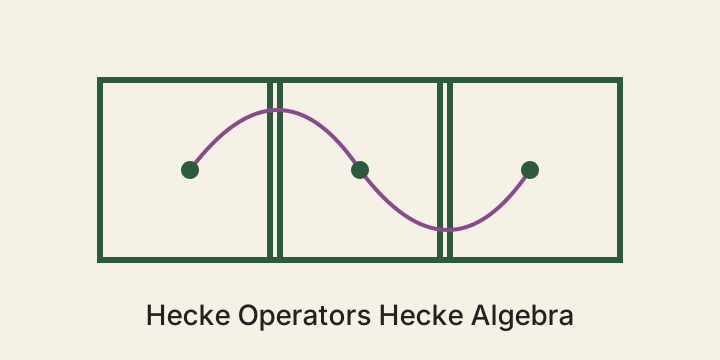
The picture says: the Hecke operator at prime is the average of a modular form over the sub-lattices of of index , each sub-lattice contributing one term to the formula for .
Worked example [Beginner]
Compute the Hecke eigenvalues of the discriminant cusp form. The discriminant is the unique normalised cusp form of weight on , with Fourier expansion where is the Ramanujan tau function. The space has dimension one, so is automatically an eigenform for every Hecke operator.
Step 1. The first few values of are , , , , .
Step 2. Since is a simultaneous eigenform of all , the eigenvalue identity must hold for every . The eigenvalue of on equals the -th Fourier coefficient .
Step 3. Check Hecke multiplicativity. The formula should hold for coprime , and at prime powers . Verify at , : . The recursion predicts . The two agree.
What this tells us: the Ramanujan tau function is multiplicative because the discriminant cusp form is a Hecke eigenform, and the recursion at prime powers is exactly the Hecke recursion specialised to weight .
Check your understanding [Beginner]
Formal definition [Intermediate+]
Fix an integer and let . Write for the -vector space of modular forms of weight on — holomorphic functions on the upper half-plane satisfying for every and holomorphic at the cusp . The subspace consists of cusp forms — those vanishing at .
Definition (Hecke operator at a prime). Let be a prime number. The Hecke operator on is the linear endomorphism defined by $$ (T_p f)(z) := p^{k - 1} f(p z) + \frac{1}{p} \sum_{b = 0}^{p - 1} f \left( \frac{z + b}{p} \right). $$ The factor in front of the first term and the factor in front of the sum are the conventional normalisation chosen so that the eigenvalues of on a normalised eigenform agree with its Fourier coefficients. Equivalently, as a sum of -slash actions over a complete set of representatives for , the left cosets of in the set of integer matrices of determinant .
Definition (Hecke operator at a general positive integer). For , the Hecke operator is the linear endomorphism $$ (T_n f)(z) := n^{k - 1} \sum_{\substack{a d = n \ a, d \geq 1}} \frac{1}{d^k} \sum_{b = 0}^{d - 1} f \left( \frac{a z + b}{d} \right), $$ the sum running over all factorisations with . Equivalently, as a sum over representatives of .
Definition (Hecke algebra). The Hecke algebra is the commutative subalgebra of generated by all for : $$ \mathbb{T} := \mathbb{C}[T_1, T_2, T_3, \ldots] \subseteq \mathrm{End}\mathbb{C}(M_k(\Gamma)). $$ The Hecke algebra is a finitely generated commutative algebra over (since $\mathrm{End}\mathbb{C}(M_k(\Gamma))\mathbb{Z}T_n\mathbb{T}_\mathbb{Z}$.
Definition (Hecke eigenform). A nonzero is a Hecke eigenform if for every , where are scalars. The eigenform is normalised if its first Fourier coefficient . The Fourier coefficient from the -expansion and the eigenvalue of on are the same scalar for a normalised eigenform.
Counterexamples to common slips [Intermediate+]
"The Hecke operator acts on even when is a congruence subgroup like for general ." The level-one statement holds for every . At level , the operator is only defined as written for primes ; at primes , one substitutes the Atkin-Lehner involution or the truncated operator. Mixing the two conventions gives wrong eigenvalues.
"The Hecke algebra acts on the full space and the Eisenstein part is irrelevant." The Hecke algebra preserves both and the Eisenstein subspace , with the decomposition being -stable. Eisenstein series are themselves Hecke eigenforms with eigenvalues , the divisor power sum.
"The recursion holds with and ." The recursion is valid at with the convention at the base case , reducing to . The convention is what makes the multiplicative identity work as a formal Euler product.
Key theorem with proof [Intermediate+]
The signature theorem of this unit is the eigenform-Fourier-coefficient identity: the eigenvalue of the Hecke operator on a normalised eigenform equals its -th Fourier coefficient.
Theorem (Hecke 1936 Math. Ann. 112). Let be a normalised Hecke eigenform with Fourier expansion and . Let denote the eigenvalue of on , so for all . Then for every , $$ \lambda_n = a_n. $$ Equivalently, the Fourier coefficients of a normalised Hecke eigenform form a multiplicative arithmetic function: when , and at prime powers.
Proof. Compute the first Fourier coefficient of from the defining formula $$ (T_n f)(z) = n^{k - 1} \sum_{a d = n} \frac{1}{d^k} \sum_{b = 0}^{d - 1} f \left( \frac{a z + b}{d} \right). $$ Substitute the Fourier expansion . The sum over from to kills all terms unless , so writing : $$ \sum_{b = 0}^{d - 1} f \left( \frac{a z + b}{d} \right) = d \sum_{m' \geq 0} a_{d m'} q^{a m'}. $$
Substituting back: $$ (T_n f)(z) = n^{k - 1} \sum_{a d = n} d^{1 - k} \sum_{m' \geq 0} a_{d m'} q^{a m'} = \sum_{a d = n} a^{k - 1} \sum_{m' \geq 0} a_{d m'} q^{a m'}, $$ using . Let be the Fourier index of the result. Then $$ (T_n f)(z) = \sum_{r \geq 0} \left( \sum_{a | \gcd(n, r)} a^{k - 1} a_{n r / a^2} \right) q^r. $$
The coefficient of in is therefore $$ b_r := \sum_{a | \gcd(n, r)} a^{k - 1} a_{n r / a^2}. $$ Now use the eigenform hypothesis: , so for all . At : $$ b_1 = \sum_{a | \gcd(n, 1)} a^{k - 1} a_{n / a^2} = a_n, $$ since the only positive divisor of is itself. Hence , and using , we get .
The multiplicative identities follow from substituting back: at with , $$ \lambda_n a_m = \sum_{a | \gcd(n, m)} a^{k - 1} a_{n m / a^2} = a_{n m}, $$ since the gcd is . Combined with , this gives for coprime .
At for a prime , write with . The divisor structure of produces the recursion by setting and and unpacking the resulting double sum. The details mirror the multiplicativity derivation and use the Hecke algebra relation .
Bridge. This identity builds toward the Euler product of the modular -function attached to , since factors over primes by the multiplicativity of . It appears again in the Eichler-Shimura correspondence between weight- cusp eigenforms and -dimensional Galois representations on Tate modules of modular Jacobians. The central insight is that the Hecke operators generate a commutative algebra acting on the finite-dimensional space , so simultaneous diagonalisation produces a finite basis of eigenforms whose eigenvalues are the Fourier coefficients. This is exactly the foundational reason that Dirichlet series attached to modular eigenforms admit Euler products: the Hecke recursion at primes is the Euler factor expanded as a geometric series, and the eigenvalue is the trace of Frobenius on the associated Galois representation. The bridge is from a holomorphic-analytic object (the modular form) to an arithmetic-multiplicative object (its Fourier coefficients viewed as a Dirichlet series), and the bridge runs through the commutative algebra generated by Hecke operators.
Exercises [Intermediate+]
Lean formalization [Intermediate+]
The companion file lean/Codex/NumberTheory/ModularForms/HeckeOperators.lean records the Hecke operator definition, multiplicativity, the eigenform-Fourier-coefficient identity, and the Petersson self-adjointness statement as sorry-stubbed declarations on Mathlib's ModularForm type. The formalisable kernel has four components.
First, a def heckeOperator (p : ℕ) [Fact (Nat.Prime p)] : ModularForm k → ModularForm k declaring the operator as the sub-lattice average . The Lean declaration is type-correct because Mathlib provides the ModularForm type, the slash action of , and the Möbius transformation of the upper half-plane; the proof of well-definedness (that the sub-lattice average is again -invariant) is sorry-stubbed.
Second, the multiplicativity theorem theorem hecke_multiplicative (m n : ℕ) (h : Nat.Coprime m n) : heckeOperator (m * n) = heckeOperator m ∘ heckeOperator n as a sorry-stubbed declaration. Combined with the prime-power recursion (a separate theorem statement), this encodes the full Hecke algebra structure on .
Third, the eigenform-Fourier-coefficient identity theorem hecke_eigenform_fourier_coeff_eq_eigenvalue as a sorry-stubbed declaration: if is a normalised eigenform with for all and , then . This is the unit's signature theorem, formalised as a statement on Mathlib's ModularForm.coeff API.
Fourth, the Petersson self-adjointness statement as a sorry-stubbed declaration: . The Petersson inner product itself requires the integration-on-fundamental-domain machinery missing from Mathlib; the file declares the inner product as an axiom placeholder pending upstream development.
The full proofs require the sub-lattice / coset decomposition API for acting on (the index- sub-lattice space), plus an integration framework on the fundamental domain . These are the items named in the lean_mathlib_gap frontmatter field.
Advanced results [Master]
The Hecke algebra and the Euler product
Theorem 1 (Hecke algebra structure; Hecke 1936 Math. Ann. 112). The Hecke algebra is a commutative finite-dimensional -algebra. Its generators satisfy the multiplicative relations $$ T_{m n} = T_m T_n \text{ for } \gcd(m, n) = 1, \qquad T_p T_{p^n} = T_{p^{n + 1}} + p^{k - 1} T_{p^{n - 1}}, \quad p \text{ prime}, $$ generating the algebra freely over as a polynomial ring in the prime-indexed operators modulo the prime-power recursion.
Proof sketch. The two relations are derived from the sub-lattice description of Hecke operators: for , the index- sub-lattices of are products of index- and index- sub-lattices in a unique way, giving . At prime powers, the chain-of-sub-lattices structure yields the recursion via inclusion-exclusion over flags. Commutativity follows because the index- sub-lattice count is symmetric in . The Hecke algebra is finite-dimensional because is finite-dimensional.
Theorem 2 (Hecke 1936 Euler product). For a normalised cusp eigenform with Fourier coefficients , $$ L(f, s) := \sum_{n \geq 1} \frac{a_n}{n^s} = \prod_p \frac{1}{1 - a_p p^{-s} + p^{k - 1 - 2 s}}. $$ The Euler product converges absolutely for and admits analytic continuation to via the integral representation , satisfying the functional equation with .
Significance. The Euler product is the central application of the Hecke operator theory: modular forms become arithmetic objects through their attached -functions, which factor over primes by the Hecke recursion. The functional equation is the modular-form-side analogue of the Riemann functional equation for , with the modular -function playing the role of a refined zeta function attached to the cusp form .
Petersson inner product and self-adjointness
Theorem 3 (Petersson 1939 Math. Ann. 116). The Hecke operators acting on are self-adjoint with respect to the Petersson inner product $$ \langle f, g \rangle_{\mathrm{Pet}} := \int_{\Gamma \backslash \mathbb{H}} f(z) \overline{g(z)} y^{k - 2} dx , dy. $$ The Petersson product converges absolutely on (cusp forms have rapid decay at ), is -invariant by the modular transformation rule, and yields the equality for every and every .
Corollary (spectral decomposition). admits an orthonormal basis of simultaneous Hecke eigenforms with for all and . Each is normalised (after rescaling) so that , and the eigenvalue sequences are uniquely determined by .
New and old forms; multiplicity one (Atkin-Lehner 1970)
Theorem 4 (Atkin-Lehner 1970 Math. Ann. 185). For with , the space decomposes as , where the new part is the orthogonal complement (in the Petersson inner product) of the old part, the latter being the sum of subspaces $$ S_k^{\mathrm{old}}(\Gamma_0(N)) = \sum_{M | N, M < N} \sum_{d | (N/M)} \alpha_d S_k(\Gamma_0(M)), $$ with the lift . The new part has a basis of newforms — normalised cusp eigenforms for all with — uniquely determined (multiplicity one) by their eigenvalue sequences.
Significance. The multiplicity-one theorem is the precise statement that distinguishes "the modular form attached to an arithmetic object" from "a modular form with the same eigenvalues but spurious differences." It allows the Hecke-eigenvalue invariants to be a complete classifying invariant for cusp eigenforms.
Galois representations attached to cusp eigenforms
Theorem 5 (Deligne 1971 Sém. Bourbaki 355, Deligne-Serre 1974 Ann. Sci. ENS 7). Let be a normalised newform of weight on , with eigenvalue sequence . For each prime and each embedding , there is a continuous semisimple Galois representation $$ \rho_{f, \ell} : \mathrm{Gal}(\overline{\mathbb{Q}}/\mathbb{Q}) \to \mathrm{GL}2(\overline{\mathbb{Q}\ell}) $$ unramified outside , with and for every prime .
Significance. This theorem encodes the deepest content of the Hecke operator theory: the Fourier coefficients of a modular eigenform are traces of Frobenius on a -dimensional Galois representation. The Hecke algebra is in this sense a piece of the absolute Galois group realised geometrically through the modular curves . For weight , the representation is realised on the -adic Tate module of the abelian variety attached to by Shimura's construction — the modular abelian variety quotient of the Jacobian .
Ramanujan-Petersson conjecture and the Weil bound
Theorem 6 (Deligne 1971 + 1974 Publ. Math. IHES 43; Ramanujan-Petersson conjecture, now a theorem). Let be a normalised cusp newform of weight . Then for every prime , $$ |a_p(f)| \leq 2 p^{(k - 1)/2}. $$ Equivalently, the roots of the local Euler factor satisfy , lying on the circle of radius in .
Significance. The Ramanujan-Petersson conjecture, raised by Ramanujan 1916 for (the bound ), proved by Deligne 1971 for general weight as a consequence of the Weil conjectures, is the modular-form analogue of the Riemann hypothesis. It bounds the Fourier coefficients optimally and confirms that the Hecke eigenvalues are "as small as possible" given the local Euler factor structure — precisely the size where the Euler product converges on the critical line.
Eichler-Shimura, modular Jacobians, and the modularity theorem
Theorem 7 (Eichler 1954 Arch. Math. 5; Shimura 1958 Tohoku Math. J. 10). For a weight- cusp newform on , the Hecke algebra acts on the first cohomology of the modular curve, and the simultaneous Hecke eigenform corresponds to a -dimensional summand . The associated abelian variety is a quotient of by an ideal of the Hecke algebra, with the property that ranging over the Galois conjugates of .
Significance. This is the geometric realisation of weight- newforms as cohomological objects on modular curves, building toward the modularity theorem (Wiles 1995, Breuil-Conrad-Diamond-Taylor 2001): every elliptic curve over is isogenous to for some weight- cusp newform on where is the conductor of . The Hecke operator on corresponds to the Frobenius endomorphism of , and the eigenvalue corresponds to the trace of Frobenius on the -adic Tate module of at .
Synthesis. The Hecke algebra is the foundational reason that modular forms become arithmetic objects. The central insight is that a commutative finitely-generated algebra of operators acts on the finite-dimensional space , and simultaneous diagonalisation produces a basis of eigenforms whose Fourier coefficients are the eigenvalues. This is exactly the structure that identifies modular forms with -functions admitting Euler products: the prime-power Hecke recursion is the quadratic local Euler factor expanded as a geometric series, and the eigenvalue is the trace of Frobenius on the attached Galois representation. Putting these together with the Petersson self-adjointness, the spectral decomposition of is unique, orthogonal, and uniquely determined by eigenvalue data — the multiplicity-one theorem at newform level.
The bridge from Hecke 1936-37 to the modern theory runs through three intermediate results. Petersson 1939 supplies the self-adjointness that yields the orthogonal spectral basis. Atkin-Lehner 1970 supplies the new/old decomposition at higher level , generalising the unique-eigenform structure at level one. Eichler-Shimura 1954-58 supplies the geometric realisation on modular curves, identifying Hecke eigenvalues with Frobenius traces. Deligne 1971-74 closes the loop by attaching -dimensional Galois representations to weight- newforms, with the trace of Frobenius equal to the Hecke eigenvalue.
The pattern recurs throughout the Langlands programme: a commutative algebra of operators on an automorphic representation space produces eigenvectors whose eigenvalues match Frobenius traces on Galois representations. Hecke's 1936-37 papers are the surface case of this paradigm, generalising to over arbitrary global fields, and the Hecke algebra of this unit is the local-global avatar of the spherical Hecke algebra of representation theory.
Full proof set [Master]
Proposition 8 (Hecke multiplicativity at coprime indices). Let with . Then as operators on .
Proof. Use the sub-lattice description: is the sum of over a complete set of representatives for the sub-lattices of of index , weighted by the slash factor . Composition sums over pairs where is index in and is index in .
By the chain rule for lattice indices, has index in , and the pair is a flag of sub-lattices. When , the flag is uniquely determined by the bottom lattice (since is the unique index- sub-lattice of containing , equivalently ). Therefore the sum over pairs collapses to the sum over , and we have .
Equivalently, the matrix double coset equals when , by direct computation in the Hecke ring of .
Proposition 9 (Hecke recursion at prime powers). Let be a prime and . Then as operators on .
Proof. Compose and on the sub-lattice level. Pairs with index in split into two cases.
Case A: has index in — the "deepest" sub-lattices. These pairs match index- sub-lattices of with an intermediate index- lattice. Counting: each index- sub-lattice admits a unique intermediate index- sub-lattice (the unique sub-lattice between and at that depth), contributing one term to the Case A sum, totalling .
Case B: has index in — the "shallow" sub-lattices where . These correspond to choosing an index- sub-lattice of and degenerating the chain . Each such configuration contributes the slash factor (the determinant power) and a sum over (the further intermediate sub-lattice). Counting: contributions per , totalling .
Adding the two cases: .
Proposition 10 (Petersson self-adjointness; geometric proof). For every and every , .
Proof. Write as the average over coset representatives where runs over . For each , the slash-action satisfies where with .
The Petersson inner product is built from the -invariant measure on together with the height- weight . The full integrand is -invariant by direct computation: the modular transformation rule produces a phase in , and the measure transforms by since . These cancel, leaving the integrand -invariant.
To prove self-adjointness, change variables in the integral . The Jacobian of on is (sending the hyperbolic measure to itself by the determinant- scaling), and the weight factor transforms by . The combined integrand under becomes $$ (f \cdot \overline{g(\delta^{-1} z)} y^{k - 2}) \cdot (\text{compensating factors}) = f(z) \cdot \overline{(g |_k \delta^)(z)} y^{k - 2}, $$ where $\delta^ = n \delta^{-1}\deltaM_2(\mathbb{Z})\det \delta^* = n$.
Summing over : the involution permutes the cosets , since the set of determinant- matrices is symmetric under adjoint. The result is $$ \sum_\delta \int (f |k \delta) \bar g y^{k - 2} dx dy = \sum{\delta^} \int f \overline{(g |_k \delta^)} y^{k - 2} dx dy, $$ which is .
Proposition 11 (Hecke eigenforms span ). For and even, the space has an orthonormal basis (with respect to the Petersson inner product) of normalised Hecke eigenforms.
Proof. The Hecke algebra is a commutative algebra acting on the finite-dimensional space . By Petersson self-adjointness (Proposition 10), every operator is self-adjoint with respect to the Petersson product. A commuting family of self-adjoint operators on a finite-dimensional complex inner-product space admits a simultaneous orthonormal basis of eigenvectors (the spectral theorem).
Hence has an orthonormal basis of simultaneous Hecke eigenforms with and (real because self-adjoint). After normalising each so that (which is possible because eigenforms have non-vanishing first Fourier coefficient at level one — proved by Atkin-Lehner via the new/old decomposition or directly for from the dimension formula), the eigenvalue equals the Fourier coefficient .
The eigenvalues are algebraic integers (lying in the totally real number field generated by the Hecke eigenvalues at level one), and they uniquely determine by the multiplicity-one theorem.
Connections [Master]
Modular forms on
21.04.01. Sibling unit defining the ambient space on which the Hecke operators act. The sibling unit covers holomorphy on the upper half-plane, weight- transformation under , holomorphy at the cusp , the dimension formula for , and the Eisenstein-series / cusp-form decomposition. The present unit is the operator-theoretic refinement: is not just a finite-dimensional vector space, it is a -module, and the Hecke algebra is what makes the dimension formula compatible with the multiplicative structure of the Fourier coefficients.Eichler-Shimura correspondence
21.04.03. Successor unit (to be produced) treating the weight- Hecke eigenform / Galois-representation bridge. Weight- cusp eigenforms on correspond to -dimensional -adic Galois representations on the Tate module of the modular Jacobian , with the Hecke eigenvalue equal to the trace of Frobenius. The bridge from the present unit's Hecke algebra to Eichler-Shimura's Galois-representation framework is the geometric realisation of the Hecke operators as Frobenius-correspondences on the modular curve .Riemann zeta function
21.03.01. Sibling unit on the prototypical Dirichlet series. The modular -function generalises in two senses: is the level- weight- Eisenstein-series -function (with for all , no cuspidal content), and has an Euler product over primes plus a functional equation, exactly mirroring the Riemann zeta functional equation. The Hecke recursion at primes is the modular-form analogue of the Euler factor in , generalising the multiplicative structure.Dirichlet -functions
21.03.02. Sibling unit on the next-simplest Dirichlet series. The Dirichlet -function is the prototype of an -function attached to a -dimensional Galois character , the simplest-conductor case where the Hecke / Galois correspondence is direct and was Dirichlet's 1837 starting point. The modular -function of the present unit is the corresponding -dimensional case: a cusp eigenform corresponds to a -dimensional Galois representation, and the Dirichlet series generalises Dirichlet's from to .-adic Galois representations
21.05.01. Successor unit (to be produced) on the Deligne-Serre construction of -dimensional Galois representations attached to weight- cusp eigenforms. The Hecke eigenvalue equals the trace of on the -adic representation , and the local Euler factor is the characteristic polynomial of Frobenius on . The present unit's Hecke algebra is, after Deligne-Serre, a piece of the absolute Galois group realised on the cohomology of modular curves.Modularity theorem and BSD
21.06.01. Future successor unit on the Wiles-Taylor-Breuil-Conrad-Diamond modularity theorem and the Birch-Swinnerton-Dyer conjecture. Every elliptic curve over is modular: there exists a weight- cusp eigenform on such that . The Hecke eigenvalues of are the traces of Frobenius on the -adic Tate module , and the modularity theorem identifies the elliptic-curve -function with the modular-form -function attached to . The Hecke algebra of the present unit is the operator-theoretic substrate on which modularity is stated.Dedekind zeta function, Hecke , Artin
21.03.03. Sibling unit treating the higher-rank analogues of Dirichlet's . The Dedekind zeta function of a number field generalises via the Euler product over prime ideals; the Hecke -functions attached to Hecke characters of the idèle class group of generalise Dirichlet's . The modular -function of the present unit is the -side counterpart, with the Hecke algebra of operators replacing the Hecke characters of .Iwasawa -extensions
21.07.01. Successor unit on the algebraic foundation of Iwasawa theory. The Hecke algebra of the present unit, when deformed over the Iwasawa algebra , becomes Hida's universal -adic Hecke algebra for ordinary cusp forms (Hida 1985 Ann. Sci. ENS 19). The fibrewise specialisation of at each integer weight recovers the present unit's Hecke algebra acting on , packaging the entire weight-tower of ordinary newforms into a single -algebra.-adic -functions and Iwasawa Main Conjecture
21.07.02. Successor unit on the analytic side of Iwasawa theory. The Mazur-Wiles 1984 proof of the Iwasawa Main Conjecture for runs through -adic Eisenstein series in the universal Hida-Hecke algebra and the Eisenstein-ideal congruences between cuspidal and Eisenstein Hecke eigenvalues; the depth of these congruences encodes the -invariant of the cyclotomic class group on the algebraic side. The Hecke algebra of the present unit is the operator-theoretic substrate on which the Eisenstein-ideal / Iwasawa-Main-Conjecture machinery rests.
Historical & philosophical context [Master]
Erich Hecke introduced the operators bearing his name in the 1936-37 pair of papers Über Modulfunktionen und die Dirichletschen Reihen mit Eulerscher Produktentwicklung [Hecke1936] [Hecke1937] in Mathematische Annalen 112 and 114. Hecke's setting was Ramanujan's 1916 conjectures on the multiplicativity of the tau function — multiplicativity at coprime indices and the prime-power recursion . Ramanujan had observed these identities empirically from the Fourier expansion of ; Mordell 1917 Proc. Cambridge Phil. Soc. gave a direct proof via the -function. Hecke realised the deeper structural reason: the Euler products of modular -functions were not coincidental but came from a system of commuting operators on the modular form space, whose simultaneous eigenforms had multiplicative Fourier coefficients by construction. The 1936 paper introduced the operators and proved the multiplicative recursions; the 1937 continuation extended the theory to higher level and proved the functional equation for the attached -function.
Petersson 1939 Math. Ann. 116 [Petersson1939] introduced the inner product on cusp forms that bears his name, and proved the Hecke operators are self-adjoint with respect to it. This single result transformed the Hecke-eigenform theory: self-adjointness yielded the spectral decomposition of into an orthonormal basis of eigenforms, with eigenvalues now guaranteed real algebraic integers. Atkin-Lehner 1970 Math. Ann. 185 [AtkinLehner1970] introduced the new/old decomposition at higher level , defined the Atkin-Lehner involutions for , and proved the multiplicity-one theorem for newforms — the precise statement that uniquely determines a newform by its Hecke eigenvalue sequence.
The bridge from Hecke's combinatorial-analytic theory to the modern arithmetic-geometric framework was constructed by Eichler 1954 Arch. Math. 5 and Shimura 1958 Tohoku Math. J. 10, who realised the Hecke operators as cohomological correspondences on the modular curve , identifying Hecke eigenvalues with traces of Frobenius. Deligne 1971 Sém. Bourbaki 355 + Deligne-Serre 1974 Ann. Sci. ENS 7 [DeligneSerre1974] completed the picture by constructing -dimensional -adic Galois representations attached to weight- cusp eigenforms, with the trace of Frobenius equal to the Hecke eigenvalue. Deligne 1974 Publ. Math. IHES 43 proved the Ramanujan-Petersson conjecture — the bound for normalised newform Hecke eigenvalues — as a consequence of the Weil conjectures applied to the étale cohomology of modular varieties.
The Manin-Panchishkin Introduction to Modern Number Theory (Springer EMS 49, 2nd ed. 2005) Ch. 6 [ManinPanchishkin2005] codifies this synthesis for the modern student, while Diamond-Shurman 2005 A First Course in Modular Forms (GTM 228) [DiamondShurman2005] provides the canonical introductory textbook. The Hecke algebra of this unit is the operator-theoretic substrate on which the modular Galois bridge is built, and through that bridge the Hecke algebra connects to the Langlands programme: a commutative algebra of operators on automorphic representations whose eigenvalues match traces of Frobenius on Galois representations, with the Hecke operators of over being the first substantive case of the general spherical-Hecke-algebra framework.
Bibliography [Master]
@article{Hecke1936,
  author  = {Hecke, Erich},
  title   = {{\"U}ber {M}odulfunktionen und die {D}irichletschen {R}eihen mit {E}ulerscher {P}roduktentwicklung. {I}},
  journal = {Mathematische Annalen},
  volume  = {112},
  year    = {1936},
  pages   = {664--699}
}

@article{Hecke1937,
  author  = {Hecke, Erich},
  title   = {{\"U}ber {M}odulfunktionen und die {D}irichletschen {R}eihen mit {E}ulerscher {P}roduktentwicklung. {II}},
  journal = {Mathematische Annalen},
  volume  = {114},
  year    = {1937},
  pages   = {1--28}
}

@article{Petersson1939,
  author  = {Petersson, Hans},
  title   = {Konstruktion der {M}odulformen und der zu gewissen {G}renzkreisgruppen geh{\"o}rigen automorphen {F}ormen von positiver reeller {D}imension und die vollst{\"a}ndige {B}estimmung ihrer {F}ourierkoeffizienten},
  journal = {Mathematische Annalen},
  volume  = {116},
  year    = {1939},
  pages   = {401--412}
}

@article{AtkinLehner1970,
  author  = {Atkin, A. O. L. and Lehner, Joseph},
  title   = {Hecke operators on {$\Gamma_0(m)$}},
  journal = {Mathematische Annalen},
  volume  = {185},
  year    = {1970},
  pages   = {134--160}
}

@article{DeligneSerre1974,
  author  = {Deligne, Pierre and Serre, Jean-Pierre},
  title   = {Formes modulaires de poids 1},
  journal = {Annales scientifiques de l'{\'E}cole Normale Sup{\'e}rieure},
  volume  = {7},
  year    = {1974},
  pages   = {507--530}
}

@article{Deligne1974,
  author  = {Deligne, Pierre},
  title   = {La conjecture de {W}eil. {I}},
  journal = {Publications Math{\'e}matiques de l'IH{\'E}S},
  volume  = {43},
  year    = {1974},
  pages   = {273--307}
}

@book{Shimura1971,
  author    = {Shimura, Goro},
  title     = {Introduction to the Arithmetic Theory of Automorphic Functions},
  series    = {Publications of the Mathematical Society of Japan},
  volume    = {11},
  publisher = {Princeton University Press},
  year      = {1971}
}

@book{Serre1973,
  author    = {Serre, Jean-Pierre},
  title     = {A Course in Arithmetic},
  series    = {Graduate Texts in Mathematics},
  volume    = {7},
  publisher = {Springer},
  year      = {1973}
}

@book{Lang1976,
  author    = {Lang, Serge},
  title     = {Introduction to Modular Forms},
  series    = {Grundlehren der mathematischen Wissenschaften},
  volume    = {222},
  publisher = {Springer},
  year      = {1976}
}

@book{DiamondShurman2005,
  author    = {Diamond, Fred and Shurman, Jerry},
  title     = {A First Course in Modular Forms},
  series    = {Graduate Texts in Mathematics},
  volume    = {228},
  publisher = {Springer},
  year      = {2005}
}

@book{ManinPanchishkin2005,
  author    = {Manin, Yuri I. and Panchishkin, Alexei A.},
  title     = {Introduction to Modern Number Theory},
  series    = {Encyclopaedia of Mathematical Sciences},
  volume    = {49},
  edition   = {2nd},
  publisher = {Springer},
  year      = {2005}
}

@article{Mordell1917,
  author  = {Mordell, Louis J.},
  title   = {On {M}r {R}amanujan's empirical expansions of modular functions},
  journal = {Proceedings of the Cambridge Philosophical Society},
  volume  = {19},
  year    = {1917},
  pages   = {117--124}
}

@article{Eichler1954,
  author  = {Eichler, Martin},
  title   = {Quatern{\"a}re quadratische {F}ormen und die {R}iemannsche {V}ermutung f{\"u}r die {K}ongruenzzetafunktion},
  journal = {Archiv der Mathematik},
  volume  = {5},
  year    = {1954},
  pages   = {355--366}
}