Riemann zeta function zeta(s)
Anchor (Master): Euler 1737 *Variae observationes circa series infinitas*; Riemann 1859 *Ueber die Anzahl der Primzahlen unter einer gegebenen Grosse*; Edwards *Riemann's Zeta Function*; Titchmarsh *The Theory of the Riemann Zeta-Function*; Ivic *The Riemann Zeta-Function*
Intuition [Beginner]
Take the reciprocals of the natural numbers and raise each to a power . The sum is the Riemann zeta function . For the sum converges to the specific value ; for it converges to . At the series is the harmonic series, which diverges to infinity.
The zeta function matters because it connects two worlds that seem unrelated: the smooth world of calculus and the discrete world of prime numbers. Euler showed that can be rewritten as a product over all primes . This product formula means that every zero of encodes information about how the primes are distributed among the integers.
Why does this concept exist? The zeta function is the analytic engine behind the prime number theorem, which counts how many primes exist below a given number. The Riemann hypothesis, the most famous unsolved problem in mathematics, conjectures that all the zeros of in the critical strip lie on the single line .
Visual [Beginner]
A plot of for real values of . The curve plunges to negative infinity as approaches from the right (the pole), then rises and approaches as grows large. The value and are marked on the curve.
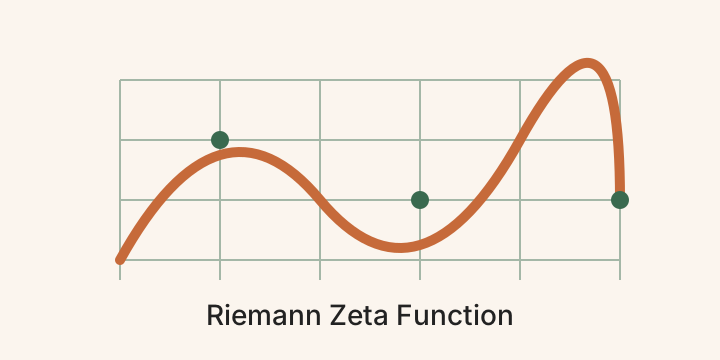
The pole at is the reason the harmonic series diverges: the function simply has no finite value there.
Worked example [Beginner]
Compute partial sums of and compare with the known value .
Step 1. The first four terms give .
Step 2. Adding the next six terms through gives .
Step 3. The exact value is . The partial sum through captures about of the total. Adding more terms approaches from below, but convergence is slow: each new term contributes only a small amount.
What this tells us: the zeta function at converges, but the convergence rate is moderate because the terms shrink only quadratically. At larger values of the terms shrink faster and convergence accelerates.
Check your understanding [Beginner]
Formal definition [Intermediate+]
Let with . The Riemann zeta function is defined by the Dirichlet series
Convergence for follows from the integral test comparison: is bounded by , which converges as when . The series converges absolutely and uniformly on compact subsets of , so is holomorphic on this half-plane. [Stein-Shakarchi Ch. 6]
Definition (Euler product). For , the zeta function factors over the primes:
This factorisation is the bridge between analysis and number theory: the zeta function on the left is an analytic object defined by a sum over all natural numbers, and the product on the right encodes the multiplicative structure of the integers in terms of prime powers.
Counterexamples to common slips
- The Dirichlet series does not converge for . At the series is the harmonic series, which diverges. For the terms do not decrease fast enough for convergence. The function must be extended analytically beyond the half-plane of convergence.
- The Euler product does not converge at . The boundary is the natural boundary for the product representation; at the product diverges because diverges.
- does not mean . The value is obtained by analytic continuation, not by summing the divergent series. The Dirichlet series diverges at ; the value comes from the functional equation.
Key theorem with proof [Intermediate+]
Theorem (Euler product convergence). For , the zeta function has the absolutely convergent product representation
where the product converges absolutely. In particular, for .
Proof. Fix with . The geometric series gives
for each prime . Take the finite product over the first primes :
Expanding the product, each factor contributes a power of , and by unique factorisation of integers, every positive integer whose prime factorisation uses only the primes appears exactly once as a term . Hence
where is the set of positive integers whose prime factors all lie in . As , every positive integer eventually appears in some , so the partial products converge to the full Dirichlet series:
For absolute convergence of the product: for , and this converges because for . An absolutely convergent infinite product of non-zero factors is non-zero, so for .
Bridge. The Euler product builds toward 06.01.04 analytic continuation, where the zeta function appears again as the central example of extending a function beyond its half-plane of convergence to a meromorphic function on all of . The foundational reason the zeta function is central to number theory is that the Euler product identifies it as the generating function of the primes, and this is exactly the bridge from analysis to arithmetic. The pattern generalises through Dirichlet -functions (replacing with for a Dirichlet character ), and putting these together identifies the zeta function as the simplest member of a vast family of -functions whose analytic properties control arithmetic distribution questions. The Euler product appears again in 06.01.27 power series as the prototypical example of an Euler-type product representation of an analytic function.
Exercises [Intermediate+]
Advanced results [Master]
Functional equation (Riemann 1859). The completed zeta function satisfies for all [Riemann 1859]. Equivalently,
The functional equation is the engine of analytic continuation: it extends from the half-plane to a meromorphic function on all of with a unique simple pole at with residue . The symmetry means the behaviour of for is determined by its behaviour for .
Elementary zeros. The functional equation forces for . At , the factor , while is finite and non-zero, and is finite and non-zero. The factor in the completed zeta function has poles at , and these poles are cancelled by the elementary zeros of , making an entire function of order one.
Zero-free region. The zeta function has no zeros for . The proof that for uses the Euler product and the inequality applied to near . Combined with the functional equation, this gives for and (via reflection) for except at the elementary zeros. The remaining region is the critical strip, where the substantive zeros lie.
Hadamard-de la Vallee Poussin zero-free region. There exists a constant such that for [Titchmarsh Ch. 3]. This is the strongest known effective zero-free region and is the input to the prime number theorem with error term.
Prime number theorem (Hadamard 1896, de la Vallee Poussin 1896). The number of primes below , denoted , satisfies as [Edwards Ch. 1]. The proof proceeds by showing that for all , then inverting the relation via a contour integral to obtain the asymptotic. The error term is controlled by the location of the substantive zeros: the Riemann hypothesis is equivalent to for every .
Riemann hypothesis. All substantive zeros of lie on the critical line [Edwards Ch. 1]. This remains the most famous unsolved problem in mathematics. Numerical verification confirms the hypothesis for the first zeros. The functional equation and the Euler product are the two structural facts that constrain the zeros; the hypothesis asserts that these constraints force the zeros onto the symmetry line of the functional equation.
Synthesis. The Riemann zeta function is the foundational reason that analytic methods control arithmetic questions about primes. The central insight is that the Euler product identifies with the primes, and the functional equation identifies the left and right halves of the complex plane, putting these together so that the distribution of primes is controlled by the location of the zeros of in the critical strip. This is exactly the structure that generalises through the Langlands programme: every -function has an Euler product, a functional equation, and an analytic continuation, and the pattern recurs across Dirichlet -functions, automorphic -functions, and the -functions of elliptic curves. The bridge is between the discrete multiplicative structure of and the continuous analytic structure of , and is the single function that carries the full dictionary between these two worlds.
Full proof set [Master]
Proposition (Zero-free region: ). For all , .
Proof. For , take the real part of via the Euler product:
For and , consider the non-negative quantity:
This follows from the inequality applied to the real parts of at arguments , , and in the Euler product expansion. Therefore
Now use the pole at : as . If for some , then as . The factor remains bounded near (it has no pole). Hence the left side behaves like as , contradicting the lower bound of . Therefore for all .
Proposition (Residue at the pole). The zeta function has a simple pole at with residue .
Proof. From Exercise 7, the representation holds in a neighbourhood of , where is holomorphic at with (the Euler-Mascheroni constant). Therefore as , establishing a simple pole with residue .
Connections [Master]
Gamma function
06.01.15. The functional equation of the zeta function involves as the normalising factor in the completed zeta function . The Gamma function's poles at non-positive integers cancel the elementary zeros of , making entire. The Gamma function is the structural partner of in the functional equation, and the reflection formula for parallels the symmetry .Power series and Laurent series
06.01.27. The Dirichlet series is the prototypical example of a Dirichlet series, a variant of the power series where the index appears in the exponent rather than the coefficient. The theory of convergence and analytic continuation for Dirichlet series parallels the radius-of-convergence theory for power series, with the abscissa of convergence playing the role of the radius of convergence.Analytic continuation
06.01.04. The zeta function is the central example of analytic continuation beyond a half-plane of convergence: the Dirichlet series converges only for , yet the functional equation extends to a meromorphic function on all of . This continuation pattern is the template for all -functions in number theory.
Historical & philosophical context [Master]
Euler 1737 [Euler 1737], in his Variae observationes circa series infinitas, discovered the product formula and used it to give a new proof that there are infinitely many primes: if diverges as and the product converges for any finite set of primes, the set of primes must be infinite. Euler also evaluated via the Bernoulli numbers, establishing the connection between the zeta function and special values.
Riemann 1859 [Riemann 1859], in his eight-page memoir Ueber die Anzahl der Primzahlen unter einer gegebenen Grosse, introduced the analytic continuation of to the full complex plane via the functional equation, identified the elementary zeros at , and conjectured that the substantive zeros lie on the line . The modern theory, including the prime number theorem (proved independently by Hadamard and de la Vallee Poussin in 1896 using the zero-free region ) and the vast machinery of -functions, all descend from Riemann's single paper. The canonical references are Edwards Riemann's Zeta Function (1974) and Titchmarsh The Theory of the Riemann Zeta-Function (1951) [Titchmarsh].
Bibliography [Master]
@article{Euler1737,
  author = {Euler, Leonhard},
  title = {Variae observationes circa series infinitas},
  journal = {Commentarii academiae scientiarum Petropolitanae},
  volume = {9},
  year = {1737},
  pages = {160--188},
  note = {Euler product formula for the zeta function}
}

@article{Riemann1859,
  author = {Riemann, Bernhard},
  title = {Ueber die Anzahl der Primzahlen unter einer gegebenen Grosse},
  journal = {Monatsberichte der K\"oniglichen Preu\ss{}ischen Akademie der Wissenschaften zu Berlin},
  year = {1859},
  pages = {671--680},
  note = {Functional equation, analytic continuation, and the Riemann hypothesis}
}

@book{Edwards1974,
  author = {Edwards, H. M.},
  title = {Riemann's Zeta Function},
  publisher = {Academic Press},
  year = {1974},
  note = {Canonical modern exposition of the theory}
}

@book{Titchmarsh1951,
  author = {Titchmarsh, E. C.},
  title = {The Theory of the Riemann Zeta-Function},
  publisher = {Oxford University Press},
  year = {1951},
  note = {Comprehensive reference on the analytic theory}
}

@book{SteinShakarchi2003,
  author = {Stein, Elias M. and Shakarchi, Rami},
  title = {Complex Analysis},
  publisher = {Princeton University Press},
  year = {2003},
  volume = {II},
  note = {Princeton Lectures in Analysis, Chapter 6}
}

@book{Ivic1985,
  author = {Ivi\'c, Aleksandar},
  title = {The Riemann Zeta-Function},
  publisher = {Wiley},
  year = {1985},
  note = {Theory of the Riemann zeta-function with emphasis on value-distribution}
}