Casimir element
Anchor (Master): Casimir 1931 Proc. Akad. Wetensch. Amsterdam; Humphreys section 6; Knapp Ch. VI
Intuition [Beginner]
The Casimir element is a special operator associated to a semisimple Lie algebra. It commutes with every element of the Lie algebra, making it a "universal symmetry" of all representations.
Think of it as a generalisation of the Laplacian. In physics, the Laplacian (the sum of second derivatives in all directions) commutes with rotations. The Casimir element does the same thing for any Lie algebra: it is a rotationally-invariant operator.
On any irreducible representation, the Casimir element acts as a scalar (by Schur's lemma, since it commutes with everything). This scalar is a quadratic function of the highest weight, and it distinguishes different representations.
For , the Casimir element is , and on the -dimensional irreducible representation it equals times the identity.
Visual [Beginner]
A diagram showing the Casimir element as an operator on a representation space . Arrows from to itself labelled with Lie algebra elements and dual elements . The total is shown as a big circle that commutes with all the smaller arrows.
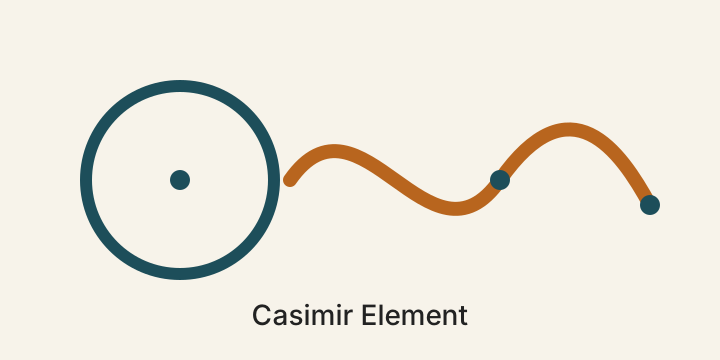
The Casimir element: a central operator that acts as a scalar on each irreducible representation.
Worked example [Beginner]
For with basis , , .
The Killing form gives dual bases: is dual to (up to scaling). The Casimir element is:
Since (by ), we get .
On the 3-dimensional representation (, highest weight ): . The Casimir eigenvalue is .
Check your understanding [Beginner]
Formal definition [Intermediate+]
Definition (Casimir element). Let be a semisimple Lie algebra with Killing form . Choose bases and of that are dual with respect to : . The Casimir element is:
where is the universal enveloping algebra.
Proposition. is independent of the choice of dual bases and lies in the centre .
The proof of centrality uses the associativity of the Killing form: for all , which gives .
Key theorem with proof [Intermediate+]
Theorem (Casimir eigenvalue). Let be the irreducible representation of with highest weight . Then:
where is the Weyl vector and is the Killing-form inner product.
Proof. Since is central and is irreducible, acts as a scalar by Schur's lemma. It suffices to compute the eigenvalue on the highest weight vector .
Write where the first sum is over positive roots and the second over a basis of the Cartan subalgebra with its dual basis.
Since for positive (by the definition of highest weight), the contribution of simplifies using :
Applied to : .
The Cartan part gives . Summing over all positive roots:
Bridge. The Casimir eigenvalue formula connects the algebraic data (the highest weight) to a numerical invariant of the representation; the foundational reason it works is that centrality forces the Casimir to be constant on irreducibles, and the eigenvalue is determined by the highest weight alone. This pattern appears again in 07.06.22 where the Casimir is the main tool in the proof of Weyl's complete reducibility theorem. The bridge is that the Casimir element generalises the Laplacian to arbitrary Lie algebras, providing a quadratic invariant that distinguishes representations.
Exercises [Intermediate+]
Advanced results [Master]
Higher Casimir operators. The centre is a polynomial algebra generated by algebraically independent elements. For , these are the Capelli determinants of degrees . The Casimir element is the degree- generator.
Harish-Chandra isomorphism. The Harish-Chandra homomorphism identifies with the algebra of -invariant polynomials on the Cartan subalgebra . Under this isomorphism, the Casimir element maps to the quadratic polynomial .
Application to complete reducibility. The Casimir element provides the key tool for Weyl's complete reducibility theorem. If is a finite-dimensional representation and is a submodule, the Casimir eigenvalue on differs from the eigenvalue on the complement (if the complement exists). The quadratic form is positive-definite on the weight lattice, which forces the complement to exist.
Synthesis. The Casimir element is the first and most important central element of the universal enveloping algebra; the central insight is that the Killing form, which measures the size of the Lie algebra, produces an operator that is invariant under the Lie algebra's own action. This pattern appears again in the higher Casimir operators and the Harish-Chandra isomorphism, which together show that the centre of is a polynomial algebra with one generator per degree equal to an exponent of the Weyl group. The bridge is that the Casimir element builds toward the entire theory of central characters and the Bernstein-Gelfand-Gelfand category .
Full proof set [Master]
Proposition (Centrality of the Casimir). lies in the centre of .
Proof. Let . Then . Write and where and . By the associativity , we get . Substituting: .
Connections [Master]
The Cartan matrix 07.06.19 determines the root system and hence the Killing form, from which the Casimir element is constructed via dual bases.
Weyl's complete reducibility theorem 07.06.22 uses the Casimir element as its main tool; the positive-definiteness of the Casimir eigenvalue forces every submodule to have a complement.
The universal enveloping algebra 07.06.02 is the ambient algebra in which the Casimir element lives; centrality means the Casimir is invariant under the adjoint action of .
The Weyl character formula 07.06.07 computes characters using the highest weight, and the Casimir eigenvalue provides a consistency check: two representations with different characters must have different Casimir eigenvalues.
Bibliography [Master]
@article{casimir1931,
  author = {Casimir, Hendrik},
  title = {{\"U}ber die Darstellung der einfach zusammenh{\"a}ngenden Gruppe durch einen Generatorem},
  journal = {Proc. Akad. Wetensch. Amsterdam},
  volume = {34},
  pages = {227--237},
  year = {1931}
}

@book{humphreys-lie,
  author = {Humphreys, James E.},
  title = {Introduction to Lie Algebras and Representation Theory},
  publisher = {Springer},
  year = {1972}
}

@book{fulton-harris,
  author = {Fulton, William and Harris, Joe},
  title = {Representation Theory: A First Course},
  publisher = {Springer},
  year = {1991}
}

@book{knapp-lie,
  author = {Knapp, Anthony W.},
  title = {Lie Groups Beyond an Introduction},
  edition = {2},
  publisher = {Birkh{\"a}user},
  year = {2002}
}
Historical & philosophical context [Master]
Hendrik Casimir introduced his namesake operator in 1931 [Casimir 1931] while studying the rotation group and its quantum-mechanical representations. The total angular momentum operator in quantum mechanics is the Casimir element of , and its eigenvalue is the Casimir eigenvalue for the spin- representation.
The Casimir element became the prototype for invariant differential operators on symmetric spaces, central characters in representation theory, and the index theory of elliptic operators on homogeneous spaces. Its centrality makes it the simplest tool for decomposing representations into irreducibles, and its eigenvalue formula provides the most accessible link between the abstract weight lattice and concrete numerical invariants.