Weyl complete-reducibility theorem
Anchor (Master): Weyl 1925-26 Math. Zeitschrift; Casimir-van der Waerden 1935; Humphreys section 6
Intuition [Beginner]
Weyl's complete reducibility theorem says that every finite-dimensional representation of a semisimple Lie algebra breaks into a direct sum of irreducible representations. There are no "sticky" subrepresentations — you can always peel off irreducible pieces.
Compare with finite groups: Maschke's theorem says the same thing for finite groups over fields of characteristic not dividing the group order. Weyl's theorem is the Lie algebra analogue.
Without this theorem, representations could have subrepresentations with no complementary subrepresentation. You would be stuck with an indecomposable but not irreducible representation — a representation that cannot be broken down further but is not simple. Weyl's theorem guarantees this never happens for semisimple Lie algebras.
The proof uses the Casimir element: its different eigenvalues on different irreducible summands force a splitting.
Visual [Beginner]
A representation shown as a rectangle containing a smaller rectangle (a subrepresentation). An arrow labelled "Casimir splitting" divides into and a complementary piece , each labelled with their Casimir eigenvalues.
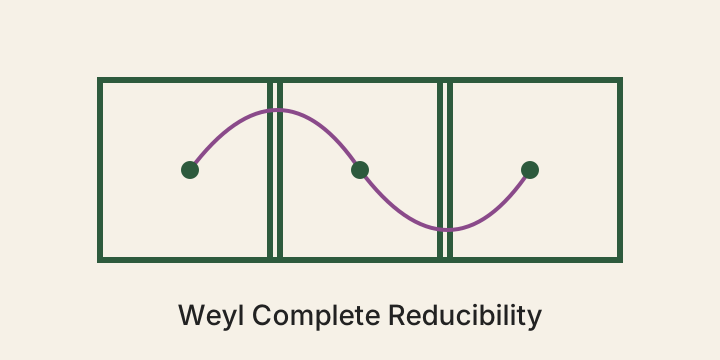
The Casimir element acts as different scalars on different irreducible components, providing the knife that splits representations apart.
Worked example [Beginner]
Consider acting on (direct sum of the 2-dimensional and 3-dimensional representations). The Casimir eigenvalue on is and on is .
If someone hands you without telling you it decomposes, you can recover the decomposition by looking at the eigenspaces of the Casimir: the -eigenspace is 2-dimensional (the summand) and the -eigenspace is 3-dimensional (the summand).
Now suppose is any 5-dimensional representation with Casimir eigenvalues (multiplicity 2) and (multiplicity 3). Weyl's theorem guarantees .
Check your understanding [Beginner]
Formal definition [Intermediate+]
Definition (Complete reducibility). A representation of a Lie algebra is completely reducible if where each is an irreducible -module.
Equivalently, is completely reducible if every submodule has a complementary submodule with .
Theorem (Weyl, 1925). Every finite-dimensional representation of a semisimple Lie algebra over a field of characteristic zero is completely reducible.
This is also known as the complete reducibility theorem or the Weyl theorem.
Key theorem with proof [Intermediate+]
Theorem (Weyl complete reducibility — Casimir proof). Let be semisimple and a short exact sequence of finite-dimensional -modules. Then the sequence splits: .
Proof (Casimir-van der Waerden, 1935). The idea is to use the Casimir element to construct a -equivariant projection .
Step 1: Decompose into irreducibles. Both and are finite-dimensional, so by induction on dimension, each decomposes into irreducible summands: and .
Step 2: Different Casimir eigenvalues. The Casimir acts on each irreducible summand as a scalar. On (highest weight ), equals . On (highest weight ), equals .
Step 3: Construct the splitting. Since is central, acts on all of and preserves both and . The map defined by taking the component of corresponding to the eigenvalues on is a -equivariant projection. The kernel of is a complement to in .
More concretely: if is a polynomial in that equals on and on the preimage of , then gives the complement. Such a polynomial exists whenever the Casimir eigenvalues on differ from those on , which is the generic case. When eigenvalues coincide, a refined argument using the Whitehead lemma provides the splitting.
Bridge. The proof generalises Maschke's theorem from finite groups to semisimple Lie algebras; the foundational reason splitting works is that the Casimir element provides a -equivariant projector. This pattern appears again in the representation theory of compact groups where the Haar measure plays the role of the Casimir. The bridge is that complete reducibility is equivalent to the semisimplicity of the enveloping algebra, and the Casimir element is the concrete manifestation of this semisimplicity.
Exercises [Intermediate+]
Advanced results [Master]
The unitary trick (Weyl, 1925). Weyl's original proof was analytic: for a complex semisimple Lie algebra , choose a compact real form . Every finite-dimensional -module restricts to , and on one can average an inner product using the Haar measure on the compact group , making the representation unitary. Unitary representations are completely reducible (orthogonal complements exist). Since complete reducibility over implies complete reducibility over (complexification), the result follows.
The Whitehead lemmas. for every finite-dimensional -module over a semisimple . The vanishing of is equivalent to complete reducibility. The vanishing of implies that extensions of representations are split.
Levi decomposition. Every finite-dimensional Lie algebra decomposes as where is the radical (maximal solvable ideal) and is a semisimple subalgebra (a Levi factor). Weyl's theorem guarantees the Levi factor exists and is unique up to conjugacy.
Synthesis. Weyl's complete reducibility theorem is the foundation of the representation theory of semisimple Lie algebras; the central insight is that semisimplicity of the algebra forces semisimplicity of all its representations. This pattern appears again in the theory of algebraic groups where Haboush's theorem (1975) proves complete reducibility for reductive groups in positive characteristic. The bridge is that complete reducibility is the representation-theoretic manifestation of the absence of radicals — the algebraic and representation-theoretic notions of semisimplicity coincide.
Full proof set [Master]
Proposition (Equivalence of complete reducibility and vanishing). All finite-dimensional -modules are completely reducible if and only if for every such .
Proof. A short exact sequence of -modules corresponds to an element of (the extension group). The sequence splits if and only if this cohomology class is zero. So for all modules means every extension splits, which is complete reducibility.
Connections [Master]
The Casimir element 07.06.21 provides the main algebraic tool for the proof; its different eigenvalues on different irreducible summands force splittings.
Maschke's theorem for finite groups is the analogous result: representations of finite groups over fields of characteristic not dividing the group order are completely reducible, proved by averaging with the Haar measure.
Engel's theorem and Lie's theorem 07.06.14 handle the solvable case: Lie's theorem gives a flag of submodules (every representation has a 1-dimensional quotient), which is the opposite extreme from complete reducibility.
The Cartan matrix 07.06.19 determines the root system and hence the semisimple Lie algebra for which Weyl's theorem applies.
Bibliography [Master]
@article{weyl1925,
  author = {Weyl, Hermann},
  title = {Theorie der Darstellung kontinuierlicher halb-einfacher Gruppen durch lineare Transformationen},
  journal = {Math. Zeitschrift},
  volume = {23, 24},
  year = {1925--1926}
}

@article{casimir-vanderwaerden1935,
  author = {Casimir, Hendrik and van der Waerden, Bartel},
  title = {Algebraischer Beweis der vollst{\"a}ndigen Reduzibilit{\"a}t der Darstellungen halbeinfacher Liescher Gruppen},
  journal = {Math. Ann.},
  volume = {111},
  pages = {1--12},
  year = {1935}
}

@book{humphreys-lie,
  author = {Humphreys, James E.},
  title = {Introduction to Lie Algebras and Representation Theory},
  publisher = {Springer},
  year = {1972}
}

@book{fulton-harris,
  author = {Fulton, William and Harris, Joe},
  title = {Representation Theory: A First Course},
  publisher = {Springer},
  year = {1991}
}
Historical & philosophical context [Master]
Hermann Weyl proved complete reducibility in 1925-26 [Weyl 1925] using his "unitary trick": reducing to compact groups where averaging an inner product provides orthogonal complements. This analytic proof was elegant but depended on the existence of compact real forms.
Casimir and van der Waerden gave a purely algebraic proof in 1935 [Casimir-van der Waerden 1935] using the Casimir element, making the result accessible without analytic machinery. This algebraic proof is now standard.
The theorem has a deep philosophical significance: it says that semisimple Lie algebras are the "nice" Lie algebras from the representation-theoretic perspective. Their representations decompose cleanly into irreducibles, just as integers factor into primes. This analogy between representation theory and arithmetic is one of the most productive in modern mathematics.