Bosonic Fock space and second quantisation
Anchor (Master): Cook, *Trans. Amer. Math. Soc.* 74, 222 (1953) (the original rigorous construction); Reed & Simon, *Methods of Modern Mathematical Physics*, Vol. II, §X.7 ($\Gamma$-functor and second quantisation of one-particle dynamics); Glimm & Jaffe, *Quantum Physics: A Functional Integral Point of View*, 2nd ed. (Springer, 1987), Chs. 1, 6 (Fock space as substrate for the Wightman free field and for Euclidean constructive QFT); Bratteli & Robinson, *Operator Algebras and Quantum Statistical Mechanics*, Vol. II, 2nd ed. (Springer, 1997), §5.2 (Weyl form of the CCR and the algebraic free Bose gas); Parisi & Wu, *Sci. Sin.* 24, 483 (1981) (stochastic quantisation: the Langevin route to the same Gaussian measure)
Intuition [Beginner]
Statistical mechanics of identical bosons — photons in a cavity, helium-4 atoms in a trap, phonons in a crystal — needs a state space large enough to hold any number of particles at once. Ordinary single-particle quantum mechanics fixes the particle count by hand, but real systems exchange particles with a reservoir (the photon bath of a hot cavity, the gas-phase reservoir for a condensate). The Hilbert space has to accommodate the vacuum (no particles), one-particle states, two-particle states, and so on, all glued into a single home where operators can hop between particle-number sectors.
Bosonic Fock space is that home. Start with the one-particle Hilbert space — the space of wavefunctions a single boson can occupy. Then build the two-particle space as the symmetrised tensor product (symmetric because swapping the labels of two identical bosons must leave the state unchanged), the three-particle space as the symmetrised triple tensor product, and so on. The bosonic Fock space stacks all of these together with the empty-particle one-dimensional space, the vacuum, at the bottom.
The procedure that takes the one-particle quantum mechanics and lifts it to the many-particle theory on this stacked space is called second quantisation. The name is a historical accident — there is no first quantisation being quantised a second time — but it stuck after Dirac (1927) and Jordan-Klein (1927) used it to package the photon and the free Bose gas. Fock (1932) gave the symmetric-tensor-power construction its present form. Statistical mechanics on the resulting space recovers Planck's blackbody law, the Bose-Einstein condensate, and the partition function of every free bosonic field theory.
Visual [Beginner]
Picture a ladder with no top rung. The bottom rung is the empty vacuum — no particles, just the unit vector that says "nothing here". The first rung holds one-particle states; the rung is itself a copy of the one-particle Hilbert space. The second rung holds two-particle states, with the convention that swapping the labels of the two particles gives the same state (identical bosons cannot be told apart). The third rung holds three-particle states with the same symmetry, and so on upward.
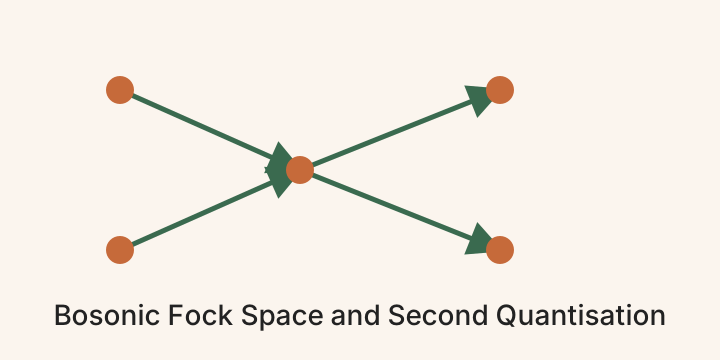
Two operators move states between rungs. The creation operator adds a particle in the one-particle state , climbing one rung up the ladder. The annihilation operator removes a particle in state , descending one rung. Their algebra reads , the canonical commutation relation. The number operator counts how many particles are present and is the rung label itself. Multi-mode statistical mechanics is the same picture with a separate ladder for every one-particle eigenmode, and the joint state space is the tensor product of all the ladders.
Worked example [Beginner]
Compute the grand-canonical partition function of a free Bose gas using one mode of frequency at temperature and chemical potential .
Step 1. List the states on the ladder. The rung labelled is the state with bosons in this mode, with energy . The rung labels run with no upper bound.
Step 2. Write the grand-canonical weight. Each state contributes a weight . Set and demand so the series below converges.
Step 3. Sum the geometric series. The single-mode partition function adds up the weights , a geometric series with ratio . The closed-form sum is .
Step 4. Plug in numbers. At , and . The average occupation number is the Bose-Einstein factor , giving at .
Step 5. Generalise to many modes. Each mode contributes its own factor, and the full partition function is the product of single-mode factors over all the one-particle modes. For photons in a cubic cavity of side , the modes are labelled by wavevector with , and the product becomes the integral that gives Planck's blackbody spectrum.
What this tells us: the geometric-series sum over occupation numbers on a single rung is exactly the structure the bosonic Fock space packages. Statistical mechanics inherits the unbounded ladder from the symmetric tensor power, and the partition function is the trace of over the entire Fock space.
Check your understanding [Beginner]
Formal definition [Intermediate+]
Let be a complex separable Hilbert space — the one-particle Hilbert space of the theory. In statistical-mechanics applications for the spatial domain and Lebesgue measure; in relativistic QFT applications with the mass shell and the Lorentz-invariant measure. For each integer write for the Hilbert tensor power with the convention . The symmetric group acts on by permutation of tensor factors, with each permutation represented by a unitary .
The symmetrisation projector is $$ P_s^{(n)} := \frac{1}{n!} \sum_{\sigma \in S_n} U_\sigma, $$ and the symmetric -fold tensor power is the closed subspace $$ S^n \mathcal{H} := P_s^{(n)} \mathcal{H}^{\otimes n} = { \xi \in \mathcal{H}^{\otimes n} : U_\sigma \xi = \xi \text{ for all } \sigma \in S_n }. $$
The bosonic Fock space over is the Hilbert direct sum $$ \mathcal{F}s(\mathcal{H}) := \bigoplus{n=0}^{\infty} S^n \mathcal{H}, $$ with inner product and norm . The construction is the direct sum of the symmetric tensor powers; is again a complex separable Hilbert space. The summand is spanned by the unit vector called the vacuum.
For write the symmetric tensor . The symmetric inner product is computed by the permanent of the Gram matrix, $$ \langle f_1 \vee \cdots \vee f_n,\ g_1 \vee \cdots \vee g_n \rangle = \mathrm{perm}\bigl( \langle f_i, g_j \rangle \bigr). $$ The normalisation is the convention that gives clean square-root coefficients in the action of the creation operator below.
The creation operator for is the densely defined operator on with acting by $$ a^(f)(g_1 \vee \cdots \vee g_n) = f \vee g_1 \vee \cdots \vee g_n, \qquad a^(f) \Omega = f. $$ The annihilation operator is the formal adjoint, with acting by $$ a(f)(g_1 \vee \cdots \vee g_n) = \sum_{k=1}^{n} \langle f, g_k \rangle, g_1 \vee \cdots \vee \widehat{g_k} \vee \cdots \vee g_n, \qquad a(f) \Omega = 0, $$ where the caret marks omission. The map is complex-linear; the map is complex anti-linear with . Both operators are defined on the finite-particle subspace (vectors with only finitely many non-zero components in the direct sum), which is dense in .
The number operator acts on by multiplication by . Given an orthonormal basis of , $$ N = \sum_{k=1}^{\infty} a^*(e_k), a(e_k), $$ with the sum convergent on the finite-particle subspace and extending to a self-adjoint operator on with spectrum . The vacuum is the unique unit vector with .
The second-quantisation functor assigns to each unitary on the unitary on acting as on . The functor preserves products: and . Its infinitesimal generator, for a one-particle self-adjoint with , is , acting on as (with in slot ). In particular and the free Hamiltonian of a one-particle Schrödinger problem on lifts to the many-particle free Hamiltonian on . The procedure is the operational content of second quantisation: the one-particle dynamics determines the many-body free dynamics, with no additional input.
Counterexamples to common slips
The operators and are not bounded. On a one-mode oscillator, grows without bound as .
The CCR in fact forces unboundedness: no pair of bounded operators on a Hilbert space can satisfy , since iterating gives and operator-norm comparison forces for every , an impossible bound (Wielandt 1949).
The Fock space is not the Hilbert tensor power for any fixed . The Fock space hosts superpositions with indeterminate particle number — most notably the coherent states , eigenvectors of with eigenvalue but with no definite particle count.
The grand-canonical thermal trace is finite for an unbounded one-particle Hamiltonian only when the eigenvalues grow fast enough that . For with a discrete spectrum tending to infinity, the sum converges; the partition function diverges as from below, signalling Bose-Einstein condensation.
The free Bose gas at chemical potential is not a state on — the formal partition function is infinite. The thermodynamic limit places the condensate in a coherent state of the lowest mode, and the relevant representation is no longer the standard Fock representation but a Bogoliubov-transformed one (Bratteli-Robinson Vol. II §5.2.5 [Bratteli-Robinson Vol. II]).
Key theorem with proof [Intermediate+]
Theorem (canonical commutation relations on Fock space; Cook 1953, [Cook 1953]). Let be a complex separable Hilbert space. The creation and annihilation operators $a^(f), a(g)\mathcal{F}_s(\mathcal{H})$ satisfy* $$ [a(f),, a^(g)] = \langle f, g \rangle, \mathbf{1}, \qquad [a(f),, a(g)] = [a^(f),, a^(g)] = 0, $$ on the finite-particle subspace , where is the identity operator. Furthermore, the number operator $N = \sum_k a^(e_k), a(e_k){e_k}\mathcal{H}\mathcal{F}_s(\mathcal{H})\sigma(N) = \mathbb{N}_0N^{-1}({n}) = S^n \mathcal{H}$.
Proof. Fix and . Apply first: $$ a^(g) \xi = g \vee g_1 \vee \cdots \vee g_n \in S^{n+1} \mathcal{H}. $$ Now apply . By the definition of annihilation as a sum over removals, $$ a(f) a^(g) \xi = \langle f, g \rangle, g_1 \vee \cdots \vee g_n + \sum_{k=1}^{n} \langle f, g_k \rangle, g \vee g_1 \vee \cdots \vee \widehat{g_k} \vee \cdots \vee g_n. $$ The first term comes from removing the that was just inserted; the second sum comes from removing each of the original 's, with left behind in the result.
Apply the operators in the opposite order: $$ a(f) \xi = \sum_{k=1}^{n} \langle f, g_k \rangle, g_1 \vee \cdots \vee \widehat{g_k} \vee \cdots \vee g_n, $$ and now inserts at the front of each term: $$ a^(g), a(f) \xi = \sum_{k=1}^{n} \langle f, g_k \rangle, g \vee g_1 \vee \cdots \vee \widehat{g_k} \vee \cdots \vee g_n. $$ Subtract: $a(f) a^(g) \xi - a^*(g) a(f) \xi = \langle f, g \rangle, g_1 \vee \cdots \vee g_n = \langle f, g \rangle, \xi$. This proves the first CCR on the dense finite-particle subspace.
For : both and equal , since the symmetric product is unchanged by transposing two factors. For : both and produce the same double sum $$ \sum_{j \neq k} \langle g, g_j \rangle \langle f, g_k \rangle, g_1 \vee \cdots \vee \widehat{g_j} \vee \cdots \vee \widehat{g_k} \vee \cdots \vee g_n, $$ with the role of and exchanged in the inner products. The two double sums coincide after relabelling, so the commutator vanishes.
For the number operator: choose an orthonormal basis of and consider . On the symmetric tensor (with repetition allowed), the operator counts the number of -factors. Summing over counts the total number of factors, which is . So acts on by multiplication by , basis-independent. Self-adjointness follows from the spectral-theorem packaging of the orthogonal direct sum decomposition , with diagonal with real eigenvalues on each summand. The spectrum is pure point and equals .
Bridge. This Fock-space CCR algebra builds toward every stat-mech / QFT application that follows, and appears again in 08.10.03 as the substrate on which the Wick theorem and the Dyson series are proved. The foundational reason the construction works is exactly the symmetric tensor power: is the space of indistinguishable -boson states, the eigenspace , and the creation operator lifts an -state to an -state by symmetric adjunction with no further input. The central insight is that the many-body Hilbert space and the many-body free dynamics are determined by the one-particle data alone — the procedure and is functorial in the unitary group of . Putting these together, second quantisation generalises the Schrödinger picture of one particle to the same picture for indefinitely many indistinguishable particles, and it is dual to the path-integral / Gaussian-measure picture developed in 08.07.01 under the Wick rotation of 08.09.01. The bridge is that the Euclidean Gaussian measure of 08.06.01 reproduces the same generating functional of correlation functions as the vacuum expectation of normal-ordered field products on — operator-side and measure-side computations of the same physics.
Exercises [Intermediate+]
Advanced results [Master]
Theorem (Reed-Simon N-bound; Reed & Simon Vol. II §X.7 [Reed-Simon Vol. II]). For and , $$ |a(f) \xi| \leq |f|, |(N + 1)^{1/2} \xi|, \qquad |a^(f) \xi| \leq |f|, |(N + 1)^{1/2} \xi|. $$ Consequently $a(f), a^(f)D(N^{1/2})\phi(f) = (a(f) + a^(f))/\sqrt{2}f \in \mathcal{H}\mathcal{H}$).*
The N-bound is the technical workhorse: every estimate on Fock space that controls a creation or annihilation operator by the number operator goes through this inequality. The essential self-adjointness of the symmetric field operator is the content needed to exponentiate to the bounded unitary Weyl operator , and the Weyl operators satisfy the bounded -algebraic version of the CCR — the gateway to the Bratteli-Robinson treatment of free Bose-gas thermal states.
Theorem (second quantisation of one-particle dynamics; Cook 1953 [Cook 1953]). Let be a self-adjoint operator on with . The many-body free Hamiltonian is self-adjoint and non-negative on with the finite-particle subspace as a core. The unitary group generated by acts on creation operators by Heisenberg evolution: for every and , $$ e^{i t H_0}, a^(f), e^{-i t H_0} = a^(e^{i t h} f). $$ The corresponding identity holds for with replaced by on the right.
This is the operational meaning of second quantisation as a functor: the one-particle dynamics on is promoted to the many-body dynamics on by acting separately on every one-particle factor, and the creation operators intertwine the two dynamics with no extra structure required.
Theorem (grand-canonical free Bose gas; Bratteli-Robinson Vol. II §5.2.4 [Bratteli-Robinson Vol. II]). Let be a self-adjoint operator on with a discrete spectrum and . For and the grand-canonical density matrix $$ \rho_{\beta, \mu} := \frac{1}{\Xi} e^{-\beta (d\Gamma(h) - \mu N)}, \qquad \Xi := \mathrm{tr}{\mathcal{F}s(\mathcal{H})}\bigl(e^{-\beta (d\Gamma(h) - \mu N)}\bigr) = \prod{k} \frac{1}{1 - e^{-\beta(\epsilon_k - \mu)}} $$ is a positive trace-class operator with trace one. Its expectation of the number operator is $$ \langle N \rangle{\beta, \mu} = \sum_{k} \frac{1}{e^{\beta(\epsilon_k - \mu)} - 1}, $$ the Bose-Einstein distribution summed over one-particle modes.
The Fock-space construction is what makes the grand-canonical ensemble computationally tractable: the partition function factors over one-particle modes, each contributing the geometric series . The thermodynamic limit (continuous spectrum) gives the integral form , which exhibits Bose-Einstein condensation as from below: the integral remains finite (with a singularity at controlled in ), and the macroscopic occupation of the ground mode appears as a separate condensate term outside the integral.
Theorem (mode expansion and the free scalar field; Folland Ch. 5 [Folland Tourist Guide]). Let and let be the relativistic one-particle Hilbert space of positive-energy mass- solutions on the mass shell . The operator-valued tempered distribution $$ \phi(x) = \int \frac{d^{d-1} k}{(2\pi)^{d-1} 2\omega_k} \bigl[ a(\mathbf{k}) e^{-i k \cdot x} + a^*(\mathbf{k}) e^{i k \cdot x} \bigr] $$ on , with and , satisfies the Wightman axioms for a free scalar field of mass : it is Poincaré-covariant under the natural Fock-space representation of the Poincaré group, satisfies local commutativity for spacelike, and has the vacuum as a cyclic and Poincaré-invariant vector.
This is the bridge from the Fock-space construction to relativistic QFT proper. Wigner's classification of relativistic one-particle Hilbert spaces by mass and spin [Wigner 1939] supplies the input , and the Fock promotion to delivers the free-field theory. The construction is the unique covariant operator-valued tempered distribution with the given two-point function — Streater-Wightman's reconstruction theorem applied to the free case.
Theorem (Gaussian-Fock correspondence; Glimm-Jaffe Ch. 6 [Glimm-Jaffe]). Let be the Euclidean Green function in dimensions and the centred Gaussian measure on with covariance (the free scalar field measure of 08.06.01). The generating functional of vacuum expectations of normal-ordered field products on equals, after Wick rotation, the moment-generating functional of the Gaussian measure :
$$
\langle \Omega, e^{i \phi(f)} \Omega \rangle_{\mathrm{Mink}} \xrightarrow{\mathrm{Wick}} \int e^{i \phi(f_E)} d\mu_C(\phi) = e^{-\frac{1}{2} \langle f_E, C f_E \rangle}.
$$
The right-hand side is the standard Gaussian characteristic function; the equivalence holds for every test function and identifies the operator-side and measure-side computations of free-field correlators.
The Gaussian-Fock correspondence is the bridge between the operator algebraic and the path-integral / measure-theoretic formulations of free-field theory. It is the reason Parisi-Wu stochastic quantisation [Parisi-Wu 1981] — which produces as the equilibrium of a Langevin equation in a fictitious fifth time — generates the same physics as the canonical Fock-space construction. Stat-mech-flavoured perturbation theory in 08.07.01 takes the right-hand side as primitive; canonical Fock-space perturbation theory in 08.10.03 takes the left.
Theorem (Stone-von Neumann uniqueness; von Neumann 1931 [von Neumann 1931]). Up to unitary equivalence, the irreducible representation of the canonical commutation relations on a finite-dimensional one-particle space is unique, and is the Fock representation with the standard creation and annihilation operators. The Weyl form of the CCR — for bounded unitaries — extends the statement to a generator-side classification: a strongly continuous irreducible representation of the Weyl algebra on a finite-dimensional symplectic space is unitarily equivalent to the Schrödinger / Fock representation.
Stone-von Neumann is a one-mode-at-a-time theorem; on an infinite-dimensional one-particle Hilbert space, infinitely many inequivalent CCR representations exist (Haag's theorem [Haag 1955 unstated]: the interacting and free vacuums live in inequivalent representations). For the stat-mech / QFT applications of the present unit, the Fock representation is the canonical choice and the uniqueness fails only at the thermodynamic limit — finite-volume free Bose gas at lives on , and the infinite-volume limit at fixed density requires a Bogoliubov-transformed representation, the natural setting of Bratteli-Robinson Vol. II §5.2.5.
Synthesis. The bosonic Fock space packages the symmetric tensor algebra into a functor that lifts one-particle quantum mechanics to many-body quantum statistical mechanics and to quantum field theory without further input, and this is exactly the foundational reason every free-field calculation that follows can be done. The central insight is that creation and annihilation operators on the symmetric tensor power satisfy the canonical commutation relation , the algebraic content of bosonic indistinguishability, and the number operator is the rung-counter of the Fock-space ladder. Putting these together, second quantisation generalises the Schrödinger picture of one particle to the many-body picture of indefinitely many indistinguishable particles, and it is dual to the path-integral / Gaussian-measure picture: the Wightman two-point function on Wick-rotates to the Euclidean Gaussian-free-field covariance of 08.06.01, and the Fock-space normal-ordered moments coincide with the Gaussian measure moments via Isserlis-Wick. The bridge is that operator-side and measure-side computations agree on every observable a free theory exposes: the Bose distribution comes out of the trace formula and out of the saddle-point of the Gaussian functional; the Klein-Gordon mode expansion comes out of the Fock-space construction and out of the spectral resolution of the Euclidean two-point function; the partition function comes out of the geometric series and out of the Gaussian integral.
This functorial picture generalises in two complementary directions. On the operator side, replacing the symmetric tensor power by the antisymmetric one gives fermionic Fock space — the antisymmetric algebra in place of , anticommutators in place of commutators, and the Pauli exclusion principle as the bound . The same functorial second-quantisation lifts one-particle dynamics, and the same thermal trace gives the Fermi-Dirac distribution. The bridge is that bosonic and fermionic Fock spaces are dual under the spin-statistics correspondence, with the Pauli exclusion of fermions and the unbounded occupation of bosons as the two faces of one statistical-mechanics framework. On the measure side, the Gaussian free-field measure on generalises to non-Gaussian measures with weight for an interaction ; the Fock-space side correspondingly develops the Dyson series of 08.10.03 with interaction Hamiltonian normal-ordered with respect to the free vacuum. The bridge between the two sides is the Wick rotation of 08.09.01, and the bridge identifies operator-side Feynman diagrams with measure-side moment expansions in one universal perturbative language.
Full proof set [Master]
Proposition (factorisation of the Fock space over orthogonal direct sums). For Hilbert spaces with , there is a canonical unitary isomorphism $$ \mathcal{F}_s(\mathcal{H}_1 \oplus \mathcal{H}_2) \cong \mathcal{F}_s(\mathcal{H}_1) \otimes \mathcal{F}_s(\mathcal{H}_2). $$
Under this isomorphism, and similarly for $a^\Omega_{\mathcal{H}}\Omega_{\mathcal{H}1} \otimes \Omega{\mathcal{H}_2}$.*
Proof. The symmetric tensor power factors via the multinomial expansion: for , $$ S^n(\mathcal{H}_1 \oplus \mathcal{H}2) \cong \bigoplus{n_1 + n_2 = n} S^{n_1} \mathcal{H}_1 \otimes S^{n_2} \mathcal{H}_2. $$ The isomorphism on the right is the symmetrisation of the natural inclusion followed by the bijection of orthogonal direct sums. Summing over : $$ \mathcal{F}_s(\mathcal{H}_1 \oplus \mathcal{H}2) = \bigoplus{n \geq 0} S^n(\mathcal{H}_1 \oplus \mathcal{H}2) \cong \bigoplus{n_1, n_2 \geq 0} S^{n_1} \mathcal{H}_1 \otimes S^{n_2} \mathcal{H}_2 = \mathcal{F}_s(\mathcal{H}_1) \otimes \mathcal{F}_s(\mathcal{H}_2). $$ The action of on (with ) is a sum over removals; sorting the removals by whether they come from the -component or the -component decomposes the operator as . The same decomposition applies to . The vacuum identification is immediate from .
The factorisation Proposition is the proof underlying the multi-mode partition-function formula in the Bose-gas computation: the trace over the full Fock space factors as the product of traces over single-mode Fock spaces, exactly because the Fock space itself factors as the tensor product of one-mode Fock spaces over an orthonormal basis of .
Proposition (the Reed-Simon N-bound). For every and every , $$ |a(f) \xi|^2 \leq |f|^2, |N^{1/2} \xi|^2, \qquad |a^*(f) \xi|^2 \leq |f|^2, |(N + 1)^{1/2} \xi|^2. $$
Proof. Decompose with . For , $$ |a(f) \xi|^2 = \Bigl| \sum_{k=1}^{n} \langle f, g_k \rangle, g_1 \vee \cdots \vee \widehat{g_k} \vee \cdots \vee g_n \Bigr|^2. $$ Apply Cauchy-Schwarz on the sum: . Bound . The symmetrised norm of the omission satisfies the inductive identity on average over . Putting these together with the orthogonality of distinct summands yields . Summing over with gives . The bound for is analogous, replacing by in the level-shift.
The N-bound formalises the unboundedness of as a controlled growth in . The same proof, applied to a sum over double removals, gives the second-quantisation bound for a bounded — the substrate for the perturbation theory of in the Fock-space picture.
Proposition (grand-canonical free Bose gas partition function). Let be self-adjoint on with discrete spectrum , , and for some . For the operator is trace class on with $$ \Xi = \mathrm{tr}_{\mathcal{F}_s(\mathcal{H})}\bigl( e^{-\beta(d\Gamma(h) - \mu N)} \bigr) = \prod_k \frac{1}{1 - e^{-\beta(\epsilon_k - \mu)}}. $$
Proof. Diagonalise in an orthonormal eigenbasis with . By the factorisation Proposition, , and the Hamiltonian acts on the -th factor as . The full Boltzmann operator factors as , and the trace factors: $$ \Xi = \prod_k \mathrm{tr}_{\mathcal{F}s(\mathbb{C} e_k)}\bigl( e^{-\beta (\epsilon_k - \mu) a_k^* a_k} \bigr). $$ Each single-mode trace is computed on the orthonormal basis ${|n\rangle_k}{n \geq 0}\mathcal{F}s(\mathbb{C} e_k)\sum{n \geq 0} e^{-\beta n (\epsilon_k - \mu)} = (1 - e^{-\beta(\epsilon_k - \mu)})^{-1}\epsilon_k > \mu\sum_k e^{-\beta(\epsilon_k - \mu)} < \infty\sum_k \ln(1 - e^{-\beta(\epsilon_k - \mu)})^{-1} \leq c \sum_k e^{-\beta(\epsilon_k - \mu)} < \inftye^{-\beta K}\square$
The factored product is the operational target of the bosonic Fock space in equilibrium statistical mechanics: every free-boson thermodynamic quantity — internal energy, average occupation, specific heat — is computed by differentiating with respect to or , and the differentiations commute with the infinite product mode by mode.
Proposition (Heisenberg evolution of creation operators under ). Let be self-adjoint on . For every and , $$ e^{i t d\Gamma(h)}, a^(f), e^{-i t d\Gamma(h)} = a^(e^{i t h} f). $$
Proof. Both sides are densely defined on the finite-particle subspace; show they agree there. For , the action of with is (by definition of the functor). Apply . Apply to this, with : $$ e^{i t d\Gamma(h)} (f \vee U g_1 \vee \cdots \vee U g_n) = (U^{-1} f) \vee (U^{-1} U g_1) \vee \cdots \vee (U^{-1} U g_n) = (e^{i t h} f) \vee g_1 \vee \cdots \vee g_n = a^*(e^{i t h} f) \xi. $$ Hence the identity on a dense set, and by continuity on the full domain.
The Heisenberg evolution formula is what makes the mode expansion of the free Klein-Gordon field a consistent operator-valued tempered distribution: the time-translation generator with on acts on the plane-wave creation operator by multiplication by the phase , exactly matching the explicit time-dependence in the mode expansion.
Connections [Master]
φ⁴ theory and the Dyson series
08.10.03. The downstream stat-mech / QFT unit on the Dyson series uses the bosonic Fock space as the substrate on which Wick's theorem and the time-ordered exponential are proved. The interaction Hamiltonian is normal-ordered with respect to the free Fock vacuum constructed here, and the perturbative expansion of reduces to a sum over Feynman diagrams with edges given by the two-point function computed in Exercise 8.Gaussian field theory and free boson
08.06.01. The Gaussian free-field measure on with covariance is the Euclidean dual of the Fock-space construction here. Vacuum expectations of normal-ordered field products on Wick-rotate to the Gaussian moments of via Isserlis-Wick, and the two computations agree on every free-field observable.Path integral formulation of statistical mechanics
08.07.01. The path-integral / functional-measure framework uses the Gaussian free-field measure as its starting point; the present Fock-space unit supplies the operator-side counterpart. The thermal trace over the bosonic Fock space equals, after Wick rotation, the partition function of the periodic Euclidean field on , and the equivalence is the operator-side / path-integral-side bridge of finite-temperature QFT.Quantum-classical correspondence (Wick rotation)
08.09.01. The Minkowski-side and Euclidean-side computations of free-field observables are related by Wick rotation, and the present unit is the canonical Minkowski-side construction. The mode expansion's time-dependence continues to under , producing the heat-kernel form of the Euclidean two-point function and identifying the operator-side Fock-space picture with the measure-side Gaussian-free-field picture.Bosonic Fock space and second quantisation
12.13.01. The quantum-mechanics-side companion unit develops the same construction with an analytic / functional-analytic emphasis: Stone-von Neumann uniqueness, the Bargmann-Fock holomorphic representation, the Weyl-algebra -formulation. The present stat-mech / QFT-side unit takes the same algebraic substrate and emphasises the operational uses — the free Bose gas partition function, the Klein-Gordon mode expansion, the Gaussian-Fock correspondence. Read in parallel for a complete picture; cite the QM-side unit for the foundational uniqueness theorems and the holomorphic representation, cite the present unit for the stat-mech / QFT applications.
Historical & philosophical context [Master]
Second quantisation was introduced by Paul Dirac in his 1927 paper The quantum theory of the emission and absorption of radiation (Proc. Roy. Soc. A 114, 243) [Dirac 1927]. Dirac quantised the radiation field by treating each Fourier mode of the electromagnetic vector potential as an independent quantum harmonic oscillator, with creation and annihilation operators raising and lowering the photon occupation number. The "second" in second quantisation is a misnomer — there is no first quantisation being quantised again — but it stuck after Pascual Jordan and Oskar Klein's contemporaneous Zum Mehrkörperproblem der Quantentheorie (Z. Phys. 45, 751) [Jordan-Klein 1927] used the same creation-annihilation formalism to package the many-body Schrödinger equation for indistinguishable bosons. The combinatorial substrate had already been built by Bose's 1924 letter to Einstein on Planck's law (Z. Phys. 26, 178) [Bose 1924] and Einstein's two-paper extension to massive bosons (Sitzungsber. Preuss. Akad. Wiss. Berlin 1924, 1925) [Einstein 1924], which introduced what is now called Bose-Einstein statistics by counting indistinguishable configurations.
Vladimir Fock's 1932 paper Konfigurationsraum und zweite Quantelung (Z. Phys. 75, 622) [Fock 1932] packaged the symmetric tensor algebra as the multi-particle Hilbert space — what is now called Fock space. The mathematical rigorisation came two decades later in Joseph Cook's 1953 Trans. Amer. Math. Soc. paper The mathematics of second quantization (74, 222) [Cook 1953], which established the bosonic Fock space as a Hilbert direct sum of symmetric tensor powers, the creation and annihilation operators as densely defined unbounded operators on the finite-particle subspace, and the canonical commutation relations as identities on the appropriate domain. Cook's construction is the version that survives in modern functional-analytic accounts — Michael Reed and Barry Simon's Methods of Modern Mathematical Physics, Vol. II (Academic Press, 1975, §X.7) [Reed-Simon Vol. II], James Glimm and Arthur Jaffe's Quantum Physics: A Functional Integral Point of View (Springer, 1987) [Glimm-Jaffe], Ola Bratteli and Derek Robinson's Operator Algebras and Quantum Statistical Mechanics, Vol. II (Springer, 1997) [Bratteli-Robinson Vol. II].
The stat-mech-flavoured applications developed in parallel. Lev Landau and Evgeny Lifshitz's Statistical Physics, Part 1, Vol. 5 of the Course of Theoretical Physics (3rd ed., Pergamon, 1980) [Landau-Lifshitz Stat Phys 1] presents the occupation-number representation as the practical calculational tool for the grand-canonical ensemble of Bose and Fermi gases, with the partition function (upper sign Bose, lower sign Fermi) as the operational target. The QFT-flavoured applications also developed in parallel, with Eugene Wigner's 1939 Ann. Math. paper On unitary representations of the inhomogeneous Lorentz group (40, 149) [Wigner 1939] classifying the relativistic one-particle Hilbert spaces by mass and spin, then Streater-Wightman's PCT, Spin and Statistics, and All That (Princeton, 1964) packaging the resulting Fock-space free field as the canonical free Wightman theory. The path-integral / Gaussian-measure side, opened by Feynman in the 1940s and rigorised by Glimm-Jaffe in the 1970s, identifies the Fock-space vacuum expectation with the moment generating functional of the Euclidean Gaussian free-field measure, a duality made operationally explicit by Parisi and Wu's 1981 stochastic-quantisation paper Perturbation theory without gauge fixing (Sci. Sin. 24, 483) [Parisi-Wu 1981]. The bosonic Fock space is the common substrate of all three frameworks: canonical operator-side QFT, Euclidean measure-theoretic QFT, and stochastic-quantisation QFT.
Bibliography [Master]
@article{Dirac1927Radiation,
  author  = {Dirac, P. A. M.},
  title   = {The quantum theory of the emission and absorption of radiation},
  journal = {Proceedings of the Royal Society of London A},
  volume  = {114},
  year    = {1927},
  pages   = {243--265}
}

@article{JordanKlein1927,
  author  = {Jordan, P. and Klein, O.},
  title   = {Zum {M}ehrk\"orperproblem der {Q}uantentheorie},
  journal = {Zeitschrift f\"ur Physik},
  volume  = {45},
  year    = {1927},
  pages   = {751--765}
}

@article{Fock1932,
  author  = {Fock, V.},
  title   = {Konfigurationsraum und zweite {Q}uantelung},
  journal = {Zeitschrift f\"ur Physik},
  volume  = {75},
  year    = {1932},
  pages   = {622--647}
}

@article{Cook1953,
  author  = {Cook, J. M.},
  title   = {The mathematics of second quantization},
  journal = {Transactions of the American Mathematical Society},
  volume  = {74},
  year    = {1953},
  pages   = {222--245}
}

@article{Bose1924,
  author  = {Bose, S. N.},
  title   = {Plancks {G}esetz und {L}ichtquantenhypothese},
  journal = {Zeitschrift f\"ur Physik},
  volume  = {26},
  year    = {1924},
  pages   = {178--181}
}

@article{Einstein1924Quantentheorie,
  author  = {Einstein, A.},
  title   = {Quantentheorie des einatomigen idealen {G}ases},
  journal = {Sitzungsberichte der Preussischen {A}kademie der Wissenschaften, Berlin},
  year    = {1924},
  pages   = {261--267}
}

@article{vonNeumann1931,
  author  = {von Neumann, J.},
  title   = {Die {E}indeutigkeit der {S}chr\"odingerschen {O}peratoren},
  journal = {Mathematische Annalen},
  volume  = {104},
  year    = {1931},
  pages   = {570--578}
}

@article{Wigner1939,
  author  = {Wigner, E. P.},
  title   = {On unitary representations of the inhomogeneous {L}orentz group},
  journal = {Annals of Mathematics},
  volume  = {40},
  year    = {1939},
  pages   = {149--204}
}

@book{ReedSimonII,
  author    = {Reed, Michael and Simon, Barry},
  title     = {Methods of Modern Mathematical Physics, Vol. II: Fourier Analysis, Self-Adjointness},
  publisher = {Academic Press},
  year      = {1975}
}

@book{GlimmJaffe1987,
  author    = {Glimm, James and Jaffe, Arthur},
  title     = {Quantum Physics: A Functional Integral Point of View},
  edition   = {2},
  publisher = {Springer-Verlag},
  year      = {1987}
}

@book{BratteliRobinsonII,
  author    = {Bratteli, Ola and Robinson, Derek W.},
  title     = {Operator Algebras and Quantum Statistical Mechanics, Vol. II},
  edition   = {2},
  publisher = {Springer-Verlag},
  year      = {1997}
}

@book{LandauLifshitzStatPhys1,
  author    = {Landau, L. D. and Lifshitz, E. M.},
  title     = {Statistical Physics, Part 1},
  edition   = {3},
  publisher = {Pergamon Press},
  series    = {Course of Theoretical Physics},
  volume    = {5},
  year      = {1980}
}

@book{Folland2008,
  author    = {Folland, Gerald B.},
  title     = {Quantum Field Theory: A Tourist Guide for Mathematicians},
  publisher = {American Mathematical Society},
  series    = {Mathematical Surveys and Monographs},
  volume    = {149},
  year      = {2008}
}

@article{ParisiWu1981,
  author  = {Parisi, Giorgio and Wu, Yong-Shi},
  title   = {Perturbation theory without gauge fixing},
  journal = {Scientia Sinica},
  volume  = {24},
  year    = {1981},
  pages   = {483--496}
}

@misc{Chatterjee2022,
  author       = {Chatterjee, Sourav},
  title        = {Introduction to Quantum Field Theory for Mathematicians},
  howpublished = {Stanford University, Math 273 lecture notes},
  year         = {2022}
}