Phase space, vector field, integral curve
Anchor (Master): Arnold *Ordinary Differential Equations* §1-§5; Coddington-Levinson *Theory of Ordinary Differential Equations* (McGraw-Hill 1955) Ch. 1-2; Hartman *Ordinary Differential Equations* (2nd ed. SIAM 2002) Ch. II-V; Lang *Differential and Riemannian Manifolds* (3rd ed. Springer 1995) Ch. IV
Intuition [Beginner]
A phase space is a place where a moving system has one and only one location at each moment. A pendulum has a phase space of two numbers, the angle and the angular speed; a falling apple has a phase space of one number, the height. A vector field is a rule that, at each point of phase space, points the way the system is heading and how fast. An integral curve is the path traced out by a point that follows the arrows for a while.
The classical analogy is wind on a weather map. Each location has an arrow attached: the wind direction and speed at that spot. Drop a balloon and it drifts along the arrows. The balloon's path is the integral curve through its starting position. Change the wind pattern and the paths change; change the starting point and you get a different curve through the same wind.
This perspective matters because every smooth dynamical system on Earth and in mathematics has a phase space, a vector field, and integral curves. Switching from "solve the equation in coordinates" to "follow the arrows of a vector field" is the move that makes mechanics, control theory, fluid flow, and even some parts of geometry into one subject.
Visual [Beginner]
The picture is a flat region of the plane with short arrows drawn at a grid of sample points and three smooth curves threading through the arrows. Each curve is tangent to the arrows it passes through. One curve circles a central point; one curve spirals outward from a different point; one curve runs in from infinity, bends near a saddle, and runs back out to infinity along a different direction. The arrows do not change; only the starting points of the curves do.
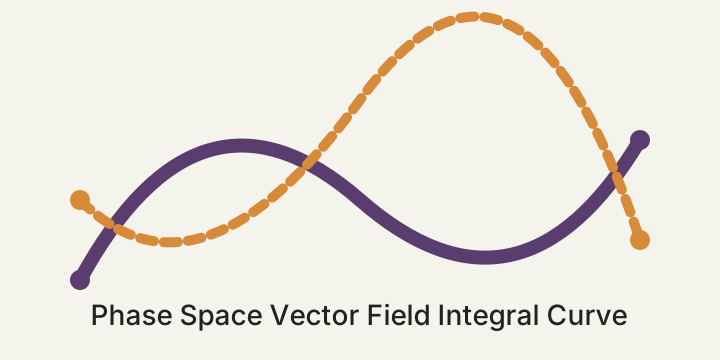
The picture captures three facts together: arrows attach to points, curves are tangent to arrows, and through each starting point passes one and only one curve. The shape of the curves depends only on the arrow pattern.
Worked example [Beginner]
Set up the simplest two-dimensional example: the harmonic oscillator on the plane. Phase space is the plane with coordinates , where is position and is velocity. The vector field is the rule "at the point , the arrow is ."
Step 1. Read off the arrows at four sample points. At the arrow is , pointing straight down. At the arrow is , pointing straight right. At the arrow is , pointing straight up. At the arrow is , pointing straight left.
Step 2. Connect the four arrows. Starting at and following the arrow, the next sample point along the flow is near ; from there the arrow leads near ; from there to ; from there back to . The arrows close into a circle.
Step 3. Check this is an integral curve. The curve has derivative . At the curve's location the vector field gives the arrow . The derivative of the curve matches the arrow at every . The unit circle, traced clockwise, is an integral curve of the vector field.
Step 4. Try a different starting point. From the point the same rule produces a circle of radius traced clockwise: the curve . Every starting point on the plane lies on its own circle (except the origin, where the arrow is the zero arrow and the curve sits still).
What this tells us: the vector field produces nested clockwise circles as integral curves, with the origin as an equilibrium. The harmonic oscillator and the rotating wind pattern share a phase portrait.
Check your understanding [Beginner]
Formal definition [Intermediate+]
Let be open. A vector field on is a map . The vector field is when is -times continuously differentiable; it is smooth () when has continuous derivatives of all orders. The set together with the rule "attach at each " is the phase space of the dynamical system .
An integral curve of through a point is a map , defined on an open interval containing , such that and for every . The integral curve is maximal when its domain cannot be enlarged: any extension with the same equation and initial condition has .
A point is an equilibrium (or fixed point, or singular point) of when . The constant curve is then an integral curve, and it is the unique maximal integral curve through when is locally Lipschitz at .
The vector field on is autonomous because the right-hand side depends on alone, not on . A time-dependent vector field on extends the framework by allowing the rule to drift with ; the standard reduction is to add the variable to phase space and consider the autonomous field on .
Sign and notation conventions
Following Arnold, the vector field is denoted when the dynamical-systems framing is in force; downstream symplectic units write for vector fields on a manifold and reserve for tangent vectors at a single point. The notation uses Newton's overdot for the time derivative. The flow is written (Arnold writes ). Time is one-dimensional and real; complex-time flows belong to a separate unit. All integral curves are parametrised so that is the initial condition.
Counterexamples to common slips
Continuity alone is not enough for uniqueness. The right-hand side on is continuous but not Lipschitz at . Two distinct integral curves pass through the origin: the constant curve and the curve . Lipschitz regularity rules this out; regularity is the standard sufficient condition.
Integral curves can fail to extend to all of . The scalar ODE with initial condition has solution , defined only on . The integral curve runs off to infinity in finite time. Globally defined flows require a hypothesis beyond local existence, such as compactness of the phase space or a linear growth bound on .
The equilibrium is not the only place uniqueness can fail. Wherever the Lipschitz constant of blows up — at cusps, at corners, at points where is only Hölder — non-uniqueness through that point is possible. The standard hypothesis " is " is a uniform safety condition over the whole phase space.
Key theorem with proof [Intermediate+]
Theorem (Picard-Lindelöf, Banach-space form). Let be a Banach space, open, and continuous and locally Lipschitz: every has a neighbourhood and a constant such that for all . For each there exists and a unique curve with and for . [Picard 1890; Lindelöf 1893; Lang Ch. IV]
Proof. Fix . Pick a closed ball on which is bounded by some and Lipschitz with constant . Choose small enough that and . Let , the Banach space of continuous curves valued in the closed ball, equipped with the sup norm . Define the Picard operator by
This integral is the Banach-valued Bochner integral; for finite-dimensional it reduces to the componentwise Riemann integral. The image is continuous because is continuous, hence Bochner-integrable on a compact interval. The image lies in because . So is a self-map on .
The operator is a contraction. For ,
Taking the sup over gives , with by choice of . The space is closed in , hence complete in the inherited sup-norm metric. The Banach fixed-point theorem 02.11.04 gives a unique with , that is,
Differentiating under the integral (legitimate because is continuous) gives and . So is the required integral curve, and uniqueness in rules out any second solution with the same initial condition and the same domain.
For the maximal-domain statement: take the union of all open intervals on which an integral curve through exists. Uniqueness on every overlap glues the local solutions into one solution on the union, which is itself an open interval. This is the maximal integral curve.
Theorem (Flow as a local one-parameter group). Let be for some . There exist an open set containing and a map such that for each the set is the maximal integral-curve domain through , , and is a -diffeomorphism on its natural domain , with wherever both sides are defined. [Arnold §3-§4; Coddington-Levinson Ch. 2; Hartman Ch. V]
Proof. The existence of as a map with and is the previous theorem packaged over all . The group law on the domain where both sides are defined follows from uniqueness: the curve and the curve both satisfy with , so they coincide on the overlap of their domains. The local diffeomorphism property on follows from the group law with .
The regularity of in follows from the implicit function theorem 02.05.04 applied to the Picard operator. Regard the fixed-point equation as a map , . The partial derivative at the fixed-point pair equals . The contraction estimate in operator norm makes this difference invertible by Neumann series; the inverse is bounded. The map is in both arguments because is and integration against a fixed parameter is bounded linear. The implicit function theorem returns a map , hence joint dependence of on . Continuity of as an open subset of follows from the same fixed-point construction applied uniformly on compact subsets of .
Bridge. The Picard-Lindelöf theorem and the flow theorem together build toward every appearance of "vector field" downstream in the curriculum. The foundational reason the local statement holds is the contraction-mapping principle on , packaged from the Banach completeness of 02.11.04: integration smooths, Lipschitz bounds the smoothing constant, and shortening the interval drives the constant below one. This is exactly the same engine that appears again in 02.05.04 (the implicit function theorem), and the smooth-dependence statement is the implicit function theorem applied to the Picard operator. The central insight is that the flow identifies the ODE with an action of on phase space by local diffeomorphisms, putting these together as one geometric object: the dynamical system is the pair (phase space, vector field), and the integral curves and the flow are its derivatives. The bridge is the recognition that this same data of "manifold plus section of the tangent bundle plus flow" generalises to the manifold setting of 03.02.01, and that on a Lagrangian configuration space 05.00.01 the Euler-Lagrange vector field on is the dynamical-systems shadow of variational mechanics.
Exercises [Intermediate+]
Lean formalization [Intermediate+]
Mathlib provides the local existence-uniqueness theorem in Mathlib.Analysis.ODE.PicardLindelof. The relevant pieces:
import Mathlib.Analysis.ODE.PicardLindelof
import Mathlib.Analysis.Calculus.ContDiff.Basic

open scoped Topology

/-- The Picard-Lindelöf local existence theorem (Mathlib name:
    `IsPicardLindelof.exists_forall_mem_closedBall_eq_forall_eq_of`).
    Given a Banach space E, a continuous time-dependent vector field
    v : ℝ → E → E satisfying a uniform Lipschitz condition in x and a
    bound on E, there exists a local C¹ integral curve from each
    initial condition. -/
example {E : Type*} [NormedAddCommGroup E] [NormedSpace ℝ E]
    [CompleteSpace E] (v : ℝ → E → E) (x₀ : E) (L K : ℝ)
    (hL : ∀ t, LipschitzWith L.toNNReal (v t))
    (hbound : ∀ t x, ‖v t x‖ ≤ K) (hcont : Continuous fun p : ℝ × E => v p.1 p.2) :
    ∃ τ > 0, ∃ γ : ℝ → E, γ 0 = x₀ ∧
      ∀ t ∈ Set.Ioo (-τ) τ, HasDerivAt γ (v t (γ t)) t := by
  sorry  -- packaged as IsPicardLindelof in Mathlib
The smooth-dependence statement and the global flow as a local one-parameter group of diffeomorphisms are not yet packaged in Mathlib as named objects. A formal layer would build them from the existing PicardLindelof infrastructure: instantiate the Picard operator as a ContractingWith self-map on C(Icc (-τ) τ, ClosedBall x₀ r), apply ContractingWith.fixedPoint for the local solution, then apply the implicit function theorem to the parameter-dependent Picard operator for smooth dependence on .
The Master-tier generalisation to vector fields on a smooth manifold ( a smooth section of the tangent bundle) is further from Mathlib's current named-theorem surface; Mathlib has the tangent bundle but no packaged flow theorem at the manifold level, and the rectification theorem is absent.
Advanced results [Master]
Theorem (smooth dependence on initial conditions). Let be with . The flow map is in . In particular, is a -diffeomorphism of its domain onto its image , with inverse . [Coddington-Levinson Ch. 2; Hartman Ch. V; Lang Ch. IV]
The proof argument is the implicit-function-theorem application sketched in the key-theorem section: the Picard operator depends on the initial condition, the contraction property makes the implicit-function hypothesis valid, and the inverse function theorem produces dependence of the fixed point on the parameter. The argument is identical to Lang's Ch. IV proof in the Banach-manifold setting; in finite dimensions it reduces to Coddington-Levinson Ch. 2.
Theorem (smooth dependence on parameters). Let be a family of vector fields parametrised by , where is an open subset of a Banach space. The flow of the family is jointly in .
The proof is the smooth-dependence-on-initial-conditions argument with the parameter absorbed into the phase space: extend the phase space to with the autonomous vector field , so that and the flow keeps constant. Smooth dependence on initial conditions in the extended phase space is smooth dependence on the parameter in the original system.
Theorem (rectification theorem; Arnold §7). Let be a vector field on and with . There exists a -diffeomorphism from a neighbourhood of to a neighbourhood of the origin in such that $\Psi_ v = \partial / \partial x_1$, the unit vector field in the first coordinate direction.*
The proof is sketched in Exercise 8: take a hypersurface transverse to at , flow along , and apply the inverse function theorem to identify the flow-out as a coordinate chart. The rectification is the geometric content of the local existence-uniqueness package: away from equilibria, every smooth vector field is locally the same up to diffeomorphism.
Theorem (flow on a compact manifold). Let be a compact smooth manifold and a vector field on (). The flow is defined for all and gives a action of on by diffeomorphisms.
The argument is in Exercise 7: compactness gives a uniform local-existence time ; the group law extends the flow by composition; iteration covers all of . Without compactness, the conclusion fails — the harmonic oscillator with phase space has a global flow, but on does not.
Theorem (linearisation at a hyperbolic equilibrium; Hartman-Grobman). Let be a vector field on with $v(x_) = 0A = Dv(x_*)Ahx_*v\dot y = Ayh \circ \varphi^t = e^{At} \circ h$.*
This is the foundational result on local stability of equilibria. The conjugacy is generic and was proved by Hartman 1960 and Grobman 1959 independently; smooth conjugacy requires additional non-resonance conditions on the eigenvalues (Sternberg's theorem). Hartman-Grobman justifies the practice of classifying equilibria by their linearisation, which is the operational content of "saddle / node / focus" terminology.
Theorem (Poincaré's classification of planar linear systems). The phase portrait of on is classified by the eigenvalues of :
- Two real eigenvalues of the same sign and distinct: improper node, stable if both negative, unstable if both positive. Phase portrait: trajectories tangent to the slow eigenvector at the origin.
- Two real eigenvalues of opposite signs: saddle. Phase portrait: stable manifold along the negative eigenvector, unstable manifold along the positive.
- Complex conjugate pair with : focus (or spiral), stable if , unstable if . Phase portrait: logarithmic spirals.
- Pure imaginary pair : centre. Phase portrait: nested closed orbits.
- Repeated real eigenvalue with one eigenvector: improper node (Jordan block). With two eigenvectors: star node (proper node).
Poincaré's 1881 Mémoire sur les courbes définies par une équation différentielle [Poincaré 1881-1886] introduced this classification together with the qualitative theory of singularities in higher dimensions. The classification is by the eigenvalue structure of alone, so the trace and determinant determine the type: and partition the plane into the cells of the classification. Centres and stars are non-generic; perturbations of a centre become spirals.
Theorem (Peano existence, without uniqueness). Let be continuous (not necessarily Lipschitz). For each there exists at least one integral curve through . Uniqueness may fail. [Peano 1886 *Sull'integrabilità delle equazioni differenziali del primo ordine* — Atti Accad. Sci. Torino 21]
The proof uses the Arzelà-Ascoli theorem on a sequence of polygonal Euler approximations rather than the Banach contraction. The standard counterexample to uniqueness, at , witnesses the gap between continuous and Lipschitz hypotheses: Peano gives at least one solution; Picard-Lindelöf gives exactly one when the additional Lipschitz condition is satisfied.
Theorem (continuation principle and blow-up). Let be a maximal integral curve of a vector field on with . Then either leaves every compact subset of as (escape to the boundary), or as (blow-up to infinity).
This characterisation of finite-time termination is the standard tool for global-existence proofs: if a Lyapunov function or a priori bound rules out both behaviours, the maximal interval is all of . The standard application is the Cauchy-Lipschitz global theorem: if (linear growth), then no integral curve blows up in finite time, and the flow is globally defined.
Synthesis. The foundational reason for the local existence-uniqueness package is the contraction-mapping engine of 02.11.04: integration is a smoothing operation, Lipschitz continuity bounds its smoothing constant, and shortening the time interval drives the contraction constant below one. This is exactly the engine that powers the implicit function theorem 02.05.04, and the smooth-dependence theorem for ODEs is the implicit function theorem applied to the Picard operator on the Banach space of continuous curves. Putting these together, one contraction-mapping framework produces local existence-uniqueness, smooth dependence on initial conditions, smooth dependence on parameters, and the local diffeomorphism structure of the flow as a one-parameter group. The bridge between the Banach-space statement and the manifold statement is the geometric reformulation that identifies a vector field on a smooth manifold with a smooth section of the tangent bundle , and identifies the flow with the action of on by diffeomorphisms generated by . This is exactly the bridge that appears again in 03.02.01 (smooth manifolds) when the tangent bundle is constructed, and in 05.00.01 (Lagrangian mechanics on ) when the Euler-Lagrange equations on are identified with a second-order vector field generating the variational flow.
The qualitative content is dual to the analytic content. Where Picard-Lindelöf gives one solution, Poincaré 1881 gives the phase portrait: the global picture of how all solutions fit together. The four planar linear classes — node, saddle, focus, centre — encode the entire local geometry of a hyperbolic equilibrium, and the Hartman-Grobman theorem says the local nonlinear picture is determined by the local linear picture up to homeomorphism. The qualitative theory is the foundational reason the modern subject of dynamical systems exists as a discipline distinct from "solving differential equations," and the central insight is that the topology of the phase portrait — equilibria, periodic orbits, invariant manifolds, basins of attraction — is invariant under smooth conjugacy, hence is an intrinsic geometric object attached to the vector field, not to its coordinate representation.
Full proof set [Master]
Proposition (Banach contraction proof of Picard-Lindelöf), proof. Given in the Intermediate-tier key-theorem section. The Picard operator on is a contraction with constant , and the Banach fixed-point theorem 02.11.04 produces the unique fixed point as the integral curve.
Proposition (smooth dependence via implicit function theorem), proof. Define by . At a fixed point , the partial is invertible because , with inverse (Neumann series, bounded). The map is in both arguments because is and the integral against a fixed parameter is linear bounded in . The implicit function theorem 02.05.04 applied to at gives a map from a neighbourhood of to . Composing with evaluation at gives the flow as a map in .
Proposition (group law ), proof. Fix and with . The curve satisfies with . The curve satisfies with . Both are integral curves of through the same initial point ; by Picard-Lindelöf uniqueness, they coincide wherever both are defined. The group law holds on the common domain.
Proposition (rectification theorem), proof. Let . Pick coordinates so is the first standard basis vector, and let be the transverse hyperplane through (parametrised by the last coordinates). Define by , with the flow of . Compute : the partial in the -direction is ; the partials in the -directions are the standard basis vectors tangent to at . So and is invertible. The inverse function theorem 02.05.04 gives a inverse from a neighbourhood of to a neighbourhood of . Under this diffeomorphism, the flow on becomes the translation on the coordinate domain, because . The pushforward of under is , so the pullback of under is .
Proposition (global flow on a compact manifold), proof. Cover by finitely many coordinate charts on each of which local Picard-Lindelöf produces a uniform existence time . Let (positive because the cover is finite). For every the maximal integral curve through is defined at least on . By the group law, for any and any , the curve through extends to by iterating: for , with chosen so that . Since this extends for arbitrary , the maximal domain is all of . The flow is jointly by the smooth-dependence theorem applied chart by chart.
Proposition (Hartman-Grobman), stated without proof — see Hartman 1960 On the local linearization of differential equations Proc. AMS 11. The full proof constructs the conjugating homeomorphism as a uniformly bounded solution of a functional equation on a small neighbourhood of the hyperbolic equilibrium, using the contraction-mapping principle on a Banach space of continuous maps. The smoothness gap between the nonlinear flow and the linear flow is real: smooth conjugacy fails generically and requires Sternberg's resonance conditions on the eigenvalues. The statement is generic and is the operational justification for "linearise and read off the type" in stability analysis.
Proposition (Peano existence, polygonal-Euler proof), proof sketch. Given a continuous bounded on , construct polygonal approximations by the Euler scheme on a partition of step . The Euler approximations are uniformly bounded and equicontinuous (the slope of each segment is bounded by ). The Arzelà-Ascoli theorem extracts a uniformly convergent subsequence . The limit satisfies the integral equation by passing to the limit in the Riemann-sum form of the Euler approximations. So is an integral curve; uniqueness is not guaranteed because different subsequences may converge to different limits.
Connections [Master]
Implicit and inverse function theorems
02.05.04. The smooth-dependence theorem for the flow is the implicit function theorem applied to the Picard operator. The rectification theorem is the inverse function theorem applied to the flow-out of a transverse hypersurface. The contraction-mapping engine of the inverse function theorem proof is the same engine that powers the Picard-Lindelöf theorem; the two foundational theorems share an analytic core and are different geometric readings of one analytic fact.Banach spaces
02.11.04. The Picard-Lindelöf theorem is a Banach fixed-point argument on , the space of continuous curves into a Banach space. The completeness of propagates to completeness of in the sup norm, and that is the load-bearing input. The Banach-space form of the existence theorem makes no use of finite-dimensionality and applies directly to ODEs on Hilbert spaces, function spaces, and infinite-dimensional dynamical systems.Smooth manifold
03.02.01. A vector field on a smooth manifold is a smooth section of the tangent bundle . The local Picard-Lindelöf theorem applies chart by chart, and the flow is well-defined globally as a local one-parameter group of diffeomorphisms. The manifold-level statement is the foundational input to symplectic and Hamiltonian mechanics, where the Hamiltonian vector field is a section of on the symplectic manifold .Phase flow / one-parameter group
02.12.02. The local flow produced here is the integrating object whose group-theoretic structure promotes the per-trajectory integral-curve construction to a one-parameter group of local diffeomorphisms. The vector field is the infinitesimal generator ; the flow is its integral. The two units are mutually determined and form the analytic-vs-geometric pair on which every downstream dynamical-systems statement rests.Rectification (straightening) of a vector field
02.12.05. Away from equilibria, the vector field has a canonical local model: in suitable coordinates . The rectifying chart is built from this unit's flow combined with a transverse hypersurface, and its existence is the geometric repackaging of the smooth-dependence theorem. Rectification is where the existence-uniqueness-smooth-dependence triad becomes a single normal-form statement.Lyapunov stability (direct method)
02.12.08. The qualitative theory of equilibria — the points excluded by rectification — is organised by Lyapunov's direct method: a positive-definite function with along trajectories certifies stability of an equilibrium without integrating . This unit's vector-field-on-phase-space framing is the setting in which the orbital derivative is defined and the stability question is posed.Lagrangian mechanics on
05.00.01. The Euler-Lagrange equations on are a second-order ODE; the second-order vector field on is the dynamical-systems shadow of the variational principle, and its flow is the time-evolution of the mechanical system. Phase space, vector field, and integral curve are the analytic structure that underlies the variational formulation. Every classical-mechanics trajectory is an integral curve of .Hamiltonian vector field
05.02.01. The Hamiltonian vector field associated to a function on a symplectic manifold is the unique vector field with . The Hamiltonian flow is the flow of , the symplectic specialisation of the general vector-field flow developed in this unit. Without the underlying vector-field-and-flow framework, has no integral-curve structure to inherit.
Historical & philosophical context [Master]
The existence problem for ordinary differential equations was formulated by Cauchy in the 1820s in his Cours d'analyse de l'École Royale Polytechnique and published in successive forms across the Exercices d'analyse et de physique mathématique of the 1830s and 1840s [Cauchy 1840]. Cauchy's proof of local existence under continuity used a polygonal approximation now called the Euler method: partition the time interval, follow the vector field's value at the current location for one step, then update. The proof was rigorous for right-hand sides and produced both existence and an explicit error bound. Lipschitz 1876 [Lipschitz 1876] identified the weakest regularity hypothesis on — the bound now bearing his name — that guarantees uniqueness, replacing Cauchy's hypothesis with a one-sided modulus condition. Picard 1890 [Picard 1890] and Lindelöf 1893 [Lindelöf 1893] reorganised the existence proof around the iterative scheme , recognising the iteration as a contraction and obtaining uniqueness directly from the contraction property. The Banach fixed-point theorem of 1922 made the contraction-mapping engine explicit and standalone, completing the modern proof structure.
The qualitative perspective is Poincaré's. Poincaré's four-part Mémoire sur les courbes définies par une équation différentielle in the Journal de Mathématiques Pures et Appliquées across 1881-1886 [Poincaré 1881-1886] inverted the framing: rather than solve the equation, study the phase portrait. The classification of planar singularities — node, saddle, focus, centre — is from this memoir, as is the index theory of vector fields on surfaces. Lyapunov's 1892 thesis Problème général de la stabilité du mouvement [Lyapunov 1892] introduced the direct method for stability via energy-like functions decreasing along trajectories. Birkhoff's 1927 Dynamical Systems [Birkhoff 1927] consolidated the qualitative theory into a textbook, and the modern subject of dynamical systems descends from this tradition through Smale, Anosov, and Arnold. Arnold's 1973 Ordinary Differential Equations [Arnold 1973] is the contemporary canonical exposition: phase space, vector field, integral curve, and flow are primitive; the existence-uniqueness theorem is deferred to Chapter 4 so the reader sees the qualitative content first.
The geometric perspective was completed in the manifold framework. A vector field on a smooth manifold is a section of the tangent bundle, and its integral curves are constructed chart by chart from the Euclidean theorem. The flow is a local action of by diffeomorphisms; on a compact manifold the flow is global. This is the framework Arnold adopts in Chapter 5 of Ordinary Differential Equations and develops in his Mathematical Methods of Classical Mechanics (Springer GTM 60, 2nd ed. 1989) [Arnold 1989], and it is the analytic substrate of every modern treatment of symplectic geometry, Hamiltonian dynamics, and geometric mechanics.
Bibliography [Master]
@book{Arnold1992ODE,
  author    = {Arnold, Vladimir I.},
  title     = {Ordinary Differential Equations},
  edition   = {3},
  publisher = {Springer-Verlag},
  series    = {Springer Textbook},
  year      = {1992},
  note      = {Translated from the Russian by Roger Cooke; ISBN 3-540-54813-0}
}

@book{Arnold1989Mechanics,
  author    = {Arnold, Vladimir I.},
  title     = {Mathematical Methods of Classical Mechanics},
  edition   = {2},
  publisher = {Springer-Verlag},
  series    = {Graduate Texts in Mathematics},
  volume    = {60},
  year      = {1989}
}

@article{Cauchy1840Memoire,
  author  = {Cauchy, Augustin-Louis},
  title   = {M{\'e}moire sur l'int{\'e}gration des {\'e}quations diff{\'e}rentielles},
  journal = {Exercices d'analyse et de physique math{\'e}matique},
  volume  = {1},
  year    = {1840},
  pages   = {327--361}
}

@article{Lipschitz1876,
  author  = {Lipschitz, Rudolf},
  title   = {Sur la possibilit{\'e} d'int{\'e}grer compl{\`e}tement un syst{\`e}me donn{\'e} d'{\'e}quations diff{\'e}rentielles},
  journal = {Bulletin des Sciences Math{\'e}matiques et Astronomiques},
  volume  = {10},
  year    = {1876},
  pages   = {149--159}
}

@article{Picard1890,
  author  = {Picard, {\'E}mile},
  title   = {M{\'e}moire sur la th{\'e}orie des {\'e}quations aux d{\'e}riv{\'e}es partielles et la m{\'e}thode des approximations successives},
  journal = {Journal de Math{\'e}matiques Pures et Appliqu{\'e}es},
  series  = {4},
  volume  = {6},
  year    = {1890},
  pages   = {145--210}
}

@article{Lindelof1893,
  author  = {Lindel{\"o}f, Ernst},
  title   = {Sur l'application de la m{\'e}thode des approximations successives aux {\'e}quations diff{\'e}rentielles ordinaires du premier ordre},
  journal = {Comptes Rendus de l'Acad{\'e}mie des Sciences (Paris)},
  volume  = {116},
  year    = {1893},
  pages   = {454--457}
}

@article{Poincare1881,
  author  = {Poincar{\'e}, Henri},
  title   = {M{\'e}moire sur les courbes d{\'e}finies par une {\'e}quation diff{\'e}rentielle},
  journal = {Journal de Math{\'e}matiques Pures et Appliqu{\'e}es},
  series  = {3},
  volume  = {7-8, (4) 1-2},
  year    = {1881--1886},
  pages   = {375--422; 251--296; 167--244; 151--217}
}

@book{Lyapunov1892,
  author    = {Lyapunov, Aleksandr M.},
  title     = {Probl{\`e}me g{\'e}n{\'e}ral de la stabilit{\'e} du mouvement},
  publisher = {Kharkov Mathematical Society},
  year      = {1892},
  note      = {French translation: Princeton University Press, Annals of Mathematics Studies 17, 1947}
}

@book{Birkhoff1927,
  author    = {Birkhoff, George D.},
  title     = {Dynamical Systems},
  publisher = {American Mathematical Society},
  series    = {Colloquium Publications},
  volume    = {9},
  year      = {1927}
}

@book{CoddingtonLevinson1955,
  author    = {Coddington, Earl A. and Levinson, Norman},
  title     = {Theory of Ordinary Differential Equations},
  publisher = {McGraw-Hill},
  year      = {1955}
}

@book{Hartman2002ODE,
  author    = {Hartman, Philip},
  title     = {Ordinary Differential Equations},
  edition   = {2},
  publisher = {SIAM},
  series    = {Classics in Applied Mathematics},
  volume    = {38},
  year      = {2002}
}

@book{Lang1995DiffRiem,
  author    = {Lang, Serge},
  title     = {Differential and Riemannian Manifolds},
  edition   = {3},
  publisher = {Springer-Verlag},
  series    = {Graduate Texts in Mathematics},
  volume    = {160},
  year      = {1995}
}

@book{HirschSmaleDevaney2013,
  author    = {Hirsch, Morris W. and Smale, Stephen and Devaney, Robert L.},
  title     = {Differential Equations, Dynamical Systems, and an Introduction to Chaos},
  edition   = {3},
  publisher = {Academic Press},
  year      = {2013}
}

@article{Hartman1960Linearization,
  author  = {Hartman, Philip},
  title   = {On the local linearization of differential equations},
  journal = {Proceedings of the American Mathematical Society},
  volume  = {11},
  year    = {1960},
  pages   = {610--620}
}

@article{Grobman1959,
  author  = {Grobman, David M.},
  title   = {Homeomorphisms of systems of differential equations},
  journal = {Doklady Akademii Nauk SSSR},
  volume  = {128},
  year    = {1959},
  pages   = {880--881}
}

@article{Peano1886,
  author  = {Peano, Giuseppe},
  title   = {Sull'integrabilit{\`a} delle equazioni differenziali del primo ordine},
  journal = {Atti della Reale Accademia delle Scienze di Torino},
  volume  = {21},
  year    = {1886},
  pages   = {677--685}
}