Phase flow / one-parameter group
Anchor (Master): Arnold *Ordinary Differential Equations* (1973) §4 and §32 (originator pedagogical treatment of the phase-flow / one-parameter-group viewpoint); Hartman *Ordinary Differential Equations* Ch. II–V; Lang *Differential and Riemannian Manifolds* Ch. IV; Cauchy 1820s lectures (originator existence theory); Lie 1880s *Theorie der Transformationsgruppen* (originator one-parameter group viewpoint); Poincaré 1881–1886 *Mémoire sur les courbes définies par une équation différentielle* (originator qualitative dynamics)
Intuition [Beginner]
Imagine a flowing fluid filling a room. Every speck of dust placed in the fluid drifts along a definite path, carried by the local current at every instant. After one second, the dust at position has moved to a new position; after two seconds, it has moved again. The map sending each starting position to its position after time is the flow at time . The whole collection of these maps, one for each , is the phase flow.
Two rules are built into this picture. First, at time zero nothing has moved: every point sits exactly where it started. Second, if you let the fluid run for seconds and then for another seconds, the total motion is the same as running it for seconds in one go. These two rules are the one-parameter group axioms. They turn the family of time- maps into a copy of the additive real line acting on the room.
Why does this matter? Solving a differential equation is the same as finding the flow of its associated vector field. Once you have the flow, you have every solution at once — one for each starting point. The flow is the geometric object that organises every trajectory of the system into a single coherent picture.
Visual [Beginner]
A schematic showing a region of the plane with a vector field drawn as small arrows on a grid. A point is marked with the dot at its position, and three trajectories are drawn through : the path the point follows for , for , and for time units, each ending at a new dot. Labels indicate , , and . A second trajectory through a nearby point shows that the flow moves every point simultaneously.
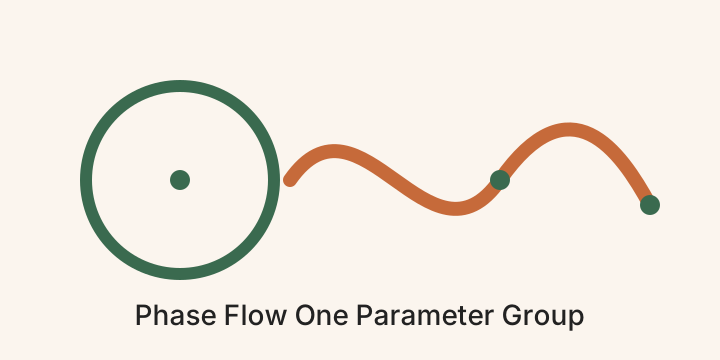
The picture captures the essential geometry: a vector field assigns a direction at every point, and the flow at time moves every point along the trajectory it would follow under that direction field for units of time. The same picture in higher dimensions replaces the plane with or a smooth manifold and the arrows with tangent vectors.
Worked example [Beginner]
Compute the phase flow of the linear vector field on the plane, and check that it satisfies the one-parameter group axioms.
Step 1. The vector field assigns the vector at the point . At the vector is , pointing up. At the vector is , pointing left. The arrows curl around the origin.
Step 2. A particle starting at has its position satisfying the system , , with starting values , . Differentiating again, , so and . The particle moves along the unit circle counterclockwise at unit speed.
Step 3. A particle starting at a general point moves to . This is the rotation of by angle around the origin. So the time- map is .
Step 4. Check the identity at time zero: . Every point sits where it started. The first group axiom is verified.
Step 5. Check the composition rule. Apply then , or apply directly. The composition is rotation by followed by rotation by , which is rotation by . The matrix identity is the angle-addition formula for sine and cosine. The second group axiom is verified.
What this tells us: the flow of the rotation vector field is the family of rotation maps, parameterised by the rotation angle. The two group axioms are the geometric statements "no rotation at time zero" and "rotation by then by equals rotation by ". Every linear vector field has a flow built the same way, using the matrix exponential in place of the rotation matrix.
Check your understanding [Beginner]
Formal definition [Intermediate+]
Let be a smooth manifold and a vector field on . An integral curve of through a point is a map on an open interval with , , and for every .
The local flow of at is a map on an open product neighbourhood of inside such that for each the map is the integral curve of through . We write for the time- map. The flow is smooth if is smooth.
The vector field is complete if every integral curve extends to all of . For a complete vector field, the flow is a globally defined family of diffeomorphisms of satisfying the one-parameter group axioms:
A complete smooth vector field on thereby gives a group homomorphism , , which is what the notation records: the flow is the one-parameter group generated by .
For a general vector field (not assumed complete), the maximal interval of existence at each is the union of all open intervals on which an integral curve through is defined. Uniqueness implies is itself an open interval with , carrying a unique maximal integral curve. The flow domain is the open subset $$ \mathcal{D}(X) = {(t, p) \in \mathbb{R} \times M : t \in I_{\max}(p)} $$ and the flow is the map assembled from all the maximal integral curves. The one-parameter-group identity holds in the form whenever both sides are defined.
A sign convention. Throughout, we use Arnold's convention: rather than . The opposite sign appears in some references (notably descent flows in optimisation) and reverses the direction of every trajectory; the group identity is unaffected.
Counterexamples to common slips
- Incompleteness from finite-time blow-up. The scalar field on has integral curves , defined only for when . The flow is not global; the trajectory escapes to infinity in finite forward time. The vector field is not complete, the one-parameter group identity fails for that push past the blow-up time, and the flow domain is a proper open subset of .
- Non-uniqueness from sub-Lipschitz regularity. The field on admits two integral curves through : the constant curve and the curve for extended by zero for . The field is continuous but not Lipschitz at the origin, and the existence theorem does not give uniqueness. The flow is not well-defined.
- Flow domain is not always a product. For a non-complete vector field, in general, but is always open in and contains . The temptation to write the flow as for every fails for non-complete fields; the correct statement is that is defined on the open subset , which may be empty for large.
Key theorem with proof [Intermediate+]
Theorem (local flow of a vector field). Let be a vector field on an open subset and let . There exist , an open neighbourhood of , and a unique map $$ \varphi : (-\varepsilon, \varepsilon) \times U \to U_0 $$ such that for every and every , $$ \partial_t \varphi(t, x) = X(\varphi(t, x)), \qquad \varphi(0, x) = x. $$ Moreover, if is then is ; if is smooth, is smooth. The local one-parameter group identity holds whenever and .
Proof. The argument has three steps: a contraction-mapping construction of the integral curve at each point (Picard-Lindelöf), continuous and differentiable dependence on the initial condition , and the group identity from uniqueness.
Step 1: Picard iteration at a single point. Choose a closed ball and let , Lipschitz constant of on (finite since is on a compact set). Pick and . For , consider the Banach space with the sup norm, and the closed subset . The integral operator $$ (T_x \gamma)(t) = x + \int_0^t X(\gamma(s)) , ds $$ maps into itself (since ) and is a contraction with constant on : $$ |T_x \gamma_1 - T_x \gamma_2|\infty \leq \varepsilon L |\gamma_1 - \gamma_2|\infty. $$ The Banach contraction principle gives a unique fixed point . Differentiating the fixed-point equation in gives , . So is the unique integral curve of through on .
Step 2: dependence on . Define on . The fixed-point construction depends continuously on because the operator depends continuously on (as a map from the ball into the Banach space of operators on , with the operator norm bounded uniformly by ); continuity of fixed points in a contraction parameter is a standard consequence of the uniform-contraction estimate. So is jointly continuous in .
For dependence: the formal variational equation with initial condition is itself a linear ODE in the variable . Linear ODEs with continuous coefficients admit unique continuous solutions on any compact -interval. The candidate solution obtained from this linear ODE matches the difference quotient in the limit uniformly in , by a Grönwall-inequality estimate on the deviation. So exists and equals , which is continuous in . The temporal derivative is continuous because is continuous and is continuous. So is on . Iterating the variational argument with of class yields of class (Hartman Ch. V).
Step 3: the group identity. Fix and with and . The curve and the curve both satisfy with . Uniqueness (Step 1) gives for . Setting proves the identity in the stated range. Setting shows is invertible with inverse , hence is a diffeomorphism onto its image. This finishes the proof.
Bridge. The local flow theorem builds toward every dynamical-systems statement that treats a vector field and its trajectories as a coherent geometric object rather than a per-point family of curves. The foundational reason the construction works is exactly the Banach contraction principle applied to the Picard integral operator: a vector field gives a Lipschitz integrand, and the contraction principle then yields existence, uniqueness, and continuous dependence in one stroke. The bridge is the identification of the time- map with an element of the local diffeomorphism group, parameterised by . This is exactly the local one-parameter-group structure that appears again in 03.02.01 (smooth manifold), where the same theorem on patches across coordinate charts via the chain rule 02.05.03 to give a coordinate-independent flow on a manifold. Putting these together, a vector field on a smooth manifold has a local flow that is itself a map of one parameter more derivative than the field allows, and the group identity propagates through the patching. The central insight is that solving a differential equation and constructing its flow are the same task viewed from two angles, and the flow is the natural object: it identifies the time evolution of every trajectory with a single map of the phase space to itself.
Exercises [Intermediate+]
Advanced results [Master]
Theorem (maximal interval of existence and blow-up alternative). Let be a vector field on an open set and let . The integral curve extends to a unique maximal solution on an open interval . If , then for every compact there exists such that for every . Equivalently, the trajectory leaves every compact subset of in forward time. The symmetric statement holds at .
The dichotomy is sharp: either the solution exists for all forward time (and similarly for all backward time), or it escapes every compact set. For a manifold without boundary, "leaves every compact set" includes the possibility of approaching the topological boundary or running off to infinity in any compactification. For the standard equation on , the trajectory escapes to in finite forward time, illustrating the blow-up branch of the alternative.
Theorem (smooth dependence on initial conditions and parameters). Let be a family of vector fields on depending -smoothly on a parameter in an open subset of . The flow on its open domain is jointly in . In particular the variational equation $$ \frac{d}{dt} D_x \varphi(t, x, \lambda) = DX_\lambda(\varphi(t, x, \lambda)) \cdot D_x \varphi(t, x, \lambda), \quad D_x \varphi(0, x, \lambda) = I_n, $$ is itself a linear ODE for the Jacobian and admits a unique global solution on .
The smooth-dependence theorem is the analytic backbone of every linearisation argument in dynamical systems, from Hartman-Grobman to Floquet to KAM. The variational equation linearises the flow around a chosen trajectory; its solution is the fundamental matrix of the linearisation, and the question of whether neighbouring trajectories converge or diverge is a question about the spectrum of the fundamental matrix at long times.
Theorem (linear flow / matrix exponential). For the constant-coefficient linear system on with , the flow is given by the matrix exponential $$ \varphi^t(z) = e^{tA} z = \sum_{k = 0}^\infty \frac{t^k A^k}{k!} z, $$ the series converging absolutely in operator norm for every . The one-parameter group identity holds for all , so is complete and is a group homomorphism .
The structure of the linear flow is read from the spectrum of . For a saddle , the flow on is , with two invariant lines (the eigenspaces) along which the flow contracts or expands exponentially and hyperbolic orbits filling the complement. For a rotation , the flow is , with circular orbits and no fixed direction other than the origin. The classification of two-dimensional linear flows by the trace-determinant plane — node, focus, saddle, centre, degenerate cases — is read off from the eigenvalues of and is the linear-systems substrate underlying the Hartman-Grobman classification of hyperbolic equilibria of nonlinear systems.
Theorem (flow as a one-parameter subgroup of ). A complete vector field on a smooth manifold , with , generates a group homomorphism $$ \Phi : \mathbb{R} \to \mathrm{Diff}^k(M), \qquad t \mapsto \varphi^t. $$ The map is continuous with respect to the -topology on , and its infinitesimal generator at is recovered by .
The identification of a complete vector field with a one-parameter subgroup of the diffeomorphism group is the foundation of Lie's programme [Lie 1888–1893]: the infinitesimal generator of a one-parameter family of transformations is a vector field, and every vector field with global flow generates such a family. The matrix exponential of the linear case generalises to the exponential map of a Lie group with Lie algebra , defined exactly as the time-1 value of the flow of the left-invariant vector field whose value at the identity is the given algebra element.
Theorem (rectification / straightening). Let be a vector field on and a point with . There exists a diffeomorphism from a neighbourhood of onto a neighbourhood of the origin in such that $\Psi_ X = \partial_1Xp$ is straight-line motion at unit speed in suitable coordinates.*
The rectification theorem is the qualitative complement to the local flow theorem: away from equilibria, every vector field looks locally like the constant vector field , and the flow looks like translation. The proof is to take any local transversal hypersurface to at , parametrise it by coordinates on , and let where is the coordinate map of . The inverse function theorem applied to the differential of this map at (which is invertible by transversality) gives the rectifying diffeomorphism.
Theorem (Liouville for the flow of a divergence-free field). If is a vector field on an open subset with , the flow preserves Lebesgue measure: for every measurable in the flow domain, .
This is the special case of Liouville's theorem from Hamiltonian mechanics that applies to any divergence-free flow on Euclidean space. The proof differentiates in and uses the variational equation to identify . Volume preservation is the geometric content of incompressibility and is the substrate underlying the Poincaré recurrence theorem.
Synthesis. The phase flow is the foundational reason the per-point study of ordinary differential equations rises to a study of group actions on phase space. The central insight is that a vector field on a manifold determines, and is determined by, its local flow: the flow is the infinitesimal generator's integral, and the generator is the flow's -derivative at . The bridge is that the one-parameter group axioms and promote the family of time- maps from an unstructured collection of functions to a homomorphism . Putting these together, the phase flow identifies the analytic problem of solving an initial-value problem with the geometric problem of constructing the integral curves of a vector field, and identifies the latter with the algebraic problem of constructing a one-parameter subgroup of the diffeomorphism group of the phase space.
The four classical statements of the theory — local flow, smooth dependence, maximal interval with blow-up alternative, and rectification — together produce one coherent picture: every smooth vector field has a local flow that is itself smooth in time and initial condition, the flow extends until trajectories leave every compact set, and the flow is straight-line motion in coordinates adapted to the field away from equilibria. This is exactly the structure that generalises to flows on Banach spaces (semigroup theory of evolution equations), to flows on infinite-dimensional manifolds (Euler equations of incompressible fluids as geodesics on ), and to flows on Lie groups (the exponential map and Cartan-Killing form). The phase flow appears again in 05.00.01 (Lagrangian on ), where the Euler-Lagrange equations of a Lagrangian on the tangent bundle generate a flow on whose time-evolution is the Hamilton-equivalent flow on , and the phase-space formulation of mechanics is the recognition that classical dynamics is the study of the phase flow of a specific natural vector field on .
The phase-flow framework identifies several pairings that look distinct on first inspection. The Picard-Lindelöf existence theorem is the flow at the level of a single trajectory; the local flow theorem is the same construction made joint in ; the smooth-dependence theorem is the same construction with derivatives in the initial condition added; the variational equation is the time-derivative of the smooth-dependence map. Each upgrade adds one structural layer to the same underlying contraction-mapping fixed point. The matrix exponential is the linear case, where the flow can be written in closed form, and the spectrum of the generator classifies the asymptotic behaviour of every orbit. The rectification theorem is the local normal form: away from equilibria, the flow has no structure beyond translation, and all genuine dynamics happens at the equilibria themselves and at the recurrence sets like periodic orbits, heteroclinic chains, and invariant tori that interpolate between them.
Full proof set [Master]
Proposition (one-parameter group axioms for a complete vector field). Let be a complete vector field on a manifold with global flow . The maps satisfy $$ \varphi^0 = \mathrm{id}_M, \qquad \varphi^{s + t} = \varphi^s \circ \varphi^t \quad \text{for all } s, t \in \mathbb{R}. $$ Each is a diffeomorphism with -inverse when is , and is a group homomorphism .
Proof. First axiom. By definition for every , so .
Second axiom. Fix and . Consider two curves in :
- , defined for by completeness,
- , defined for by completeness.
Both satisfy the initial-value problem , : for , , with ; for , , with . By uniqueness of solutions (Picard-Lindelöf), on all of . Setting gives . Since was arbitrary, .
Diffeomorphism. Setting in the second axiom gives ; symmetrically . So has as two-sided inverse. The smoothness implies for every fixed , with inverse . So each is a diffeomorphism, and is a group homomorphism .
Proposition (blow-up alternative). Let be a vector field on an open set . For each , the maximal forward existence time is the supremum of times for which an integral curve through exists. If , then for every compact there exists with for all .
Proof. Suppose and, for contradiction, that there exists a compact and a sequence with for every . By compactness, pass to a subsequence with . The local flow theorem applied at produces an and a neighbourhood such that for every the integral curve through exists on . For large, and , so the integral curve through extends to the interval . But , contradicting the definition of as the supremum. The contradiction shows that no such compact exists, and the trajectory leaves every compact subset of as . The symmetric argument handles .
Proposition (matrix exponential and the linear flow). For , the series converges absolutely in operator norm for every , defines a map , , satisfies the differential equation , and is the flow of the linear vector field . The group identity holds for all .
Proof. Convergence. For the operator norm , , so the series of operator norms is dominated by . Absolute convergence in operator norm follows. The map is therefore well-defined, and because each truncation is a polynomial in and the tail vanishes uniformly on every compact -interval.
Derivative. Term-by-term differentiation of the series gives . The equality follows because commutes with every power of itself.
Flow property. The curve satisfies and . So is the integral curve of through , and the flow of is .
Group identity. The scalar-multiple matrices and commute since they are scalar multiples of . For commuting matrices the binomial theorem holds, and substituting into the exponential series with , and rearranging the absolutely convergent double series yields . Hence . The values and confirm that takes values in , and the homomorphism property is the group identity.
Proposition (rectification of a non-vanishing vector field). Let be a vector field on with at some . There exists a diffeomorphism from a neighbourhood of onto a neighbourhood of such that $\Psi^ X = \partial_1\Psi$-coordinates.*
Proof. By a preliminary linear change of coordinates, arrange , the first standard basis vector. Let be the affine hyperplane through transverse to ; parametrise by near via . Define
$$
\Psi(t, x_2, \ldots, x_n) = \varphi^t(\sigma(x_2, \ldots, x_n))
$$
on a small neighbourhood of in . By the local flow theorem, is . At the origin, the differential of sends and for (since and the differential of on is the natural inclusion). So is the identity, hence invertible. By the inverse function theorem 02.05.04, is a local diffeomorphism. By construction, the -curve is the integral curve of through , so , equivalently .
Proposition (Liouville for divergence-free fields). If is a vector field on an open subset with , the flow preserves Lebesgue measure on the flow domain.
Proof. Let be compact and let be small enough that . By change of variables, $$ \mathrm{Leb}(\varphi^t(A)) = \int_A |\det D_x \varphi^t(x)| , dx. $$ Set . From the variational equation and Jacobi's formula applied to : $$ \partial_t \log |J(t, x)| = \mathrm{tr}\big(D_x \varphi^t(x)^{-1} \cdot DX(\varphi^t(x)) \cdot D_x \varphi^t(x)\big) = \mathrm{tr}(DX(\varphi^t(x))) = \mathrm{div}, X(\varphi^t(x)) = 0. $$ So is constant in for each , and at , . Hence for all in the flow domain. Substituting back, . Extending from compact to general measurable by inner regularity completes the argument.
Connections [Master]
Vector field foundations
02.12.01. The phase flow of a vector field on a manifold is the geometric incarnation of the assignment : every trajectory of is a flow line, and the time- map packages every trajectory at time into a single map of the phase space. The two objects are mutually determined: recovers the vector field as the infinitesimal generator of the flow, and the integral-curve construction recovers the flow from the field.Smooth manifold
03.02.01. The local flow theorem is stated on , but its conclusions are coordinate-independent: the time- map is a diffeomorphism that patches across charts because the integral-curve construction commutes with the chain rule02.05.03. The flow of a vector field on a smooth manifold is therefore a map on an open subset of , and the one-parameter group identity holds wherever both sides are defined.Lagrangian on
05.00.01. Classical mechanics in Lagrangian form is the study of the phase flow of a specific vector field on the tangent bundle of configuration space, generated by the Euler-Lagrange equations of the Lagrangian . The Legendre transform sends this flow to the Hamiltonian flow on the cotangent bundle , where the symplectic structure organises the dynamics through Hamilton's equations. The phase-flow viewpoint of this unit is the unifying notion: classical dynamics, geodesic flow, rigid-body motion, the Kepler problem are all instances of the same construction.Implicit and inverse function theorems
02.05.04. The existence-and-uniqueness argument for the local flow is a Banach-fixed-point construction that shares its analytic engine with the inverse function theorem: a Lipschitz right-hand side gives a contractive integral operator on a closed ball of curves, and the unique fixed point is the integral curve. The smooth-dependence theorem similarly uses the inverse function theorem in the form of the implicit function theorem applied to the linearised flow equation.Multivariable chain rule
02.05.03. Patching the local flow across overlapping charts of a manifold uses the chain rule to relate the time derivative in one chart to the time derivative in another. The variational equation is itself a chain-rule statement: differentiating the integral-curve equation in the spatial variable produces the linearisation of the flow around each trajectory.Rectification (straightening) of a vector field
02.12.05. The rectification theorem is the local normal form of the phase flow: away from equilibria, the flow combined with a transverse section assembles into a chart in which the field is the constant unit translation , so every trajectory becomes a horizontal line moving rightward at unit speed. The smooth-dependence theorem proved here is exactly the analytic input that makes the rectifying chart a local diffeomorphism by the inverse function theorem. Rectification is the geometric repackaging of the local flow theorem; the two units describe the same data, one as a dynamical object and one as a geometric normal form.Lyapunov stability (direct method)
02.12.08. The asymptotic-stability conclusion in Lyapunov's theorem is convergence under the forward flow generated here, and the orbital derivative that drives the proof is the -derivative of . The sub-level set is forward-invariant under precisely because is the flow generated by the vector field on which the sign condition is imposed. Without the one-parameter group assembled in this unit, Lyapunov's argument has no time-evolution to track.
Historical & philosophical context [Master]
Cauchy lectured on the existence theory for ordinary differential equations at the École Royale Polytechnique in the 1820s, introducing the polygonal construction (now called the Cauchy-Euler method) that gives the first rigorous existence proof under continuity hypotheses; the lectures were published posthumously in his Œuvres Complètes (Sér. 2) [pending]. Cauchy's proof produced a single solution on a small time interval; the flow as a -family of maps was implicit but not named. The contraction-mapping refinement, which gives existence, uniqueness, and continuous dependence in one stroke, was developed by Picard in 1890 (J. Math. Pures Appl. (4) 6, 145–210) [pending] and refined by Lindelöf in 1894 (Comptes Rendus Acad. Sci. 116) [pending]; their combined treatment is what every modern textbook calls the Picard-Lindelöf theorem.
The identification of a vector field with the one-parameter group of transformations it generates is due to Sophus Lie. His three-volume Theorie der Transformationsgruppen (1888–1893) [pending] introduced the systematic study of continuous transformation groups via their infinitesimal generators — a smooth vector field is the derivative at the identity of a one-parameter family of transformations, and the family is recovered as the flow of . Lie's programme reframed the integration of differential equations as the study of their symmetry groups, and the language of one-parameter groups became the foundational vocabulary of what later became Lie theory, the theory of Lie groups, and the theory of Lie algebras. The notation used by Arnold in Ordinary Differential Equations (1973) [pending] is a direct descendant of Lie's for the one-parameter group of a vector field.
Poincaré's four-part Mémoire sur les courbes définies par une équation différentielle (J. Math. Pures Appl., 1881–1886) [pending] initiated the qualitative theory of differential equations: instead of seeking closed-form solutions, study the topological structure of the phase portrait — the equilibria, periodic orbits, recurrence sets, and asymptotic behaviour of trajectories. The phase flow is the central object of Poincaré's theory, and questions about long-time behaviour become questions about the dynamical system given by the flow. The Poincaré recurrence theorem, the Poincaré-Bendixson theorem, the index theory of critical points, and the study of homoclinic and heteroclinic orbits are all formulated in terms of properties of the flow. Arnold's 1973 textbook Ordinary Differential Equations synthesised the Cauchy-Picard analytic tradition with the Lie geometric tradition and the Poincaré qualitative tradition into a single coherent presentation centred on the phase flow as the principal object of study, an organisational choice that has shaped every subsequent textbook on the subject. The viewpoint reframes the entire field: a differential equation is not a relation to be solved for a function but a vector field on a phase space, and the object of interest is the family of diffeomorphisms it generates.
Bibliography [Master]
@book{Arnold1992ODE,
  author    = {Arnold, Vladimir I.},
  title     = {Ordinary Differential Equations},
  publisher = {Springer-Verlag},
  edition   = {3},
  year      = {1992},
  note      = {English translation of the 1984 Russian edition; the canonical pedagogical source for the phase-flow viewpoint}
}

@book{Hartman2002ODE,
  author    = {Hartman, Philip},
  title     = {Ordinary Differential Equations},
  publisher = {SIAM},
  edition   = {2},
  year      = {2002},
  note      = {Reissue of the 1964 Wiley original}
}

@book{HirschSmaleDevaney2004,
  author    = {Hirsch, Morris W. and Smale, Stephen and Devaney, Robert L.},
  title     = {Differential Equations, Dynamical Systems, and an Introduction to Chaos},
  publisher = {Academic Press},
  edition   = {2},
  year      = {2004}
}

@book{Lang1995DiffRiem,
  author    = {Lang, Serge},
  title     = {Differential and Riemannian Manifolds},
  publisher = {Springer-Verlag},
  series    = {Graduate Texts in Mathematics},
  volume    = {160},
  year      = {1995}
}

@book{Lie1888TransGruppen,
  author    = {Lie, Sophus},
  title     = {Theorie der Transformationsgruppen, B\"ande I--III},
  publisher = {Teubner, Leipzig},
  year      = {1888--1893},
  note      = {Originator of the one-parameter-group viewpoint; vector fields as infinitesimal generators of continuous transformation groups}
}

@article{Poincare1881Memoire,
  author  = {Poincar{\'e}, Henri},
  title   = {M{\'e}moire sur les courbes d{\'e}finies par une {\'e}quation diff{\'e}rentielle},
  journal = {Journal de Math{\'e}matiques Pures et Appliqu{\'e}es},
  series  = {3{\`e}me s{\'e}rie},
  volume  = {7--8 \& 4{\`e}me s{\'e}rie 1--2},
  year    = {1881--1886},
  note    = {Four-part memoir, originator of the qualitative theory of dynamical systems}
}

@article{Picard1890,
  author  = {Picard, {\'E}mile},
  title   = {M{\'e}moire sur la th{\'e}orie des {\'e}quations aux d{\'e}riv{\'e}es partielles et la m{\'e}thode des approximations successives},
  journal = {Journal de Math{\'e}matiques Pures et Appliqu{\'e}es},
  series  = {4{\`e}me s{\'e}rie},
  volume  = {6},
  year    = {1890},
  pages   = {145--210}
}

@article{Lindelof1894,
  author  = {Lindel{\"o}f, Ernst},
  title   = {Sur l'application de la m{\'e}thode des approximations successives aux {\'e}quations diff{\'e}rentielles ordinaires du premier ordre},
  journal = {Comptes Rendus de l'Acad{\'e}mie des Sciences},
  volume  = {116},
  year    = {1894},
  pages   = {454--457}
}

@book{CauchyOeuvres,
  author    = {Cauchy, Augustin-Louis},
  title     = {{\OE}uvres Compl{\`e}tes, S{\'e}rie 2},
  publisher = {Gauthier-Villars, Paris},
  year      = {1899--1932},
  note      = {Posthumous publication of the 1820s {\'E}cole Polytechnique lectures introducing the polygonal existence proof for ODE}
}

@book{Banach1922,
  author    = {Banach, Stefan},
  title     = {Sur les op{\'e}rations dans les ensembles abstraits et leur application aux {\'e}quations int{\'e}grales},
  publisher = {Fundamenta Mathematicae},
  volume    = {3},
  year      = {1922},
  pages     = {133--181},
  note      = {Contraction-mapping principle as an abstract tool, underpinning the modern Picard-Lindel{\"o}f proof}
}

@book{AbrahamMarsdenFoundations,
  author    = {Abraham, Ralph and Marsden, Jerrold E.},
  title     = {Foundations of Mechanics},
  publisher = {Benjamin/Cummings},
  edition   = {2},
  year      = {1978},
  note      = {Phase flow as a Hamiltonian-flow on the cotangent bundle; the geometric mechanics viewpoint}
}