Rectification (straightening) of a vector field
Anchor (Master): Arnold *Ordinary Differential Equations* Ch.2 §7 + Ch.4 §31 (the flow-box theorem as the geometric form of existence-uniqueness-smooth-dependence); Hartman *Ordinary Differential Equations* Ch. IV §1 (smoothing-the-flow-by-the-transverse-section construction with full Banach-space generality); Lang *Differential Manifolds* Ch. IV §2 (flow-box theorem on a smooth manifold); Hörmander *The Analysis of Linear Partial Differential Operators* Vol. I §8.1 (rectification as the gateway to the method of characteristics for first-order PDEs)
Intuition [Beginner]
A flowing river has currents that swirl, slow down, and speed up. But if you zoom in on a single point in the middle of the river where the water is moving — not stuck in an eddy and not stalled at the bank — the local flow looks like uniform motion along straight parallel lines. Pick the right coordinate system aligned to the current direction at that point, and locally the flow becomes "everything moves rightward at unit speed". The rectification theorem is the precise statement that every smooth vector field looks like this near any point where the field is non-zero.
The picture is geometric. Draw a small surface through your chosen point, transverse to the flow direction. Each starting point on this surface, when carried by the flow for various small times, traces out a curve. The two coordinates "starting point on the surface" and "time spent flowing" together label every nearby point. In these new coordinates, the flow is the simple translation in the time-direction. The vector field has been straightened.
Why does it matter? Local ODE theory split into existence, uniqueness, and smooth dependence on initial data is the calculational content. Rectification is the same content in geometric clothing: at every point where the field does not vanish, the flow is a uniform straight-line motion in disguise. Everything interesting about an ODE — singularities, periodic orbits, equilibria — happens at the points the theorem excludes.
Visual [Beginner]
A pair of side-by-side phase portraits. On the left, a smooth vector field on the plane near a non-equilibrium point: the arrows curve, vary in length, and may form loops or spirals further away. On the right, the same neighbourhood after the rectifying coordinate change: the arrows are all horizontal, all of the same length, pointing rightward. A small vertical line segment in the right picture marks the transverse section that the rectification used to build the new coordinates.
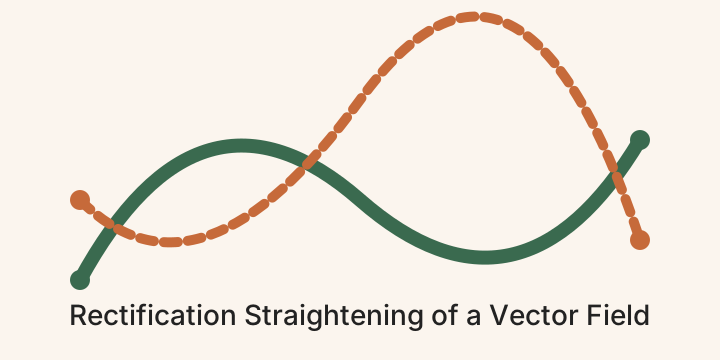
The picture conveys the structural content: every regular point of a smooth vector field has a neighbourhood in which the field is a uniform translation. The transverse section is the geometric input that builds the coordinate change. Outside this neighbourhood the field can do anything, but inside it the flow is straight-line motion.
Worked example [Beginner]
Rectify the planar vector field given by the system , near the point . This is the rotation flow whose trajectories are circles around the origin; the field vanishes at the origin and is non-zero everywhere else.
Step 1. Check that the field is non-zero at . At the velocity vector is . The field points straight up at with unit length. So is a regular point and rectification applies.
Step 2. Choose a transverse section. The line segment passes through and is transverse to the flow at because the velocity at has no horizontal component while runs horizontally.
Step 3. Compute the flow. The trajectories of the rotation system are circles: starting at on and flowing for time , the trajectory is . So the flow at time of the point is .
Step 4. Build the rectifying coordinates. Define new coordinates on a neighbourhood of by (time flowed) and (starting radius on ). The map back to the original coordinates is , . This is polar coordinates with angle and radius , defined on the neighbourhood , .
Step 5. Read off the flow in new coordinates. In , the flow is , which is uniform translation in the direction. In these coordinates the rotation has been straightened into uniform horizontal motion: the trajectories are now horizontal lines along which varies and stays constant.
What this tells us: rectification turns the curved circular flow into uniform translation. The single trick — pick a transverse section, parametrise by "starting point and time flowed" — works near every non-zero point. The origin is excluded because the field vanishes there and there is nothing to straighten.
Check your understanding [Beginner]
Formal definition [Intermediate+]
Let be a smooth -dimensional manifold and let be a vector field on . A point is regular for when ; otherwise it is an equilibrium (or singular point). The local flow of near is the unique map defined on an open neighbourhood for that satisfies and for every .
A rectifying chart for at is a diffeomorphism from an open neighbourhood of onto an open neighbourhood of with and $$ \Phi_*(\partial / \partial y^1) = X|W, $$ where $\Phi*(y^1, \ldots, y^n)\Phi^{-1}X\partial / \partial y^1$.
A local transverse section through for is a embedding of a neighbourhood of with and not contained in the tangent space . The image is a hypersurface meeting the flow line through transversally at .
The straightening map built from and is $$ \Phi : (-\varepsilon, \varepsilon) \times \Sigma_0 \to M, \qquad \Phi(t, y) = g^t(\sigma(y)). $$ The rectification theorem states that is a local diffeomorphism near and that the inverse coordinates on a neighbourhood of rectify to .
Counterexamples to common slips
- The hypothesis is required. At an equilibrium the flow fixes , every transverse section through collapses to a point under the flow, and the straightening map cannot be a diffeomorphism — the linearisation degenerates.
- The choice of transverse section is not unique. Different sections produce different rectifying charts that agree on the field but differ in the transverse coordinates. The theorem produces a rectification, not a canonical one.
- The theorem is local. The flow may rectify on a small neighbourhood but the rectifying chart need not extend globally; an integral curve may return arbitrarily close to itself, producing topological obstructions that the local theorem ignores.
- Smoothness matches the field. A vector field admits a rectifying chart by the same construction, since the flow inherits joint regularity from the smooth-dependence-on-initial-conditions theorem.
Key theorem with proof [Intermediate+]
Theorem (rectification theorem; Arnold ODE Ch.2 §7). Let be a smooth -manifold and a vector field on for some . For every regular point of (i.e., ) there is a local diffeomorphism from a neighbourhood of in onto a neighbourhood of in such that $$ \Phi_*(\partial / \partial y^1) = X. $$ Equivalently, there exist local coordinates near in which .
Proof. The argument has three steps. First, reduce to Euclidean space by a chart. Second, build the candidate diffeomorphism from the flow and a transverse section. Third, apply the inverse function theorem to verify it is a local diffeomorphism.
Step 1: reduction to Euclidean space. Choose a smooth chart around with . The vector field pushes forward under to a vector field on with . If the theorem holds on for at , the composition with produces the rectifying chart for at on . Reduction complete.
Step 2: transverse section and straightening map. Work on with . By a linear change of coordinates we arrange , the first standard basis vector. The hyperplane passes through the origin and is transverse to . The local flow of exists on a neighbourhood of for , is in jointly by the smooth-dependence-on-initial-conditions theorem, and satisfies , .
Define the straightening map $$ \Phi : (-\varepsilon, \varepsilon) \times \Sigma_0 \to \mathbb{R}^n, \qquad \Phi(t, y) = g^t(0, y), $$ where identifies points of with their last coordinates and . The map is in jointly.
Step 3: inverse function theorem. Compute the differential of at . For the -derivative, $$ \frac{\partial \Phi}{\partial t}(0, 0) = \frac{d}{dt}\Big|{t=0} g^t(0) = \widetilde X(0) = e_1. $$ For the -derivative with , $$ \frac{\partial \Phi}{\partial y^j}(0, 0) = \frac{d}{ds}\Big|{s=0} g^0(0, 0, \ldots, s, \ldots, 0) = e_j, $$ where the sits in slot and . So the Jacobian matrix of at is $$ D\Phi(0, 0) = [e_1 \mid e_2 \mid \cdots \mid e_n] = I_n, $$ the identity. By the inverse function theorem, is a local diffeomorphism on some neighbourhood of in onto its image, an open neighbourhood of in .
It remains to identify in the rectified coordinates. By construction, $$ \Phi_*\left(\frac{\partial}{\partial t}\right)\bigg|{\Phi(t, y)} = \frac{d}{ds}\bigg|{s=0} \Phi(t + s, y) = \frac{d}{ds}\bigg|{s=0} g^{t+s}(0, y) = \widetilde X(g^t(0, y)) = \widetilde X(\Phi(t, y)). $$ So $\Phi*(\partial / \partial t) = \widetilde Xt = y^1y = (y^2, \ldots, y^n)\Phi^{-1}\widetilde X = \partial / \partial y^1\psiM\square$
Bridge. The rectification theorem builds toward the geometric language of ODE theory: rather than thinking of as a calculational object, the theorem reframes local ODE theory as the assertion that every regular point of a vector field has a neighbourhood diffeomorphic to a constant horizontal flow on . This is exactly the geometric repackaging of the existence-uniqueness-smooth-dependence triad: existence becomes the existence of the flow , uniqueness becomes injectivity of on a small enough neighbourhood, and smooth dependence becomes joint regularity of . The foundational reason the theorem works is exactly the smooth-dependence theorem of Picard-Lindelöf applied to the flow : differentiating in recovers the field, differentiating in at recovers the embedding of the transverse section.
This pattern appears again in the constant-rank theorem of multi-variable calculus, where a map of locally constant rank is straightened to a linear projection, and in the local theory of foliations, where a non-singular distribution is straightened to a sub-bundle of coordinate vector fields. The central insight is that local geometric structures with a non-degenerate first jet have a canonical local model — and the canonical local model is computed by the inverse function theorem. Putting these together, rectification identifies the local theory of a non-vanishing vector field with the local theory of a constant vector field on : every question about regular points reduces to a question about the constant translation flow . The bridge is the recognition that local ODE theory is the geometric content of the inverse function theorem applied to the flow.
Exercises [Intermediate+]
Lean formalization [Intermediate+]
Mathlib has the local-flow infrastructure for ODEs (Mathlib.Analysis.ODE.PicardLindelof, Mathlib.Analysis.ODE.Gronwall) and the inverse function theorem (Mathlib.Analysis.Calculus.InverseFunctionTheorem), but does not package the rectification theorem as a named result. The intended formalisation reads schematically:
import Mathlib.Analysis.ODE.PicardLindelof
import Mathlib.Analysis.Calculus.InverseFunctionTheorem.FDeriv
import Mathlib.Geometry.Manifold.MFDeriv.Basic

/-- A local transverse section to a C^1 vector field at a regular point. -/
structure TransverseSection {E : Type*} [NormedAddCommGroup E]
    [NormedSpace ℝ E] (X : E → E) (p : E) where
  embedding : (Fin (Nat.pred (Module.finrank ℝ E))) → E
  base_point : embedding 0 = p
  transverse : sorry  -- X(p) ∉ range (d embedding 0)

/-- Rectification theorem: a C^1 vector field is locally diffeomorphic to
    the constant vector field e₁ near every regular point. -/
theorem rectificationTheorem
    {E : Type*} [NormedAddCommGroup E] [NormedSpace ℝ E] [FiniteDimensional ℝ E]
    (X : E → E) (hX : ContDiff ℝ 1 X) (p : E) (hp : X p ≠ 0) :
    ∃ (V : Set (ℝ × E)) (W : Set E) (hV : IsOpen V) (hW : IsOpen W)
      (Φ : ℝ × E → E),
      (0, p) ∈ V ∧ p ∈ W ∧
      ContDiffOn ℝ 1 Φ V ∧
      Set.BijOn Φ V W ∧
      ∀ q ∈ W, fderiv ℝ Φ (Φ.symm q) (1, 0) = X q :=
  sorry  -- straightening map Φ(t, y) = g^t(σ(y)), apply IFT
The proof gap is the named transverse-section structure, the construction of the straightening map from the local flow, and the application of the inverse function theorem with the Jacobian-equals-identity calculation at the base point. Each piece is formalisable from existing Mathlib infrastructure but has not been packaged. The manifold version of the theorem (with replaced by a smooth manifold and the field a section of the tangent bundle) is a further packaging target, predicated on Mathlib's existing SmoothManifoldWithCorners framework.
Advanced results [Master]
Theorem (rectification on a smooth manifold). Let be a manifold and a vector field on . For every regular point of there is a chart at with , , and $\Phi_ X = \partial / \partial y^1Ug^tXC^k\Sigmap\Phi^{-1}(t, y) = g^t(\sigma(y))$.*
The manifold version reduces to the Euclidean version by composition with a smooth chart, exactly as in Step 1 of the proof of the basic theorem. The local flow exists on as a map on a neighbourhood of in by the manifold version of Picard-Lindelöf. The transverse hypersurface is an embedded submanifold of codimension one through meeting transversally. The straightening map is the composition of the section embedding with the flow, and the inverse function theorem applied at produces the chart.
Theorem (first integrals near a regular point). Let be a vector field on () with . There is a neighbourhood of on which there exist independent first integrals of , meaning for every and the differentials are linearly independent at every point of . The level sets are exactly the integral curves of on .
The proof is immediate from rectification: in rectifying coordinates the functions for are first integrals because , and their differentials are linearly independent. This is the maximal possible number of locally independent first integrals on : any further first integral would have to be a function of by the implicit function theorem and the linear independence of the differentials.
Theorem (relative rectification of a non-vanishing distribution). A involutive distribution of rank on is, near every point, of the form in suitable local coordinates. (This is the Frobenius theorem.) The rectification theorem is the rank-one special case: a single non-vanishing vector field is an involutive line distribution, and Frobenius reduces to the existence of a single straightening coordinate.
Frobenius reduces to rectification when because every line distribution is involutive (Lie brackets vanish for rank-one distributions of sections proportional to a single vector field), and the rectification chart provides the straightening. Higher-rank Frobenius requires an additional argument: a sequence of rectifications, with each step rectifying one coordinate at a time and using the involutivity hypothesis to ensure the successive rectifications are compatible. The base case is the rectification theorem; the induction step is the involutivity-driven extension.
Theorem (rectification implies local uniqueness of integral curves). Let be a vector field on and a regular point. Any two integral curves of through agree on the intersection of their domains in a neighbourhood of .
In rectifying coordinates near the field is , whose integral curves are the horizontal lines for . Two integral curves through must lie on the same horizontal line and have the same parametrisation up to a time translation, hence agree wherever both are defined. The local rectification picture makes uniqueness of integral curves geometrically evident.
Theorem (method of characteristics for first-order PDEs; Arnold §31, Hörmander §8.1). Let be functions with on , and let . The general solution of the homogeneous first-order linear PDE on is locally of the form where are the rectifying coordinates transverse to and is an arbitrary function of variables. The integral curves of are the characteristics; the general solution is constant along each characteristic.
The proof is the application of rectification to followed by integration of . The first-order PDE becomes the elementary equation in rectifying coordinates, whose solutions are precisely the functions independent of . The method extends to inhomogeneous and quasilinear PDEs by introducing the dependent variable as an extra coordinate and rectifying in dimensions.
Theorem (flow-equivariance of rectifying charts). Let be two rectifying charts for at , both with and both sending to . Then the transition map has the form for some functions , where is a diffeomorphism of the transverse part.
Both charts identify with , so the transition map commutes with the time-translation flow . A diffeomorphism commuting with horizontal translation must add an arbitrary function of the transverse coordinates to and act on the transverse coordinates by an arbitrary diffeomorphism. The freedom is parametrised by ; the transverse-section choice fixes a representative in the equivalence class.
Synthesis. Rectification is the foundational reason every non-equilibrium point of a smooth vector field has a canonical local model, and that model is the uniform translation flow on . The central insight is that the local flow combined with a transverse section assembles into a diffeomorphism whose Jacobian is the identity at the base point — and by the inverse function theorem, this is enough to make a local diffeomorphism that rectifies to . Putting these together, rectification gives the geometric form of local ODE theory: existence-uniqueness-smooth-dependence is exactly the assertion that the flow plus a transverse section produces a rectifying chart, and every other local property of the field is read off from the constant-field picture in rectified coordinates. The bridge is the recognition that local geometric structures with a non-degenerate first jet — non-vanishing vector fields, full-rank linear maps, immersions of constant rank, involutive distributions — all have a canonical local model computed by the inverse function theorem applied at the base point.
The theorem identifies several pictures that look distinct at first inspection. The smooth-dependence-on-initial-conditions theorem of Picard-Lindelöf is identified with the joint regularity of . The local uniqueness of integral curves is identified with the injectivity of on a small enough neighbourhood. The existence of local first integrals is identified with the rectifying coordinates — these are the constants of motion that label the integral curves. The method of characteristics for first-order PDEs is identified with the rectification of the characteristic vector field followed by integration of the rectified equation. Rectification generalises to higher rank as the Frobenius theorem on involutive distributions, where a single straightening coordinate is replaced by coordinates spanning the distribution. The pattern recurs in the constant-rank theorem of multi-variable calculus, where a map of locally constant rank is straightened to a linear projection, and in symplectic geometry as the Darboux theorem, where a non-degenerate closed two-form is straightened to the standard symplectic form. Each of these is the inverse function theorem applied to a structure with a non-degenerate first jet at a point.
Full proof set [Master]
Theorem (rectification theorem), proof. Given in the Intermediate-tier section: reduce to by a chart, build the straightening map from the local flow and a transverse section, compute that the Jacobian at the origin is the identity, apply the inverse function theorem to conclude is a local diffeomorphism, and identify by direct computation.
Theorem (rectification on a smooth manifold), proof. Let be a chart at with . The pushforward is a vector field on with since is a diffeomorphism. Apply the rectification theorem on to at , producing a rectifying chart with . The composite is a chart on at that rectifies to . The construction is functorial in the chart : a different choice of produces a rectifying chart related by a transition map of the form recorded in the flow-equivariance theorem.
Theorem (first integrals near a regular point), proof. Let be rectifying coordinates near . Define for . Since in these coordinates, $$ X(\phi^j) = \frac{\partial y^j}{\partial y^1} = 0 $$ for each . The differentials are linearly independent on the chart domain because the are coordinate differentials. The level sets are the horizontal lines in rectified coordinates, which are exactly the integral curves of . Any further first integral on the chart would satisfy , hence depends only on ; the implicit function theorem expresses as a function of .
Theorem (rectification implies local uniqueness), proof. Let be two integral curves of through with , defined on a common interval . In rectifying coordinates near , the field has integral curves . The condition corresponds to in rectified coordinates, fixing for all . So both curves are on a sufficiently small interval, and they coincide. The argument applies on any rectified neighbourhood of , hence the curves agree on the intersection of their domains restricted to a neighbourhood of . The local uniqueness extends to a global uniqueness statement on the maximal interval of existence by the connectedness argument standard in Picard-Lindelöf.
Theorem (method of characteristics), proof. Let be the non-vanishing characteristic field. By rectification, near any point of there are local coordinates with . The PDE becomes , whose solutions are precisely the functions of . Writing for (first integrals of ), the general local solution is for an arbitrary function of variables. The integral curves of are the level sets in — the characteristics. The solution is constant along each characteristic because is constant where is constant.
Theorem (flow-equivariance of rectifying charts), proof. Let be two rectifying charts as in the statement. The composition is a diffeomorphism fixing the origin. Both charts identify with , so intertwines the horizontal translation flow: where . Writing , the intertwining condition reads and . The first condition forces for some . The second forces independent of . The diffeomorphism property of on forces to be a local diffeomorphism on the transverse part.
Connections [Master]
Vector field
02.12.01. The rectification theorem is a structural statement about smooth vector fields on smooth manifolds: every regular point of a smooth vector field has a neighbourhood diffeomorphic to a constant horizontal flow on . The unit02.12.01introduces the vector field and its integral curves in a coordinate-free framework; rectification refines this picture by exhibiting the canonical local model at every non-equilibrium point.Phase flow
02.12.02. The straightening map is built from the local flow of the field combined with a transverse section. Without the flow there is no straightening map to construct; without rectification, the flow is just an existence-uniqueness fact rather than a geometric local model. The two units are dual viewpoints on local ODE theory: the flow is the dynamical object, rectification is the geometric repackaging of its smooth dependence.Smooth manifold
03.02.01. The rectification theorem is most cleanly stated on a smooth manifold, where the rectifying chart is a coordinate chart in the smooth atlas. The reduction to Euclidean space by a chart is the standard manifold-theoretic move, and the rectifying coordinates produced are local smooth coordinates around the regular point. The unit03.02.01provides the framework in which the theorem is naturally stated and where the inverse function theorem and the smooth-dependence theorem are available.Implicit and inverse function theorems
02.05.04. The proof of rectification reduces to the inverse function theorem applied to the straightening map at the base point, where the Jacobian is computed to be the identity. This is exactly the pattern of every local-normal-form theorem in differential topology: a structure with a non-degenerate first jet at a point admits a canonical local model whose existence is verified by an inverse-function-theorem argument on the appropriate candidate diffeomorphism.Frobenius theorem on involutive distributions. Rectification is the rank-one case of Frobenius: a non-vanishing vector field is an involutive line distribution, and the rectifying chart is the Frobenius chart. The general Frobenius theorem on an involutive rank- distribution produces straightening coordinates, with the rank-one case reducing to ordinary rectification. The connection makes precise the sense in which Frobenius is "many rectifications at once".
First integrals / conserved quantities
02.12.12. Rectification is the local-existence theorem for first integrals in disguise: the rectifying coordinates are functionally independent first integrals of near the regular point, with the level-set partition recovering the family of integral curves. The unit02.12.12takes this corollary as its main theorem, packages the maximality count and the implicit-function-theorem-based functional-independence criterion, and extends to the Hamiltonian setting where Poisson-commutation replaces . The present unit is the geometric foundation;02.12.12is the dedicated conserved-quantity treatment with the Noether and Liouville-Arnold upgrades.
Historical & philosophical context [Master]
The geometric picture of a flow near a regular point goes back to Cauchy's 1820s lectures at the École Polytechnique on the existence theorem for ODEs (collected in the Œuvres complètes Série II Tome XI), where the polygon method exhibits local solutions as nearly-straight broken-line approximations to the flow [Cauchy 1820s]. Cauchy's framing was calculational rather than geometric, but the underlying observation — that a smooth flow near a regular point looks like uniform motion — is implicit in the polygon construction. Liouville's 1838 note on the variation of arbitrary constants (J. Math. Pures Appl. 3, 342-349) [Liouville 1838] introduced an early form of the one-parameter group concept under the language of "arbitrary constants", treating the flow as a family of diffeomorphisms parametrised by time. The geometric viewpoint emerged in Poincaré's 1881-1886 mémoire Sur les courbes définies par une équation différentielle (J. de Math. Pures et Appl.) [Poincaré 1881-1886], which framed local and global ODE theory in terms of phase portraits, distinguishing regular points (where flows look straight) from singular points (where the local model is the linearisation), and introducing transverse sections as the natural geometric input to the local analysis.
The modern statement of rectification as a stand-alone theorem — separating the geometric content (existence of straightening coordinates) from the calculational content (the polygon-method or Picard-iteration proof of existence and uniqueness) — was crystallised by Arnold in Ordinary Differential Equations (Russian first edition 1971, English translation 1973) [Arnold 1973]. Arnold's Ch.2 §7 calls the result the flow-box theorem and presents it as the geometric form of the existence-uniqueness-smooth-dependence package, arguing that this is the right way to state local ODE theory once one is doing geometry rather than calculation. The same theorem appears in Hartman's Ordinary Differential Equations (1964) Ch. IV §1 [Hartman 1964] in the Banach-space generality, in Spivak's Calculus on Manifolds (1965) Ch.5 [Spivak 1965] as the smooth-manifold version, and in Lang's Differential Manifolds (1972) Ch. IV §2 [Lang 1972] with the rectifying chart named explicitly. The theorem extends to first-order PDEs via the method of characteristics, treated in Hörmander's The Analysis of Linear Partial Differential Operators Vol. I (1983) §8.1 [Hörmander 1983] as the geometric foundation of the characteristic-curve method. Through Arnold's framing, rectification became one of the recognisable Russian-school local-normal-form theorems, alongside the Morse lemma, Darboux's theorem on symplectic manifolds, and the Frobenius theorem on involutive distributions — all instances of the same pattern: a structure with a non-degenerate first jet has a canonical local model verifiable by an inverse-function-theorem argument.
Bibliography [Master]
@book{Arnold1973ODE,
  author    = {Arnold, Vladimir I.},
  title     = {Ordinary Differential Equations},
  publisher = {MIT Press},
  year      = {1973},
  note      = {Translated from the 1971 Russian edition by Richard A. Silverman}
}

@book{Hartman1964ODE,
  author    = {Hartman, Philip},
  title     = {Ordinary Differential Equations},
  publisher = {John Wiley \& Sons},
  year      = {1964}
}

@book{Spivak1965CalculusManifolds,
  author    = {Spivak, Michael},
  title     = {Calculus on Manifolds: A Modern Approach to Classical Theorems of Advanced Calculus},
  publisher = {W. A. Benjamin},
  year      = {1965}
}

@book{Lang1972DifferentialManifolds,
  author    = {Lang, Serge},
  title     = {Differential Manifolds},
  publisher = {Addison-Wesley},
  year      = {1972}
}

@book{Hormander1983LPDO,
  author    = {H{\"o}rmander, Lars},
  title     = {The Analysis of Linear Partial Differential Operators I: Distribution Theory and Fourier Analysis},
  publisher = {Springer-Verlag},
  series    = {Grundlehren der mathematischen Wissenschaften},
  volume    = {256},
  year      = {1983}
}

@article{Poincare1881,
  author  = {Poincar{\'e}, Henri},
  title   = {M{\'e}moire sur les courbes d{\'e}finies par une {\'e}quation diff{\'e}rentielle},
  journal = {J. de Math{\'e}matiques Pures et Appliqu{\'e}es},
  volume  = {7},
  year    = {1881},
  pages   = {375--422},
  note    = {Continued in volumes 8 (1882), 1 (1885), 2 (1886).}
}

@article{Liouville1838,
  author  = {Liouville, Joseph},
  title   = {Note sur la th{\'e}orie de la variation des constantes arbitraires},
  journal = {J. Math. Pures Appl.},
  volume  = {3},
  year    = {1838},
  pages   = {342--349}
}

@book{Cauchy1820sLectures,
  author    = {Cauchy, Augustin-Louis},
  title     = {{\OE}uvres compl{\`e}tes, S{\'e}rie II Tome XI},
  publisher = {Gauthier-Villars},
  year      = {1913},
  note      = {Collected lectures at the {\'E}cole Polytechnique on the existence theorem for ODEs, originally delivered in the 1820s.}
}

@book{Strogatz2015NonlinearDynamics,
  author    = {Strogatz, Steven H.},
  title     = {Nonlinear Dynamics and Chaos: With Applications to Physics, Biology, Chemistry, and Engineering},
  publisher = {Westview Press},
  edition   = {2},
  year      = {2015}
}

@book{Teschl2012ODE,
  author    = {Teschl, Gerald},
  title     = {Ordinary Differential Equations and Dynamical Systems},
  publisher = {American Mathematical Society},
  series    = {Graduate Studies in Mathematics},
  volume    = {140},
  year      = {2012}
}