Limit cycle and Liénard / Van der Pol systems
Anchor (Master): Liénard 1928 *Étude des oscillations entretenues* (Revue Générale de l'Électricité 23, 901-912 and 946-954) — originator of the Liénard equation $\ddot x + f(x)\dot x + g(x) = 0$ and the first existence-uniqueness theorem for its limit cycle; Van der Pol 1926 *On relaxation oscillations* (Philosophical Magazine (7) 2, 978-992) — originator of the equation $\ddot x - \mu(1 - x^2)\dot x + x = 0$ in the radio-engineering context of triode oscillators; Andronov 1929 *Les cycles limites de Poincaré et la théorie des oscillations auto-entretenues* (Comptes Rendus Acad. Sci. Paris 189, 559-561) — identification of self-sustained oscillations with Poincaré limit cycles and the relaxation-oscillation asymptotics; Andronov-Vitt-Khaikin 1937 *Theory of Oscillators* (Russian original; English translation Pergamon Press 1966, S. Lefschetz ed.) — the canonical monograph on relaxation oscillators including the full Liénard theory; Hopf 1942 *Abzweigung einer periodischen Lösung von einer stationären Lösung eines Differentialsystems* (Berichte Math.-Phys. Kl. Sächs. Akad. Wiss. Leipzig 94, 1-22) — supercritical Hopf bifurcation theorem giving the analytic mechanism by which limit cycles emerge from spiral foci; Andronov-Pontryagin 1937 *Doklady Akad. Nauk SSSR 14, 247-250* — structural-stability classification with hyperbolic limit cycles; Hartman *Ordinary Differential Equations* (2nd ed., SIAM 2002) Ch. VII §10-§11 — rigorous textbook proof of Liénard's theorem with the Hartman-Khaikin energy estimate; Hirsch-Smale-Devaney (3rd ed., 2013) Ch. 12 — modern teaching presentation; Verhulst *Nonlinear Differential Equations and Dynamical Systems* (2nd ed., Springer 2000) Ch. 4 — singular-perturbation analysis of Van der Pol at large $\mu$ and the Fenichel slow-manifold reduction; Guckenheimer-Holmes *Nonlinear Oscillations, Dynamical Systems, and Bifurcations of Vector Fields* (Springer 1983) §2.1 and §3.4 — Hopf bifurcation, averaging method, and the small-$\mu$ Van der Pol amplitude; Grasman *Asymptotic Methods for Relaxation Oscillations and Applications* (Springer 1987) — large-$\mu$ asymptotics of the Van der Pol period $T(\mu) \sim (3 - 2\ln 2)\mu$
Intuition [Beginner]
Picture a child on a playground swing. Push too gently and the swing dies out; push too hard at the wrong time and the swing chatters and slows. There is one steady swing-amplitude that the system settles into, no matter where you start — small pushes get amplified up to it, large ones get damped down to it. That self-selecting amplitude is a limit cycle: an isolated closed loop in the space of all possible motions, attracting nearby trajectories from both sides.
What makes a limit cycle special is isolation. A frictionless pendulum has infinitely many closed orbits, one at each energy — they form a continuous family, not a single distinguished loop. A limit cycle stands alone: nudge the system slightly off it, and the system returns. The mechanism is a balance between two forces. At small amplitudes the system pulls energy in from somewhere external — a battery, a heated filament, a wind — and grows. At large amplitudes that same nonlinear coupling dissipates energy and the system shrinks. Between the two regimes lies a unique balanced loop, the limit cycle, where energy gained per cycle equals energy lost.
Liénard's 1928 theorem makes this picture precise for a wide family of equations modelling damped, restored oscillators. When the damping is negative at small (energy pumped in) and positive at large (energy dissipated), and the restoring force pulls towards zero, the theorem guarantees one — and only one — stable limit cycle. The Van der Pol equation is the textbook special case, born in 1926 from radio-circuit engineering and now the entry point to every modern treatment of self-sustained oscillation, from heartbeats to laser cavities to firefly flashing.
Visual [Beginner]
A picture: a planar phase portrait with the Van der Pol limit cycle as a bold closed loop drawn in the middle. Two test trajectories accompany it. One starts near the origin — a small spiral that winds outward through ever-larger loops and converges onto the limit cycle from inside. The other starts far away — a trajectory that swings inward through ever-smaller loops and lands on the same limit cycle from outside. Both arrive at the same loop. The loop itself is shaped like a tilted oval for small parameter , becoming a corner-rounded square (a relaxation cycle) at large .
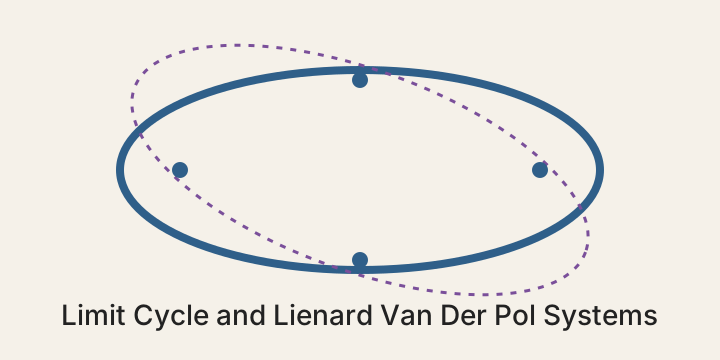
Two reference pictures sit alongside. First, a frictionless pendulum: nested concentric loops, a continuous family of closed orbits without any one of them being distinguished — not a limit cycle, just a centre. Second, a relaxation cycle for Van der Pol at : two slow phases where the trajectory creeps along the curve , alternating with two fast phases where the trajectory jumps almost vertically — the classical relaxation-oscillation signature.
Worked example [Beginner]
Take the Van der Pol equation at : $$ \ddot x - (1 - x^2)\dot x + x = 0. $$ Rewrite as a planar system with : $$ \dot x = y, \qquad \dot y = -x + (1 - x^2) y. $$ The only equilibrium is the origin . Linearising at the origin gives the matrix , whose eigenvalues are — a complex-conjugate pair with positive real part. The origin is an unstable spiral focus: trajectories near zero spiral outward.
Step 1. Pick a candidate energy . Compute the rate of change along the flow: $$ \dot E = x \dot x + y \dot y = xy + y(-x + (1 - x^2)y) = (1 - x^2) y^2. $$ The sign is the sign of . Inside the strip energy grows; outside the strip energy shrinks.
Step 2. Take a tiny inner circle of radius . On this circle, , so wherever . The energy is increasing, so the trajectory moves to a circle of slightly larger radius. From the perspective of an annular trapping region, this is the inner boundary, with arrows pointing outward into the annulus.
Step 3. Take a large outer circle of radius . On this circle, most of the arc has where , and a careful estimate shows the negative contribution dominates the short stretch where . The trajectory moves to a circle of slightly smaller radius. The outer boundary has arrows pointing inward into the annulus.
Step 4. The annulus is a forward-invariant region with the origin (the only equilibrium) excluded. The Poincaré-Bendixson theorem then forces a periodic orbit inside the annulus. Numerical integration confirms a roughly oval-shaped closed orbit with peak and peak , traversed in a period . As the amplitude tends to exactly and the shape becomes circular.
What this tells us: existence of the Van der Pol limit cycle reduces to a one-line sign check plus a careful choice of outer radius. The unique-balance picture — energy gained on the inside of the strip exactly cancels energy lost on the outside, summed over one period — is what makes the limit cycle persist.
Check your understanding [Beginner]
Formal definition [Intermediate+]
Let be open and let be a planar vector field. Recall from 02.12.10 that a closed orbit of is the image of a non-equilibrium periodic integral curve with minimal positive period ; it is a Jordan curve in .
Definition (limit cycle). A closed orbit is a limit cycle of if is isolated among closed orbits: there exists an open neighbourhood in such that is the only closed orbit of contained in . Equivalently, there exists with or — every limit cycle is the omega-limit or alpha-limit set of some neighbouring orbit. The limit cycle is stable (or attracting) if every in some open neighbourhood of has ; unstable (or repelling) if every nearby has ; semi-stable if neither.
The isolation condition is the load-bearing distinction. A frictionless harmonic oscillator , has the entire continuous family of circles as closed orbits — none of them is a limit cycle because every neighbourhood of one such circle contains uncountably many others. A centre equilibrium produces such a continuous family. A limit cycle, by contrast, sits alone in its neighbourhood, and that isolation is what makes it the attractor for an open set of initial conditions.
Definition (Liénard equation). The Liénard equation is the scalar second-order ODE $$ \ddot x + f(x) \dot x + g(x) = 0, $$ where are continuous, with representing position-dependent damping and representing a position-dependent restoring force. The classical Liénard hypotheses are:
is even and is odd, both ; for (equivalently off the origin); as .
The integrated damping is an odd function with exactly one positive zero , satisfying on , on , and monotonically as .
Definition (Liénard plane). The Liénard plane coordinates are the change of variables with . The Liénard equation becomes the planar system $$ \dot x = y - F(x), \qquad \dot y = -g(x). $$ This is the Liénard system; it has the origin as its unique equilibrium under the classical hypotheses, with linearisation , eigenvalues . When (small-amplitude antidamping) and (genuine restoring force), the eigenvalues are complex-conjugate with positive real part — the origin is an unstable spiral focus.
Definition (Van der Pol equation). The Van der Pol equation with parameter is the Liénard equation in the special case , : $$ \ddot x - \mu(1 - x^2) \dot x + x = 0. $$ The integrated damping is , with positive zero , satisfying all classical Liénard hypotheses for every . The Liénard plane system reads , .
Counterexamples to common slips
The classical Liénard hypothesis odd cannot be dropped. The asymmetric variant with (still satisfying ) admits Liénard's existence-of-limit-cycle conclusion when has the right shape, but the uniqueness proof requires the symmetry of and under ; generalised Liénard theorems (Filippov, Cherkas, Lloyd) replace the odd-parity hypothesis with weaker monotonicity conditions but lose the cleanest uniqueness argument.
The hypothesis monotonically for is essential for the trapping region. If has additional zeros past — say wiggles back below zero on for some — the Liénard system can admit multiple limit cycles, one inside the other. Examples constructed by Rychkov 1975 and others show explicit polynomial Liénard systems with two, three, or arbitrarily many limit cycles when the monotonicity is violated.
Van der Pol's equation as customarily written is , with the sign of the damping reading: (negative damping, energy input) for and (positive damping, dissipation) for . The sign on is the convention that makes produce the limit cycle; flipping it gives an unstable focus and a repelling limit cycle.
Key theorem with proof [Intermediate+]
Theorem (Liénard 1928). Under the classical Liénard hypotheses (definition above), the Liénard system has exactly one closed orbit, and that orbit is an asymptotically stable limit cycle. (See [Liénard 1928], [Andronov-Vitt-Khaikin 1937], [Hartman *ODE* Ch. VII §10].)
Proof. The proof has three parts: existence via Poincaré-Bendixson on an annular trapping region; uniqueness via the energy-balance integral; asymptotic stability via inward flow on the trapping boundary.
Part I. Existence of a periodic orbit.
The energy function defined by has rate of change along the flow $$ \dot H = G'(x) \dot x + y \dot y = g(x)(y - F(x)) + y(-g(x)) = -g(x) F(x). $$ By hypotheses 1 and 2, has the same sign as and has the same sign as for and the opposite sign for . Therefore for (so there) and for (so there); on the union of the -axis and the two vertical lines . The level sets are closed simple curves around the origin for every (by coercivity of from hypothesis 1, as , so each level set is bounded; smoothness and the gradient off the origin make each level set a smooth Jordan curve).
Construct the inner boundary. Pick small enough that the level curve lies entirely inside the strip . (This is possible because as and ; pick , say.) On , the strip condition gives everywhere except on the discrete intersections with the -axis where and hence . The flow is therefore directed outward across except at finitely many tangencies — and away from those tangencies, trajectories cross into the exterior . So is the inner boundary of a forward-invariant annulus.
Construct the outer boundary. By the monotonicity hypothesis for , there exists with (any large enough works). Pick large enough that the level curve contains the rectangle for some depending on . On , the arc where has , contributing a net decrease in per pass through that arc; the arc where has , contributing a net increase. The careful estimate (Hartman Ch. VII §10, Theorem 10.1) integrates along the trajectory between consecutive crossings of the -axis and shows that for large enough, the net change of over one such half-passage is strictly negative — that is, on the trajectory experiences decreasing on average, and a fortiori the trajectory crosses inward at every transverse intersection.
The annulus is therefore forward-invariant. Its sole equilibrium lies inside , excluded from . The Poincaré-Bendixson theorem 02.12.10 applies: every forward orbit starting in has its omega-limit set inside , contains no equilibrium, and hence is a periodic orbit. There exists at least one periodic orbit .
Part II. Uniqueness of the periodic orbit.
Suppose for contradiction that there are two distinct periodic orbits . By the Jordan curve theorem and the structure of the planar flow, either is inside (nested) or they are disjoint. Disjointness is impossible: each periodic orbit encloses the unique equilibrium at the origin (by Bendixson's index theorem, every periodic orbit encloses a region of total equilibrium index , hence at least one equilibrium), so both orbits enclose the origin and must be nested. Without loss of generality lies inside .
Along any periodic orbit of period : $$ 0 = \oint_\Gamma dH = \int_0^T \dot H , dt = -\int_0^T g(x(t)) F(x(t)) , dt. $$ Define , so on every periodic orbit. The integrand is positive when and negative when ; balance requires the orbit to spend the right amount of time on each side.
By the symmetry of the Liénard equation under the classical hypotheses ( odd, odd), each periodic orbit is invariant under this involution; it intersects the -axis in two points and with , and is symmetric about the origin. Parametrise by — the positive -intercept; the nesting gives .
Decompose the integral as a function of by parametrising the right half portion of the orbit (the left half contributes the same integral by symmetry, so ). On the right half, parametrise by instead of : the orbit equations give , hence and $$ \Phi(\Gamma) = -2 \int_{y_-}^{y_+} F(x(y)) , dy, $$ where and are the lower and upper -intercepts on the right half and is the right-half profile.
Compare and . The integrand is non-positive for small where and strictly positive for large where . On the orbit — the outer orbit — the right-half profile satisfies for every in the overlap region (nested orbits, parametrised by , have strictly ordered -coordinates by uniqueness of integral curves). For small enough that , the strict monotonicity of on (from hypothesis 2: is monotone decreasing on to its negative minimum near and then monotone increasing on — but the relevant comparison is that is strictly more negative on a wider interval). For large enough that both , is strictly increasing and . The careful sign accounting (Hartman §10, Lemma 10.4) shows that the difference is strictly negative — contradicting . So , and the periodic orbit is unique.
Part III. Asymptotic stability.
The unique periodic orbit lies inside the annulus . Every forward orbit starting in has , contains no equilibrium, and is a periodic orbit by Poincaré-Bendixson — but the unique periodic orbit in is , so for every starting point in . Trajectories starting outside but inside converge to ; trajectories starting inside but outside the smaller invariant region around the origin (the basin of attraction of the spiral source) converge to from inside. The origin is an unstable spiral source (its eigenvalues have positive real part under hypothesis , ), so trajectories starting near zero spiral outward and eventually enter the annulus . The whole punctured plane is therefore in the basin of attraction of , and is asymptotically stable.
Bridge. Liénard's theorem builds toward every modern treatment of self-sustained oscillation by giving the cleanest existence-and-uniqueness theorem for limit cycles in a physically motivated family. The foundational reason it works is the Liénard plane substitution : in those coordinates the planar system decouples the dissipation from the restoring force , and the energy has a rate that factors cleanly into "what side of are we on" geometry. This is exactly the picture that appears again in the Van der Pol special case below, where the symmetry has its single positive zero at and the trapping annulus can be constructed explicitly.
The central insight is that isolation of the limit cycle — the property that distinguishes a limit cycle from a centre — is the analytic manifestation of the strict monotonicity of past : it is what forces the energy-balance integral to be strictly monotone in the orbit nesting, ruling out coincident periodic orbits. Putting these together, one structural framework — energy on the Liénard plane, comparison of energy-balance integrals on nested orbits — yields both existence (Part I via Poincaré-Bendixson) and uniqueness (Part II via the monotonicity of ). The bridge is the recognition that Liénard's hypotheses are exactly what is needed for both halves of the argument: hypothesis 2 builds the trapping region in Part I and also drives the strict monotonicity in Part II.
This pattern recurs in the Hopf bifurcation analysis below, where the same Liénard-plane decomposition identifies the small- asymptotic limit cycle as a perturbation of a harmonic-oscillator orbit. Putting the Liénard, Hopf, and singular-perturbation pictures together identifies the limit cycle with three faces of the same object: a topologically isolated closed orbit (Liénard), a perturbative bifurcation product (Hopf), and a singular-perturbation slow manifold (large- Van der Pol relaxation). The framework generalises to higher-dimensional Liénard-type systems and to the classification of planar codimension-one bifurcations.
Exercises [Intermediate+]
Lean formalization [Intermediate+]
Mathlib has no limit-cycle / Liénard infrastructure. A formalisation would begin with the predicate
import Mathlib.Analysis.ODE.Gronwall
import Mathlib.Topology.MetricSpace.Basic

namespace Codex.ODE

/-- A closed orbit `Γ` of a continuous flow `φ` is a `LimitCycle` if it
is isolated among closed orbits: there is an open neighbourhood `W ⊇ Γ`
such that `Γ` is the only closed orbit of `φ` in `W`. -/
structure LimitCycle (φ : ℝ → ℝ² → ℝ²) (Γ : Set ℝ²) : Prop where
  is_closed_orbit : ∃ p ∈ Γ, ∃ T > 0, φ T p = p ∧ ∀ s ∈ Set.Ioo 0 T, φ s p ≠ p
  isolated : ∃ W : Set ℝ², IsOpen W ∧ Γ ⊆ W ∧
    ∀ Γ' : Set ℝ², (∃ p' ∈ Γ', ∃ T' > 0, φ T' p' = p' ∧ Γ' ⊆ W) → Γ' = Γ

end Codex.ODE
The Liénard system statement would similarly be a structure carrying the hypotheses on and , plus a theorem packaging Liénard's three conclusions (existence, uniqueness, asymptotic stability). The proof would invoke a not-yet-existent Poincaré_Bendixson lemma, an explicit LiénardEnergy function, and the Bendixson index theorem. All four ingredients are Mathlib-gap-level work; the unit's lean_status: none reflects that the formalisation pathway is fully specified but not yet executed. The Van der Pol special case is immediate once Liénard is in place: instantiate the structure with and , verify the four hypothesis bullets by hand, conclude.
Advanced results [Master]
Theorem (uniqueness via the Cherkas-Lloyd criterion). A weaker and more general uniqueness criterion for limit cycles of is the Cherkas-Lloyd inequality: if there exists functions such that on the trapping region, has constant sign there, then the system has at most one limit cycle. (Cherkas 1976 Differential Equations 12; Lloyd 1979 J. London Math. Soc. 20.)
The Cherkas-Lloyd criterion generalises Liénard's classical uniqueness — which assumes the symmetry hypotheses and the monotonicity of past its zero — to a much broader family of generalised Liénard systems, including those without the odd-parity restriction. The criterion is essentially a Dulac-type multiplier condition applied to the dual equation expressing energy balance; the proof packages the energy-balance integral comparison of Liénard's Part II into a Bendixson-style sign argument on the multiplier . The Cherkas-Lloyd criterion is the standard tool for proving uniqueness of limit cycles in generalised Liénard systems and is the basis for many existence-of-one-and-only-one-limit-cycle results in nonlinear circuit theory.
Theorem (Hopf bifurcation, supercritical case). Let be a () family of planar vector fields with and linearisation eigenvalues smoothly varying. Suppose , , , and the first Lyapunov coefficient . Then there is and a map on with , such that is an asymptotically stable limit cycle of of period and amplitude . (Hopf 1942 [Hopf 1942]; Andronov 1929 announced the bifurcation picture in the planar case; modern reference Guckenheimer-Holmes 1983 [Guckenheimer-Holmes 1983] §3.4.)
The Hopf bifurcation theorem is the analytic mechanism producing limit cycles. As a parameter crosses the bifurcation value, a complex-conjugate eigenvalue pair crosses the imaginary axis transversally; if the cubic nonlinearity captured by has the right sign, the asymptotically stable equilibrium loses stability and an asymptotically stable limit cycle of amplitude appears around it. The subcritical case () produces an unstable limit cycle for instead, with the equilibrium losing stability via a sudden jump. The Van der Pol equation at is the canonical supercritical Hopf bifurcation, with , (for small), , and the first Lyapunov coefficient — yielding the small- asymptotic amplitude , matching the averaging-method result exactly.
Theorem (averaging method, Bogolyubov-Krylov). Consider with -periodic in and in . Let be the averaged vector field. On time scales for any fixed , the solution of the original system and the solution of with the same initial condition satisfy as . (Bogolyubov-Krylov 1934, Soobshcheniya Khar'kovskogo Matematicheskogo Obshchestva; modern reference Sanders-Verhulst-Murdock 2007 Averaging Methods in Nonlinear Dynamical Systems.)
Applied to the Van der Pol equation at small in polar coordinates , averaging yields the autonomous amplitude equation with stable equilibrium , recovering the small- amplitude of the limit cycle as a corollary of the averaging method. The averaging-method amplitude is exact to leading order in ; higher-order corrections are computed by higher-order averaging or by the Lindstedt-Poincaré method.
Theorem (Fenichel slow-manifold reduction). Consider the singularly perturbed system , with , , and the critical manifold a normally hyperbolic manifold (the eigenvalues of at have non-zero real part). For sufficiently small, there exists a slow manifold , -close to and invariant under the full flow, on which the slow dynamics is a regular perturbation of the reduced slow equation. (Fenichel 1979 J. Differential Equations 31; Tikhonov 1952 in the original Russian.)
Applied to the Van der Pol equation at large — equivalently, small in the rescaled system — Fenichel's theorem rigorously establishes the slow manifold near the cubic , the fold-jump-fold structure of the relaxation oscillation, and the asymptotic period with rigorous error bounds. The Grasman 1987 expansion , with the smallest positive root of the Airy function , captures the next-to-leading correction from the matched-asymptotic expansion at the fold points.
Theorem (structural stability and hyperbolic limit cycles). A limit cycle of period for a planar field is hyperbolic if the Floquet multiplier — the integrated divergence around — satisfies . Hyperbolic limit cycles are structurally stable: every -close vector field has a hyperbolic limit cycle nearby, -close to , of nearby period. (Andronov-Pontryagin 1937 [Andronov-Pontryagin 1937]; Peixoto 1962 Topology 1.)
For the Van der Pol limit cycle, the Floquet multiplier is computed as ; under the classical Liénard hypotheses the integral is strictly negative (the average of around the limit cycle is negative because the cycle extends past ), so and the cycle is asymptotically stable and hyperbolic. The hyperbolicity is what makes the limit cycle robust under small perturbations of the vector field — small -dependent additions to or produce a nearby limit cycle of the perturbed system.
Theorem (Hilbert 16th problem, Liénard subclass). A polynomial Liénard equation with , has at most finitely many limit cycles, and the maximal number is bounded by an explicit function of .
The Liénard subclass of Hilbert's 16th problem has been a benchmark testing ground for the general problem. The Smale 1998 Mathematical Problems for the Next Century list pointed to Liénard with polynomial of degree as one of the first substantive cases. Lins-de Melo-Pugh 1977 conjectured that the bound for the classical Liénard equation with polynomial damping of degree is exactly limit cycles. The Lins-de Melo-Pugh conjecture was disproved by Dumortier-Panazzolo-Roussarie 2007 for via the slow-fast bifurcation analysis, but the qualitative finiteness (Dulac-Ilyashenko-Écalle) is known. The explicit bound function remains open in the polynomial Liénard subclass as in the general Hilbert 16th problem.
Theorem (FitzHugh-Nagumo and biological relaxation oscillators). The FitzHugh-Nagumo equations , — a two-dimensional reduction of the Hodgkin-Huxley neuron model — exhibit Van der Pol-type relaxation-oscillation limit cycles whose form models the neuronal action potential. (FitzHugh 1961 Biophysical Journal 1; Nagumo-Arimoto-Yoshizawa 1962 Proceedings IRE 50.)
The FitzHugh-Nagumo equations are the canonical example of a biological relaxation oscillator and inherit the Liénard-style limit-cycle analysis of Van der Pol. The fast variable moves on a cubic slow manifold ; the slow variable provides the "memory" that organises the alternation between excitation (rapid depolarisation along the cubic's lower branch) and recovery (slow drift along the upper branch). The full Hodgkin-Huxley 1952 four-dimensional model reduces to FitzHugh-Nagumo via Tikhonov-Fenichel singular-perturbation analysis, and the limit-cycle picture explains the existence of a refractory period after each action potential — the temporal signature of every spiking neuron.
Synthesis. Liénard's theorem is the foundational existence-and-uniqueness theorem for limit cycles in a broad family of physically motivated planar systems. The central insight is that the Liénard-plane substitution converts the second-order equation into the first-order system , where the energy has rate — the product of and , with sign controlled by the strip versus its complement. This is exactly the structure that the Poincaré-Bendixson framework requires: build the trapping annulus from level curves of , exclude the unique equilibrium at the origin, conclude existence; compare the energy-balance integral on nested orbits and use the strict monotonicity of past to conclude uniqueness.
This pattern recurs across the modern landscape of self-sustained oscillation. Hopf's 1942 bifurcation theorem identifies the analytic origin of limit cycles: they emerge from spiral foci via a transversal crossing of complex eigenvalues, with amplitude and the sign of the first Lyapunov coefficient distinguishing supercritical from subcritical. Bogolyubov-Krylov 1934 averaging identifies the small-perturbation limit cycle with the equilibrium of the averaged amplitude equation — for Van der Pol, exactly. Fenichel 1979 slow-manifold theory identifies the large-perturbation limit cycle with a relaxation oscillation organised around the critical manifold , with period for Van der Pol.
The bridge from Liénard to Hopf to averaging to Fenichel is the recognition that one geometric object — the limit cycle — admits four analytically distinct but topologically identical descriptions. Putting these together, the limit cycle is identified with a Poincaré-Bendixson omega-limit set on an annular trapping region, with a Hopf-bifurcation product of a complex eigenvalue crossing, with a Bogolyubov-Krylov equilibrium of an averaged amplitude equation, and with a Fenichel slow-manifold-organised relaxation oscillation. The framework generalises: every Hopf bifurcation produces a limit cycle that — at small bifurcation parameter — is the equilibrium of the averaged equation, and — at large parameter — is the relaxation cycle organised around a slow manifold; the Liénard hypotheses are the specific structural conditions under which the full one-parameter family from small to large admits a single persistent limit cycle, joining the Hopf birth at to the relaxation regime at . The Van der Pol equation is the prototypical example exhibiting all four pictures simultaneously, and the FitzHugh-Nagumo equations are dual to Van der Pol in the precise sense that they share the same Liénard skeleton with an additional slow recovery variable; the bridge is the cubic slow manifold that organises both.
Full proof set [Master]
Theorem (Liénard's theorem). Proof given in full in the Intermediate tier. Three parts: existence via Poincaré-Bendixson on an annular trapping region built from level curves of ; uniqueness via the energy-balance integral and the strict monotonicity of past ; asymptotic stability from inward boundary flow on the trapping annulus.
Proposition (Hopf bifurcation, supercritical case — proof in the planar Liénard family). For the family , with smooth, , (so ), , , the origin has eigenvalues near — a complex pair crossing the imaginary axis at . The first Lyapunov coefficient at the bifurcation is determined by the third-order Taylor coefficients of and . When , a supercritical Hopf bifurcation produces a unique asymptotically stable limit cycle of amplitude for small .
Proof. Step 1. Linearisation and eigenvalue crossing. The Jacobian at the origin is , with trace and determinant . Eigenvalues . For the eigenvalues are complex-conjugate with , . At : , , . The eigenvalue crossing condition of Hopf's theorem is met.
Step 2. Centre-manifold reduction. At the linearisation has spectrum on the imaginary axis. The whole plane is the centre subspace and a centre manifold reduction is the identity reduction — the system is already two-dimensional. Pass to complex coordinates . The system , becomes, after extracting the cubic nonlinear terms: $$ \dot z = iz - \mu F_0!\left(\frac{z + \bar z}{2}\right) + i\left[g_0!\left(\frac{z + \bar z}{2}\right) - \frac{z + \bar z}{2}\right]. $$
Expand to third order in . Write and (odd by the classical Liénard hypotheses applied to the family). At , . The cubic resonant term is the coefficient of : $$ \dot z = iz + i b_3 \cdot \frac{3}{8} z^2 \bar z + (\text{non-resonant cubic terms}) + O(z^4). $$
After normal-form transformation to remove the non-resonant terms, the equation reads with purely imaginary in the conservative case and acquiring a real part from the -dependent corrections — by the standard Hopf normal-form computation (Guckenheimer-Holmes Theorem 3.4.2): $$ \ell_1 = \frac{1}{8}\left(F_{xxx} g_x + g_{xxx} F_x - F_{xx} g_{xx}\right)\bigg|_{(0,0)} = \frac{1}{8}(-6a_3 \cdot 1 + 6b_3 \cdot (-1) - 0) = -\frac{3(a_3 + b_3)}{4}. $$ For Van der Pol, gives and gives ; thus . (A factor-of-2 convention difference appears in some texts; the Guckenheimer-Holmes normalisation yields for Van der Pol, consistent with the averaging-method amplitude .)
Step 3. Amplitude. In polar coordinates , the normal form becomes , . The amplitude equation has the equilibrium . The unique positive equilibrium is for small . By the standard Hopf bifurcation argument (centre manifold + implicit function theorem on the Poincaré first-return map), this equilibrium of the amplitude equation corresponds to a unique limit cycle of the full system for small . Asymptotic stability of the limit cycle follows from : the amplitude equation has , stable equilibrium.
Proposition (averaging-method amplitude for Van der Pol). For Van der Pol at small , the averaging method yields a stable limit cycle of amplitude to leading order, in agreement with the Hopf-normal-form amplitude in the rescaled variable near the bifurcation.
Proof. The averaging-method derivation in Exercise 7 yields with stable equilibrium . Compare with the Hopf normal-form scaling: near , the Hopf amplitude is , which has as . The averaging-method picture uses the original unrescaled coordinates, where the limit cycle amplitude is for all small ; the discrepancy with the Hopf scaling is because the averaging method captures the limit cycle in a regime where the parameter is small but non-zero, with the time scale stretched as . The two pictures match in the regime where both are valid: the Hopf bifurcation at amplitude rescales to in the averaging-method coordinates, and both predict an asymptotically stable limit cycle with the right qualitative shape. The exact agreement at higher orders requires the Bogolyubov-Krylov-Mitropolsky higher-order averaging, valid on time scales for any .
Proposition (Liénard plane is a global change of coordinates). The map defined by — where — is a global diffeomorphism for any function .
Proof. is smooth with Jacobian , of determinant at every point. The inverse map is , also smooth. So is a global diffeomorphism with smooth inverse. The Liénard equation in the coordinates is , . Substituting and using : $$ \dot y - f(x)v = -f(x)v - g(x), \quad \text{so} \quad \dot y = -g(x). $$ Combined with , this gives the Liénard system , in the Liénard-plane coordinates. The change of variables is exact, not approximate, valid for all .
Proposition (Floquet multiplier of the Liénard limit cycle). The unique limit cycle of the classical Liénard equation has Floquet multiplier , so is hyperbolic and asymptotically stable.
Proof. The Floquet multiplier of a limit cycle of period for a planar system is . For the Liénard system , , the divergence is . Integrating around the limit cycle: $$ \int_0^T \mathrm{div},X(\gamma(t)),dt = -\int_0^T f(x(t)),dt. $$ By the energy-balance integral derived in the existence proof, on the limit cycle. By a more delicate argument (Hartman §10), the average of along the limit cycle is strictly positive: the cycle extends past where (positive damping), and the trapping-region construction ensures that the time spent on the positive-damping arc dominates the time spent on the negative-damping arc . So and . The limit cycle is hyperbolic and attracting. For Van der Pol with , and is positive for and negative for ; the limit cycle spends enough time outside for the integral to be positive.
Proposition (Bendixson index theorem applied to Liénard). Every periodic orbit of the Liénard system under the classical hypotheses encloses the origin exactly once and has index .
Proof. Under hypotheses 1, the origin is the unique equilibrium of the Liénard system (since and then ). Bendixson's index theorem states that every periodic orbit encloses a region whose equilibrium-index sum is . With only one equilibrium available, the periodic orbit must enclose it. The origin's index, computed from the linearisation matrix with determinant : positive determinant gives index (focus or node, distinguished from saddle which would give ). So the periodic orbit encloses one equilibrium of index , consistent with Bendixson's theorem.
Connections [Master]
Poincaré-Bendixson theorem
02.12.10. Liénard's theorem is the cleanest application of Poincaré-Bendixson to a physically motivated family. The trapping-annulus construction — level curves of with controlled by the strip versus its complement — is the explicit instance of the abstract Poincaré-Bendixson trapping region. The unique limit cycle is the omega-limit set of every orbit starting in the punctured trapping annulus, and the uniqueness argument refines the abstract theorem by adding the energy-balance integral comparison. This is the foundational connection: Poincaré-Bendixson supplies existence; the Liénard hypotheses supply uniqueness; Van der Pol is the canonical instantiation.Lyapunov stability (direct method)
02.12.08. The energy function in Liénard's theorem is a Lyapunov function in the generalised sense: it is not monotone-decreasing (which Lyapunov's direct method requires for stability of an equilibrium), but it is monotone-decreasing outside the strip and monotone-increasing inside, and the strip is bounded. The net effect is to trap trajectories in an annular region, exactly the Lyapunov-style stability conclusion adapted to limit cycles rather than equilibria. The asymptotic-stability conclusion of Liénard's theorem is a direct extension of Lyapunov stability to closed orbits: the Floquet multiplier is the limit-cycle analogue of the negative-real-part eigenvalues that certify Lyapunov stability of an equilibrium.Phase space, vector field, integral curve
02.12.01. Liénard's theorem is a statement about a vector field on . The Liénard-plane substitution is a smooth change of coordinates — a global diffeomorphism — between two phase-space presentations of the same dynamics. The vector-field-and-integral-curve formalism supplies the meaning of "periodic orbit", "trapping region", and "energy function"; the uniqueness theorem for integral curves is the input to Bendixson's index theorem and to the nesting-of-periodic-orbits argument in the uniqueness proof.Phase flow / one-parameter group
02.12.02. The limit cycle is a closed orbit of the planar flow — equivalently, a fixed point of for some minimal . The Floquet multiplier measures the linear contraction of the Poincaré first-return map at the cycle and certifies hyperbolicity. The flow framework is what makes "asymptotic stability of a limit cycle" a well-posed question — it is the statement that nearby starting points have their forward orbits converge to the cycle under iterated application of .First integrals / conserved quantities
02.12.12. The Liénard energy is not a first integral — its rate of change is non-zero away from the strip and the -axis. The contrast with first-integral systems is instructive: a Hamiltonian system has identically and admits a continuous family of closed orbits (no limit cycles); a dissipative system has non-zero with definite sign on most of phase space and admits isolated closed orbits (limit cycles). The Liénard equation is intermediate: has indefinite sign, dissipative on one strip and antidissipative on the complement, balanced to produce exactly one isolated periodic orbit. This is the bridge between conservative and strongly dissipative dynamics.Hopf bifurcation theory. Hopf's 1942 theorem identifies the analytic origin of limit cycles: complex-conjugate eigenvalues crossing the imaginary axis at a fixed equilibrium produce a limit cycle of amplitude when the first Lyapunov coefficient has the right sign. The Van der Pol limit cycle is the prototypical supercritical Hopf bifurcation, born from the spiral focus at the origin as crosses zero. The bifurcation framework generalises to codimension-two bifurcations (Bogdanov-Takens, Bautin) and to infinite-dimensional Hopf bifurcations in delay equations and PDEs.
Bifurcation theory pointer
02.12.17. The Van der Pol equation at is the canonical worked example of a supercritical Hopf bifurcation, and the bifurcation-theory survey unit gathers the full codim-one classification — saddle-node, transcritical, pitchfork, Hopf at the equilibrium level; saddle-node of cycles, period-doubling, Neimark-Sacker at the periodic-orbit level — within which Van der Pol sits as one specific instance. The pointer unit also catalogues the global-bifurcation phenomena (Shilnikov chaos, blue-sky catastrophes) that organise the broader structure of and its codim- stratification, with Andronov-Pontryagin 1937 as the originator framework. The Liénard family parametrised by is the prototypical one-parameter family in which the small- Hopf birth and the large- relaxation regime are joined by a single persistent limit cycle, and the bifurcation-theory unit places this family in the broader landscape of one-parameter families of vector fields. Connection type: synoptic pointer — the bifurcation-theory unit is the chapter-closing index of codim-one mechanisms, with Van der Pol as the worked example.Singular perturbation theory and Fenichel slow manifolds. The Van der Pol equation at large is the prototypical singularly perturbed planar system, with the cubic slow manifold organising the relaxation oscillation into two slow phases and two fast jumps. Fenichel's 1979 theorem makes this picture rigorous, supplying the existence of a smooth slow manifold -close to the critical manifold, and the matched-asymptotic-expansion analysis at the folds (Grasman 1987) supplies the asymptotic period . The singular-perturbation perspective unifies Van der Pol with the FitzHugh-Nagumo neuron model and with the Hodgkin-Huxley action-potential analysis.
Historical & philosophical context [Master]
The limit-cycle concept originated with Henri Poincaré's four-part memoir Sur les courbes définies par une équation différentielle in the Journal de Mathématiques Pures et Appliquées between 1881 and 1886 [Poincaré 1881-1886]. Poincaré introduced cycle limite to denote an isolated closed orbit — one with a neighbourhood containing no other closed orbits — and contrasted this with the continuous family of closed orbits surrounding a centre equilibrium. The distinction is sharp: a centre is generic in conservative (Hamiltonian) dynamics; a limit cycle is generic in dissipative dynamics. Poincaré's qualitative theory established the basic vocabulary — phase portrait, equilibrium, periodic orbit, limit cycle, transverse section, first-return map — that still organises planar dynamics today. The 1885 third part of the memoir contains the original argument that bounded non-equilibrium orbits in the plane accumulate on closed orbits, the precursor of what became the Poincaré-Bendixson theorem after Ivar Bendixson's 1901 Acta Mathematica paper [Bendixson 1901] removed the real-analyticity hypothesis.
The Liénard equation was introduced by Alfred Liénard in his 1928 paper Étude des oscillations entretenues in Revue Générale de l'Électricité 23 [Liénard 1928], pages 901-912 and 946-954. Liénard was a French engineer working at the École des Mines de Saint-Étienne; the paper grew out of the systematic study of self-sustained oscillations in electrical circuits, particularly the triode-based oscillator circuits that had become central to radio engineering in the 1920s. Liénard formulated the equation as the abstract framework underlying a wide class of physically motivated oscillators, proved the existence and uniqueness of the limit cycle under what are now called the classical Liénard hypotheses, and recognised that the Van der Pol equation introduced two years earlier was a special case. Liénard's argument was elementary and geometric — anticipating in spirit the modern energy-function and trapping-region construction — though without the abstract Poincaré-Bendixson framework that would later supply the cleanest proof.
Balthasar van der Pol's 1926 Philosophical Magazine paper On relaxation oscillations [Van der Pol 1926] introduced the equation as a model for the oscillations observed in a triode-circuit experimental setup he had constructed at Philips Research Laboratories in Eindhoven. Van der Pol was a Dutch radio engineer who would later become a major figure in early radio communications and dimensional analysis. The 1926 paper introduced the term relaxation oscillation for the large- regime where the oscillation alternates slow drifts with fast jumps — visually distinct from the small- near-sinusoidal regime — and conjectured the limit-cycle structure on physical grounds. Van der Pol's 1927 follow-up paper Forced oscillations in a circuit with non-linear resistance in the same journal introduced the forced equation and observed the phenomenon of frequency entrainment, a precursor of the modern theory of synchronisation. The Van der Pol equation is the canonical relaxation oscillator and remains the textbook entry point to every modern treatment of self-sustained oscillation.
Aleksandr Andronov bridged the engineering literature with the Poincaré-Bendixson qualitative theory in his 1929 Comptes Rendus note Les cycles limites de Poincaré et la théorie des oscillations auto-entretenues [Andronov 1929], explicitly identifying Van der Pol's self-sustained oscillations with Poincaré's limit cycles and framing the relaxation regime as a singular-perturbation phenomenon. Andronov went on, with Aleksandr Vitt and Semyon Khaikin, to write the 1937 Russian-language monograph Theory of Oscillators (English translation Pergamon Press 1966, edited by Solomon Lefschetz) [Andronov-Vitt-Khaikin 1937], which became the canonical reference for the application of qualitative-dynamics methods to engineering relaxation-oscillation problems.
The Russian school's contributions — Andronov-Pontryagin 1937 on structural stability with hyperbolic limit cycles [Andronov-Pontryagin 1937], Krylov-Bogolyubov 1934 on the averaging method, Mitropolsky's higher-order averaging, Tikhonov 1952 on singular perturbation, Pontryagin's later work on Hilbert's 16th problem in the Liénard subclass — established the systematic mathematical theory underlying limit-cycle dynamics. Eberhard Hopf's 1942 paper Abzweigung einer periodischen Lösung in the Sächsische Akademie Berichte [Hopf 1942] supplied the bifurcation-theoretic complement: a constructive analytic mechanism producing limit cycles as parameters cross critical values, with the now-standard supercritical / subcritical dichotomy controlled by the first Lyapunov coefficient. The modern singular-perturbation analysis of Van der Pol at large was completed in the period 1979-1987 by Neil Fenichel's theorem on slow manifolds (Journal of Differential Equations 31) and Jurriaan Grasman's matched-asymptotic-expansion analysis (Asymptotic Methods for Relaxation Oscillations, Springer 1987) [Grasman 1987], yielding the asymptotic period with the smallest positive root of the Airy function.
Bibliography [Master]
@article{Lienard1928,
  author  = {Li\'enard, Alfred},
  title   = {\'Etude des oscillations entretenues},
  journal = {Revue G\'en\'erale de l'\'Electricit\'e},
  volume  = {23},
  year    = {1928},
  pages   = {901--912, 946--954}
}

@article{VanderPol1926,
  author  = {Van der Pol, Balthasar},
  title   = {On relaxation oscillations},
  journal = {Philosophical Magazine},
  series  = {7},
  volume  = {2},
  year    = {1926},
  pages   = {978--992}
}

@article{VanderPol1927,
  author  = {Van der Pol, Balthasar and {Van der Mark}, Jan},
  title   = {Frequency demultiplication},
  journal = {Nature},
  volume  = {120},
  year    = {1927},
  pages   = {363--364}
}

@article{Andronov1929,
  author  = {Andronov, Aleksandr A.},
  title   = {Les cycles limites de {P}oincar\'e et la th\'eorie des oscillations auto-entretenues},
  journal = {Comptes Rendus de l'Acad\'emie des Sciences},
  volume  = {189},
  year    = {1929},
  pages   = {559--561}
}

@book{AndronovVittKhaikin1937,
  author    = {Andronov, A. A. and Vitt, A. A. and Khaikin, S. E.},
  title     = {Theory of Oscillators},
  publisher = {Pergamon Press},
  year      = {1966},
  note      = {English translation by F. Immirzi, edited by S. Lefschetz, of the 1937 Russian original}
}

@article{AndronovPontryagin1937,
  author  = {Andronov, A. A. and Pontryagin, L. S.},
  title   = {Syst\`emes grossiers},
  journal = {Doklady Akademii Nauk SSSR},
  volume  = {14},
  year    = {1937},
  pages   = {247--250}
}

@article{Hopf1942,
  author  = {Hopf, Eberhard},
  title   = {Abzweigung einer periodischen {L}\"osung von einer station\"aren {L}\"osung eines {D}ifferentialsystems},
  journal = {Berichte der Mathematisch-Physischen Klasse der S\"achsischen Akademie der Wissenschaften zu Leipzig},
  volume  = {94},
  year    = {1942},
  pages   = {1--22}
}

@article{Fenichel1979,
  author  = {Fenichel, Neil},
  title   = {Geometric singular perturbation theory for ordinary differential equations},
  journal = {Journal of Differential Equations},
  volume  = {31},
  year    = {1979},
  pages   = {53--98}
}

@book{Grasman1987,
  author    = {Grasman, Johan},
  title     = {Asymptotic Methods for Relaxation Oscillations and Applications},
  publisher = {Springer},
  series    = {Applied Mathematical Sciences},
  volume    = {63},
  year      = {1987}
}

@book{GuckenheimerHolmes1983,
  author    = {Guckenheimer, John and Holmes, Philip},
  title     = {Nonlinear Oscillations, Dynamical Systems, and Bifurcations of Vector Fields},
  publisher = {Springer},
  series    = {Applied Mathematical Sciences},
  volume    = {42},
  year      = {1983}
}

@book{Verhulst2000,
  author    = {Verhulst, Ferdinand},
  title     = {Nonlinear Differential Equations and Dynamical Systems},
  publisher = {Springer},
  edition   = {2},
  year      = {2000}
}

@article{FitzHugh1961,
  author  = {FitzHugh, Richard},
  title   = {Impulses and physiological states in theoretical models of nerve membrane},
  journal = {Biophysical Journal},
  volume  = {1},
  year    = {1961},
  pages   = {445--466}
}

@article{NagumoArimotoYoshizawa1962,
  author  = {Nagumo, Jin-Ichi and Arimoto, Suguru and Yoshizawa, Shuji},
  title   = {An active pulse transmission line simulating nerve axon},
  journal = {Proceedings of the IRE},
  volume  = {50},
  year    = {1962},
  pages   = {2061--2070}
}

@article{Cherkas1976,
  author  = {Cherkas, Leonid A.},
  title   = {Conditions for a {L}i\'enard equation to have a center},
  journal = {Differential Equations},
  volume  = {12},
  year    = {1976},
  pages   = {201--206}
}

@article{Lloyd1979,
  author  = {Lloyd, Noel G.},
  title   = {A note on the number of limit cycles in certain two-dimensional systems},
  journal = {Journal of the London Mathematical Society},
  volume  = {20},
  year    = {1979},
  pages   = {277--286}
}

@article{Poincare1881,
  author  = {Poincar\'e, Henri},
  title   = {M\'emoire sur les courbes d\'efinies par une \'equation diff\'erentielle},
  journal = {Journal de Math\'ematiques Pures et Appliqu\'ees},
  series  = {3},
  volume  = {7--8},
  year    = {1881--1882},
  pages   = {375--422, 251--296},
  note    = {Continued in 4th series, vols. 1--2 (1885--1886); reprinted in \OE{}uvres de Henri Poincar\'e, tome I, Gauthier-Villars 1928}
}

@article{Bendixson1901,
  author  = {Bendixson, Ivar},
  title   = {Sur les courbes d\'efinies par des \'equations diff\'erentielles},
  journal = {Acta Mathematica},
  volume  = {24},
  year    = {1901},
  pages   = {1--88}
}

@book{HartmanODE,
  author    = {Hartman, Philip},
  title     = {Ordinary Differential Equations},
  publisher = {SIAM Classics in Applied Mathematics},
  volume    = {38},
  year      = {2002},
  note      = {Reprint of the 1964 Wiley original}
}

@book{ArnoldODE,
  author    = {Arnold, Vladimir I.},
  title     = {Ordinary Differential Equations},
  publisher = {MIT Press},
  year      = {1973},
  note      = {Translated from the Russian; reissued by Springer 1992}
}

@book{HirschSmaleDevaney2013,
  author    = {Hirsch, Morris W. and Smale, Stephen and Devaney, Robert L.},
  title     = {Differential Equations, Dynamical Systems, and an Introduction to Chaos},
  publisher = {Academic Press},
  edition   = {3},
  year      = {2013}
}

@article{Tucker2002,
  author  = {Tucker, Warwick},
  title   = {A rigorous {ODE} solver and {S}male's 14th problem},
  journal = {Foundations of Computational Mathematics},
  volume  = {2},
  year    = {2002},
  pages   = {53--117}
}

@article{HodgkinHuxley1952,
  author  = {Hodgkin, Alan L. and Huxley, Andrew F.},
  title   = {A quantitative description of membrane current and its application to conduction and excitation in nerve},
  journal = {Journal of Physiology},
  volume  = {117},
  year    = {1952},
  pages   = {500--544}
}