Sectional curvature, Ricci tensor, scalar curvature
Anchor (Master): Riemann 1854 Habilitationsschrift; Ricci 1892; Einstein 1915; Petersen Riemannian Geometry Ch. 3
Intuition [Beginner]
Curvature measures how a surface bends. On a sphere, triangles have angles summing to more than 180 degrees. On a saddle, they sum to less. The Riemann curvature tensor captures this in every direction at every point, but it has many components. Three successive simplifications extract more digestible information from it.
First, the sectional curvature picks a pair of directions (a 2-plane) and measures the Gaussian curvature of the surface swept out by those directions. This is the most fundamental reduction: all curvature information is contained in these 2-plane measurements.
Second, the Ricci tensor averages the sectional curvature over all 2-planes containing a given direction. It tells you how volume changes in that direction compared to flat space.
Third, the scalar curvature averages the Ricci tensor over all directions, giving a single number at each point. Positive scalar curvature means the space curves "like a sphere" on average; negative means it curves "like a saddle."
Why does this concept exist? These three quantities encode increasingly coarse summaries of the same curvature information, each useful in different contexts. The scalar curvature is the simplest; sectional curvature is the most detailed.
Visual [Beginner]
A drawing showing three surfaces: a sphere (positive curvature), a flat plane (zero curvature), and a saddle (negative curvature). At a marked point on each surface, a small triangle is drawn. On the sphere, the triangle angles sum to more than 180 degrees. On the saddle, they sum to less. The scalar curvature is a single number: positive for the sphere, zero for the plane, negative for the saddle.
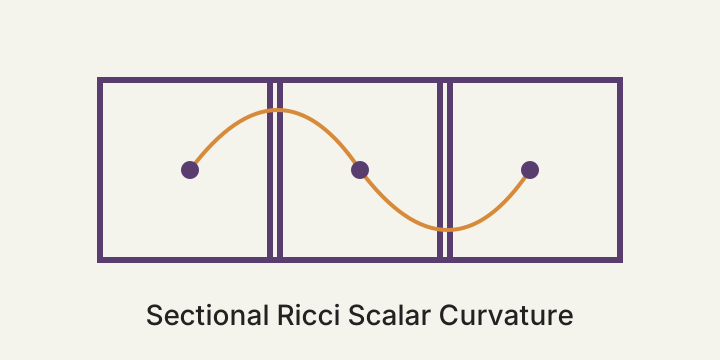
The sectional curvature at a point measures the Gaussian curvature of each 2-dimensional slice. The Ricci tensor measures how volumes distort along each direction.
Worked example [Beginner]
Consider the 2-sphere with radius (unit sphere). We compute the three curvatures at every point.
Step 1. The sectional curvature of the unit sphere is constant: at every point, for every 2-plane. This is because the Gaussian curvature of a sphere of radius is , and here .
Step 2. The Ricci tensor on a 2-dimensional manifold satisfies , where is the Gaussian curvature and is the metric. For with : (the Ricci tensor equals the metric tensor). In the standard round metric, this means and for any orthonormal basis .
Step 3. The scalar curvature is for the unit 2-sphere. (In general, for constant curvature in dimension , so .)
What this tells us: the three curvature quantities agree for a surface of constant curvature --- they all report the same information in different formats.
Check your understanding [Beginner]
Formal definition [Intermediate+]
Let be a Riemannian manifold with Riemann curvature tensor . In components, .
Definition (Sectional curvature). For linearly independent vectors , the sectional curvature of the 2-plane is:
The denominator is the squared area of the parallelogram spanned by and .
Definition (Ricci tensor). The Ricci tensor is the contraction of the Riemann tensor:
where is any orthonormal basis of . The Ricci tensor is symmetric: .
Definition (Scalar curvature). The scalar curvature is the trace of the Ricci tensor:
Counterexamples to common slips
Scalar curvature does not determine sectional curvature. Two manifolds can have the same scalar curvature at every point but very different sectional curvatures. A product has positive scalar curvature but zero sectional curvature on the -direction planes.
Ricci-flat does not mean flat. A manifold with need not have . K3 surfaces (Calabi-Yau manifolds of complex dimension 2) are Ricci-flat but have non-zero Riemann curvature tensor. The Riemann tensor can have non-zero components in directions not captured by the Ricci contraction.
The sign convention matters. Some authors define with opposite sign. The sectional curvature formula absorbs this: , so if flips sign, flips sign. Always check the convention.
Key theorem with proof [Intermediate+]
Theorem (Curvature determined by sectional curvatures). The Riemann curvature tensor is completely determined by the sectional curvature function on the Grassmannian of 2-planes in . Specifically, if and are two curvature tensors with the same sectional curvature for every 2-plane , then .
Proof. Define (the fully covariant form, using the metric to lower the first index). The symmetries of are:
- (skew in first pair)
- (skew in second pair)
- (pair exchange)
- (first Bianchi)
The sectional curvature determines the quantity for all pairs . The goal is to recover all of from these values.
Step 1: Polarisation. For fixed , we use the bilinear form on 2-vectors. By the polarisation identity for bilinear forms:
Expanding , so:
By symmetry (3): . And by (2). So:
All terms on the right are sectional-curvature expressions (known from ).
Step 2: Recover the full tensor. For general , apply the first Bianchi identity to permute arguments and use the result from Step 1 to express everything in terms of quantities of the form where the last two arguments coincide. Each such quantity is recovered by polarisation in Step 1.
Bridge. This theorem builds toward Schur's theorem on constant-curvature spaces and appears again in the classification of model geometries 03.02.06. The foundational reason is that sectional curvature is the "unit of information" from which all curvature quantities are built, and this is exactly the bridge between the multilinear algebra of the curvature tensor and the geometry of 2-dimensional slices. Putting these together with the Ricci tensor (which is the average of sectional curvatures) and the scalar curvature (which is the average of Ricci curvatures), the three quantities form a hierarchy of increasingly compressed curvature data.
Exercises [Intermediate+]
Advanced results [Master]
Theorem 1 (Bianchi identities). The Riemann curvature tensor satisfies two algebraic identities and one differential identity:
- First Bianchi: .
- Second (differential) Bianchi: . Contracting the second Bianchi identity gives , relating the divergence of the Ricci tensor to the gradient of the scalar curvature.
Theorem 2 (Schur's theorem). Let be a connected Riemannian manifold of dimension . If the sectional curvature at each point is independent of the 2-plane (so is a function of alone), then is constant on .
Theorem 3 (Einstein manifolds). A Riemannian manifold is Einstein if for a constant . In dimension , the Einstein condition is equivalent to the vanishing of the traceless Ricci tensor . The scalar curvature of an Einstein manifold is . By Schur's theorem, any manifold of dimension with for a smooth function is automatically Einstein (with constant).
Theorem 4 (Scalar curvature and volume comparison). Let be a complete Riemannian manifold with scalar curvature for a positive constant . Then the volume of geodesic balls in is bounded above by the volume of geodesic balls in the constant-curvature sphere of scalar curvature . Conversely, gives a volume lower bound compared to hyperbolic space.
Theorem 5 (Decomposition of the curvature tensor). In dimension , the Riemann curvature tensor decomposes into three irreducible components under the orthogonal group: the scalar part , the traceless Ricci part, and the Weyl tensor . The Weyl tensor captures the curvature information not seen by either Ricci or scalar curvature. In dimension 3, the Weyl tensor vanishes identically, and is determined by .
Synthesis. The hierarchy from sectional to Ricci to scalar curvature is the foundational reason that geometric analysis can operate at multiple levels of resolution. The central insight is that sectional curvature is the irreducible unit of curvature information, and this is exactly the bridge from which both Ricci and scalar curvatures are derived by averaging. Putting these together with the Bianchi identities, the contracted second Bianchi identity forces the Einstein condition to be rigid in dimension via Schur's theorem. The pattern generalises: the Weyl tensor captures the curvature information invisible to both Ricci and scalar curvature, and this appears again in conformal geometry where the Weyl tensor is the conformal invariant.
Full proof set [Master]
Proposition 1 (Schur's theorem). Let be a connected Riemannian manifold of dimension such that the sectional curvature at each point depends only on (not on the 2-plane). Then is constant.
Proof. If the sectional curvature at is independent of the 2-plane, then the curvature tensor has the form where . The Ricci tensor is then , and the scalar curvature is .
Differentiating the relation and contracting with the second Bianchi identity: the contracted second Bianchi identity gives (after appropriate index manipulation). Substituting :
Contracting with (trace over ):
For , the coefficient , so for all . Since is connected, is constant.
Proposition 2 (Contracted Bianchi identity). The Riemann curvature tensor of any Riemannian manifold satisfies .
Proof. The second Bianchi identity in coordinates reads (with sign conventions appropriately chosen). Contracting on the first and fourth indices: set (or use the metric to contract):
\nabla^i R_{ijk}^{\quad l} - \nabla_j R_{ik}^{\quad k}_i + \nabla_k R_{ij}^{\quad j}_i = 0
After simplification using the symmetry properties of : . The standard computation gives , which in coordinate-free notation is .
Connections [Master]
Frobenius theorem
03.02.04. The Frobenius theorem controls when distributions integrate to submanifolds. Curvature measures the failure of second-order commutativity of covariant derivatives, a dual perspective on the same Lie-bracket structure. The integrability of a distribution is a curvature-type condition.Constant-curvature spaces
03.02.06. The sectional, Ricci, and scalar curvatures developed here are the quantities that classify the constant-curvature model spaces. Schur's theorem from this unit is the key ingredient in the Killing-Hopf classification of03.02.06.Einstein field equations
03.02.05. The Ricci tensor and scalar curvature are the geometric quantities appearing in the Einstein field equations of general relativity. The contracted Bianchi identity ensures conservation of energy-momentum.
Historical & philosophical context [Master]
Riemann introduced the curvature tensor in his 1854 Habilitationsschrift "Ueber die Hypothesen welche der Geometrie zu Grunde liegen" [Riemann1854], recognising that a Riemannian metric determines a notion of curvature generalising Gauss's Theorema Egregium. Riemann's insight was that curvature is an intrinsic property of the metric, not dependent on any embedding.
Ricci-Curbastro introduced the contracted curvature tensor in his 1892 paper on the absolute differential calculus (later popularised as tensor calculus by Ricci and Levi-Civita) [Ricci1892]. Einstein used the Ricci tensor (in the form of the Einstein tensor ) in his 1915 field equations of general relativity (Sitzungsber. Preuss. Akad. Wiss.) [Einstein1915], establishing the link between spacetime geometry and gravitation that persists as the cornerstone of modern physics.
Bibliography [Master]
@incollection{Riemann1854,
  author = {Riemann, Bernhard},
  title = {Ueber die Hypothesen welche der {G}eometrie zu {G}runde liegen},
  booktitle = {Abhandlungen der K\"{o}niglichen Gesellschaft der Wissenschaften zu G\"{o}ttingen},
  volume = {13},
  year = {1854},
  pages = {133--152},
}

@article{Ricci1892,
  author = {Ricci-Curbastro, Gregorio},
  title = {R\'{e}sum\'{e} de quelques travaux sur les syst\`{e}mes variables de fonctions associ\'{e}s \`{a} une forme diff\'{e}rentielle quadratique},
  journal = {Bull. Sci. Math.},
  volume = {16},
  year = {1892},
  pages = {167--189},
}

@article{Einstein1915,
  author = {Einstein, Albert},
  title = {Die Feldgleichungen der Gravitation},
  journal = {Sitzungsber. Preuss. Akad. Wiss.},
  year = {1915},
  pages = {844--847},
}

@book{doCarmo1992,
  author = {do Carmo, Manfredo P.},
  title = {Riemannian Geometry},
  publisher = {Birkh\"{a}user},
  year = {1992},
}

@book{Petersen2006,
  author = {Petersen, Peter},
  title = {Riemannian Geometry},
  edition = {2},
  publisher = {Springer},
  year = {2006},
}