Holomorphic vector bundle
Anchor (Master): Grauert 1958; Atiyah 1957; Bott-Chern 1965; Kobayashi Ch. 1-3
Intuition [Beginner]
A vector bundle assigns a vector space to each point of a manifold. A holomorphic vector bundle does the same on a complex manifold, but the assignment varies holomorphically: the fibres are complex vector spaces and the way they change from point to point respects complex analysis.
The simplest example is the holomorphic tangent bundle of . At each point the tangent space is , and the coordinate basis vectors depend holomorphically on position. More interesting examples include the tautological line bundle over , where the fibre over a point is the complex line that point represents.
Holomorphic bundles are much more rigid than smooth bundles. A smooth vector bundle can be deformed continuously, but a holomorphic bundle has discrete invariants (Chern classes) that constrain its shape.
Visual [Beginner]
A complex manifold with a complex line attached to each point, varying smoothly as you move across the manifold. The line is drawn as a copy of the complex plane, and the transition between overlapping charts preserves the holomorphic structure.
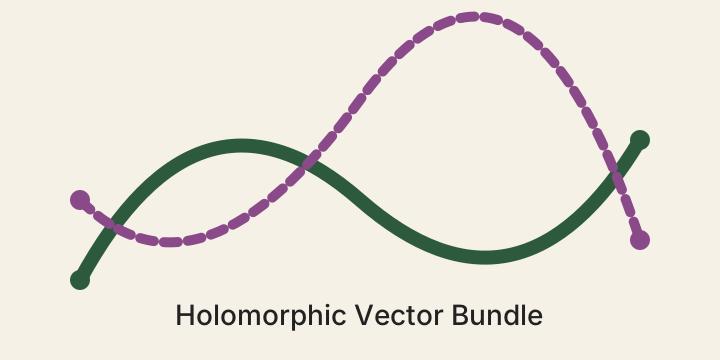
A holomorphic vector bundle: complex fibres glued by holomorphic transitions.
Worked example [Beginner]
The tautological line bundle over assigns to each point of the projective line the complex line in .
On the chart with coordinate , the fibre is spanned by . On with coordinate , the fibre is spanned by . The transition function is holomorphic. The dual bundle has transition , also holomorphic.
Check your understanding [Beginner]
Formal definition [Intermediate+]
Definition. A holomorphic vector bundle of rank over a complex manifold is a complex manifold with a holomorphic surjection such that:
- Each fibre has the structure of an -dimensional complex vector space.
- There exists an open cover of and biholomorphisms that are linear on each fibre.
- The transition functions are holomorphic.
Sheaf-theoretic formulation. Holomorphic vector bundles of rank over correspond to locally free coherent sheaves of -modules of rank . The sections of over are the holomorphic sections of over .
Key invariants. The Chern classes are the topological invariants of a holomorphic vector bundle. For line bundles, classifies the topological type completely.
Key theorem with proof [Intermediate+]
Theorem (Birkhoff-Grothendieck). Every holomorphic vector bundle on decomposes as a direct sum of line bundles: for unique integers .
Proof sketch. Cover by two charts with coordinate overlap . The transition function is a holomorphic map . By Laurent expansion, can be factored (via diagonalisation of the principal part) into upper-triangular form, then further into diagonal form . Uniqueness follows from the splitting type being invariant under holomorphic gauge transformations.
Bridge. The Birkhoff-Grothendieck theorem extends the fibre-bundle reconstruction principle 03.05.00 — where bundles are built from transition functions — to the holomorphic category on , where the rigidity of holomorphic functions forces a complete classification. This mirrors the way holomorphic functions are more constrained than smooth functions, a pattern that recurs throughout complex geometry. The theorem also previews the role of Chern classes, since the integers encode the first Chern class of each summand.
Exercises [Intermediate+]
Advanced results [Master]
Narasimhan-Seshadri theorem (1965). On a compact Riemann surface of genus , stable holomorphic vector bundles of degree 0 correspond bijectively to irreducible unitary representations of the fundamental group. This links holomorphic bundle theory to representation theory and is the prototype for the Hitchin-Kobayashi correspondence.
Hitchin-Kobayashi correspondence. A holomorphic vector bundle over a compact Kahler manifold admits a Hermitian-Einstein metric if and only if is polystable (a direct sum of stable bundles of the same slope). This generalises Narasimhan-Seshadri to higher dimensions and was proved independently by Donaldson and Uhlenbeck-Yau.
Kodaira vanishing and Serre duality. For an ample line bundle on a compact Kahler manifold, for . Combined with Serre duality, this provides powerful tools for computing cohomology of holomorphic bundles.
Synthesis. Holomorphic vector bundles sit at the intersection of complex analysis, algebraic geometry, and differential geometry. Extending the fibre-bundle framework 03.05.00 to the holomorphic category introduces rigidity that enables classification results like Birkhoff-Grothendieck. The sheaf-theoretic formulation connects bundles to algebraic geometry via the locally-free-sheaf correspondence, while stability conditions and the Hitchin-Kobayashi correspondence bridge to gauge theory and Hermitian metrics 03.05.20. This web of equivalences — holomorphic, sheaf-theoretic, and metric — is a paradigmatic example of how different mathematical languages describe the same underlying objects.
Full proof set [Master]
Proposition. A holomorphic line bundle on a complex manifold is determined up to isomorphism by its transition functions , which satisfy the cocycle condition on triple overlaps. Isomorphism classes of holomorphic line bundles form a group under tensor product.
Proof. The cocycle condition ensures the gluing is consistent, by the same argument as for smooth bundles 03.05.00. Two sets of transitions and define isomorphic line bundles if and only if there exist holomorphic maps with . This is precisely the cohomological relation defining .
Connections [Master]
General fibre bundles 03.05.00 provide the topological and smooth framework; holomorphic vector bundles add the requirement that transition functions be holomorphic, introducing the rigidity characteristic of complex geometry.
The holonomy group 03.05.16 and holonomy reduction 03.05.18 constrain the type of holomorphic bundle that can admit a compatible metric; a holomorphic bundle with a Hermitian-Einstein connection has reduced holonomy.
Hermitian metrics and the Chern connection 03.05.20 provide the differential-geometric tools for studying holomorphic bundles, linking the holomorphic category to curvature, stability, and gauge theory.
Bibliography [Master]
@book{huybrechts,
  author = {Huybrechts, Daniel},
  title = {Complex Geometry: An Introduction},
  publisher = {Springer},
  year = {2005}
}

@book{kobayashi-cvb,
  author = {Kobayashi, Shoshichi},
  title = {Differential Geometry of Complex Vector Bundles},
  publisher = {Princeton Univ. Press},
  year = {1987}
}

@book{griffiths-harris,
  author = {Griffiths, Phillip and Harris, Joseph},
  title = {Principles of Algebraic Geometry},
  publisher = {Wiley},
  year = {1978}
}
Historical & philosophical context [Master]
Holomorphic vector bundles were studied systematically from the 1950s onward, motivated by the desire to apply sheaf-theoretic methods to geometric problems. The Serre-Swan analogy — between projective modules over a ring and vector bundles over a space — was extended to the holomorphic setting by Grauert (1958), who proved that holomorphic vector bundles correspond to locally free sheaves.
The Birkhoff-Grothendieck theorem for illustrates a philosophical divide between smooth and holomorphic categories. Smooth vector bundles on are classified by , a subtle homotopy invariant. Holomorphic bundles on are classified by a finite tuple of integers, a much finer classification enabled by the rigidity of holomorphic functions. This rigidity-versus-flexibility dialectic pervades complex geometry.
The Narasimhan-Seshadri theorem (1965) opened the door to a deep interaction between algebraic geometry and gauge theory, culminating in the Hitchin-Kobayashi correspondence and Donaldson's work on four-manifold topology, where holomorphic bundle moduli spaces became powerful tools for studying smooth structures.