Hermitian metric on a complex bundle; Chern connection
Anchor (Master): Chern 1946; Kobayashi Ch. 1-4; Griffiths-Harris Ch. 0; Wells Ch. 3-5
Intuition [Beginner]
A Hermitian metric adds a notion of length and angle to a complex vector bundle. Just as a Riemannian metric provides an inner product on each tangent space of a real manifold, a Hermitian metric provides a complex inner product on each fibre of a complex bundle. The inner product is conjugate-symmetric: swapping two vectors conjugates the result.
The Chern connection is the canonical way to differentiate sections of a Hermitian holomorphic bundle. It is the unique connection that simultaneously respects the Hermitian metric (preserves lengths and angles during parallel transport) and the holomorphic structure (differentiates holomorphic sections in the holomorphic direction without producing anti-holomorphic terms).
Think of the Chern connection as the "best" connection on a complex bundle with a Hermitian metric: it is the only one that plays nicely with both the complex geometry and the metric geometry.
Visual [Beginner]
A complex curve with a complex plane (fibre) attached at each point. Each fibre has a Hermitian inner product visualised as a unit circle. The Chern connection ensures that parallel transport preserves these unit circles and respects the holomorphic direction.
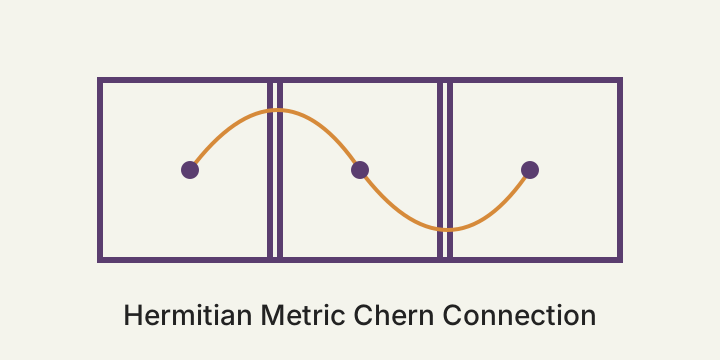
The Chern connection preserves both the metric and the holomorphic structure.
Worked example [Beginner]
The holomorphic tangent bundle of with coordinate has the standard flat Hermitian metric . The inner product of two tangent vectors and (viewed as complex numbers) is .
The Chern connection on this bundle is flat (since is constant), so parallel transport is ordinary translation: a constant section is parallel.
For the hyperbolic metric on , the Chern connection is curved, with Gaussian curvature . The connection form depends on both and , encoding the varying inner product across the fibre.
Check your understanding [Beginner]
Formal definition [Intermediate+]
Definition (Hermitian metric). A Hermitian metric on a holomorphic vector bundle is a smooth assignment of a positive-definite Hermitian inner product to each fibre, varying smoothly with . In a local holomorphic frame , is represented by a Hermitian matrix with .
Definition (Chern connection). Given a holomorphic vector bundle with Hermitian metric , the Chern connection is the unique connection on satisfying:
- Metric compatibility: for all smooth sections .
- Compatibility with holomorphic structure: , meaning the -part of the connection equals the Dolbeault operator.
In a local holomorphic frame, the connection matrix is where is the Hermitian matrix of .
Key theorem with proof [Intermediate+]
Theorem (Chern). For any Hermitian metric on a holomorphic vector bundle , there exists a unique connection satisfying both metric compatibility and . Its curvature is a -form with values in .
Proof. In a local holomorphic frame , define . Check metric compatibility: since is Hermitian. The -part is , giving , which equals on sections. The curvature is of type . Uniqueness follows because any two such connections would have the same in every holomorphic frame.
Bridge. The Chern connection theorem brings together the holomorphic vector bundle 03.05.19 — which provides the complex-analytic structure — with the metric geometry of Hermitian inner products. Extending the fibre-bundle connection framework 03.05.00, the theorem produces a canonical connection that simultaneously respects both structures. This dual-compatibility condition is the complex-geometric analogue of the Levi-Civita theorem in Riemannian geometry, where the metric and torsion-free conditions uniquely determine a connection.
Exercises [Intermediate+]
Advanced results [Master]
Hermitian-Einstein metrics. A Hermitian metric on a holomorphic vector bundle over a Kahler manifold is Hermitian-Einstein if the mean curvature is proportional to the identity: for a constant (where is contraction with ). The Hitchin-Kobayashi correspondence states that admits such a metric if and only if is polystable.
Kahler condition as a Chern curvature property. A Hermitian metric on a complex manifold is Kahler if and only if the Chern connection of the holomorphic tangent bundle has symmetric torsion (equivalently, the and parts of the torsion vanish). This gives a curvature-theoretic characterisation of the Kahler condition.
Bott-Chern secondary classes. When two Hermitian metrics produce Chern connections with different curvature forms, the Bott-Chern secondary class interpolates between the two Chern-Weil representatives of the same Chern class, providing a refinement of Chern-Weil theory in the complex setting.
Synthesis. The Chern connection is the linchpin connecting Hermitian differential geometry to complex-analytic geometry. Building on the holomorphic vector bundle framework 03.05.19 and the general connection theory of fibre bundles 03.05.00, the Chern connection provides a unique canonical connection for each Hermitian holomorphic bundle. The Hermitian-Einstein condition links this connection to algebraic stability via the Hitchin-Kobayashi correspondence, while the Kahler condition translates into a curvature property of the Chern connection on the tangent bundle. This circle of ideas — metric, connection, curvature, stability — unifies differential geometry, complex analysis, and algebraic geometry into a single coherent theory.
Full proof set [Master]
Proposition. The first Chern form of a Hermitian holomorphic vector bundle is a closed real -form whose cohomology class equals the topological first Chern class .
Proof. The curvature is of type , so is a -form. Closedness follows from the Bianchi identity and the trace: . If is another Hermitian metric, write locally (for a line bundle); then , so is exact. Thus the cohomology class is independent of and equals the topological Chern class by the Chern-Weil construction.
Connections [Master]
General fibre bundles 03.05.00 supply the connection theory and curvature formalism that the Chern connection instantiates in the complex setting; the Chern connection is the unique connection respecting both metric and holomorphic structures.
Holomorphic vector bundles 03.05.19 provide the complex-analytic framework; the Hermitian metric equips the bundle with a smoothly varying inner product, and the Chern connection is the canonical geometric operator associated to this pair.
The holonomy group 03.05.16 of the Chern connection detects the geometric type of the bundle; for example, the Chern connection of a Hermitian-Einstein metric on a stable bundle has holonomy contained in precisely when the bundle has vanishing first Chern class.
Bibliography [Master]
@book{kobayashi-cvb,
  author = {Kobayashi, Shoshichi},
  title = {Differential Geometry of Complex Vector Bundles},
  publisher = {Princeton Univ. Press},
  year = {1987}
}

@book{huybrechts-cg,
  author = {Huybrechts, Daniel},
  title = {Complex Geometry: An Introduction},
  publisher = {Springer},
  year = {2005}
}

@book{wells,
  author = {Wells, Raymond O.},
  title = {Differential Analysis on Complex Manifolds},
  publisher = {Springer},
  edition = {3},
  year = {2008}
}
Historical & philosophical context [Master]
The Chern connection was introduced by Shiing-Shen Chern in his 1946 paper on characteristic classes of complex vector bundles. Chern recognised that the Hermitian structure and the holomorphic structure together determine a unique connection, paralleling the Levi-Civita theorem for Riemannian manifolds.
The philosophical point is that complex geometry enjoys more canonical structures than real differential geometry. A Riemannian metric determines the Levi-Civita connection, but a complex manifold with a Hermitian metric inherits both the Levi-Civita connection (on the underlying real bundle) and the Chern connection (on the holomorphic bundle). When the metric is Kahler, these two connections coincide on the holomorphic tangent bundle, explaining the privileged status of Kahler geometry.
The development of Hermitian-Einstein metrics by Narasimhan-Seshadri (1965), Donaldson (1985), and Uhlenbeck-Yau (1986) transformed the Chern connection from a technical tool into a bridge between algebraic geometry (stability of bundles) and gauge theory (existence of canonical metrics), a theme that continues to drive research in complex differential geometry and string theory.