Horizontal lift and parallel transport
Anchor (Master): Kobayashi-Nomizu Vol. 1 Ch. 2-3; Husemoller Fibre Bundles Ch. 4
Intuition [Beginner]
A connection on a principal bundle tells you which directions are "horizontal" — directions that move you off the current fibre toward neighbouring fibers. Given a path in the base, the horizontal lift is the unique path in the bundle that follows the connection's horizontal directions and projects down to the original path.
Think of walking along a spiral staircase. Your position on the staircase is a point in the bundle. Walking along the ground floor (the base) has a corresponding path up the staircase. The staircase's slope is the connection, and your path up the stairs is the horizontal lift.
Parallel transport is what happens when you lift a path. Starting at a point in one fibre and moving horizontally along the lift, you arrive at a specific point in the destination fibre. This defines a map between the two fibres — the parallel transport map. It tells you how to carry fibre data consistently along the base.
If your path in the base is a closed loop, parallel transport gives you an automorphism of the starting fibre. This automorphism is the holonomy of the loop. Holonomy measures how much the connection twists the fibres as you go around.
Visual [Beginner]
A curved surface with a vector drawn at one point. As the vector is parallel-transported around a closed triangular path on the surface, it rotates, ending up at a different angle than where it started. The angular difference is the holonomy.
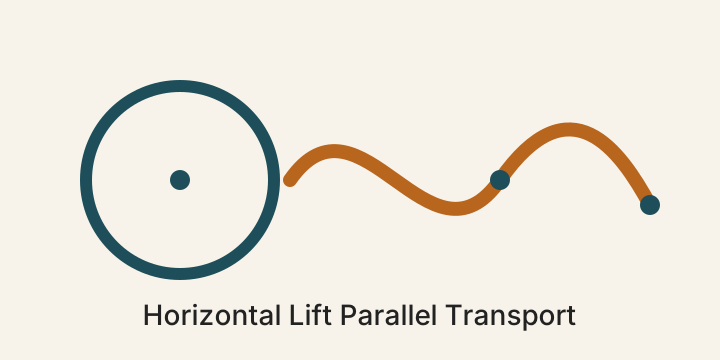
The connection determines how the vector turns as it moves.
Worked example [Beginner]
On the sphere , consider parallel-transporting a tangent vector along a triangular path: start at the north pole, go south along a meridian to the equator, travel along the equator for 90 degrees, then return north along a meridian to the north pole.
Starting with a vector pointing along the first meridian, after reaching the equator it still points south. After the 90-degree equatorial segment, it points along the second meridian (perpendicular to the original direction). Returning to the north pole, the vector has rotated by 90 degrees.
The holonomy angle equals the area of the spherical triangle (one-eighth of the sphere), which is for a unit sphere. This is a direct measurement of the curvature integrated over the enclosed area.
Check your understanding [Beginner]
Formal definition [Intermediate+]
Definition (Connection form). A connection form on a principal -bundle is a -valued 1-form satisfying:
- for all fundamental vector fields .
- for all (equivariance).
The horizontal subspace at is . The splitting follows from condition (1).
Definition (Horizontal lift). Given a curve and a point , the horizontal lift is the unique curve with , , and for all .
Definition (Parallel transport). The parallel transport along from to is the map defined by , where is the horizontal lift starting at .
Key theorem with proof [Intermediate+]
Theorem (Existence and uniqueness of horizontal lifts). Let be a connection form on a principal -bundle , let be a smooth curve, and let . There exists a unique horizontal lift with .
Proof. In a local product chart with connection form (where is a -valued form on ), the horizontality condition becomes the ODE in the group variable . This is a first-order ODE on the Lie group , smooth and linear in , hence has a unique solution on by the Picard-Lindelof theorem. Globally, uniqueness prevents branching, and existence follows by patching local solutions along .
Bridge. The horizontal lift is the mechanism by which a connection on a principal bundle moves fibre data along base curves; this builds directly on the vertical subbundle 03.05.06 whose complement the horizontal distribution defines. The parallel transport map is the integrated version of the connection form, much as the exponential map is the integrated version of the Lie algebra, and the equivariance of the connection form ensures that parallel transport commutes with the right -action on fibres. Together these three constructions — the connection form, the horizontal lift, and the parallel transport map — translate the infinitesimal data of the connection into finite geometric operations on the bundle.
Exercises [Intermediate+]
Advanced results [Master]
The Ambrose-Singer theorem. The holonomy algebra at a point is the Lie subalgebra of generated by the curvature form evaluated at all points reachable from by horizontal lifts:
where denotes the holonomy bundle (all points reachable from by horizontal curves).
Reduction theorem. Let denote the holonomy bundle through . Then is a reduction of with structure group , and the connection restricts to a connection on .
Synthesis. Parallel transport is the integrated manifestation of a connection, translating the infinitesimal splitting of the tangent bundle into finite geometric data; the holonomy group captures the total twisting effect of the connection on the fibres, and the Ambrose-Singer theorem identifies the infinitesimal generators of holonomy with the curvature values throughout the holonomy bundle. The horizontal lift construction connects the local ODE theory of connection forms to the global topology of loops and homotopy, while the reduction theorem shows that the holonomy bundle is the minimal sub-bundle carrying all the connection's geometric information. These results establish parallel transport as the bridge between the differential (curvature) and the topological (characteristic classes) faces of fibre bundle theory.
Full proof set [Master]
Proposition (-equivariance of parallel transport). For any curve in and any , .
Proof. If is the horizontal lift of starting at , then is a curve starting at projecting to (since ). By equivariance of , , so is horizontal. By uniqueness, it is the horizontal lift starting at . Hence .
Proposition (Path-independence under null-homotopy). If and are homotopic curves in with the same endpoints, and the connection is flat (), then .
Proof. A homotopy between and lifts to a horizontal map with fixed (since the fibres are discrete under the horizontal condition). Flatness ensures the lift exists globally. The boundary values give and , and the top edge being horizontal with the same endpoint forces equality.
Connections [Master]
The vertical subbundle 03.05.06 provides the complementary subbundle that the horizontal distribution splits against; a connection is a choice of horizontal complement to the vertical directions.
The general fibre bundle 03.05.00 supplies the principal bundle on which the connection form lives and from which horizontal lifts are constructed.
The holonomy group links to the structure group reduction 03.05.12 since the holonomy bundle is a reduction of with structure group equal to the holonomy group.
Bibliography [Master]
@book{kobayashi-nomizu,
  author = {Kobayashi, Shoshichi and Nomizu, Katsumi},
  title = {Foundations of Differential Geometry},
  volume = {1},
  publisher = {Wiley},
  year = {1963}
}

@article{ambrose-singer1953,
  author = {Ambrose, Warren and Singer, Isadore M.},
  title = {A theorem on holonomy},
  journal = {Trans. Amer. Math. Soc.},
  volume = {75},
  year = {1953},
  pages = {428--443}
}

@book{husemoller,
  author = {Husemoller, Dale},
  title = {Fibre Bundles},
  edition = {3},
  publisher = {Springer},
  year = {1994}
}
Historical & philosophical context [Master]
Parallel transport has its origins in Levi-Civita's 1917 construction of "transport parallelo" on Riemannian manifolds, which gave an intrinsic meaning to keeping a tangent vector "constant" along a curve. Cartan generalized this to moving frames and connections on frame bundles (1920s).
Ehresmann (1950) formulated the general notion of a connection on a principal bundle as a horizontal distribution, making parallel transport the integrated shadow of the connection. The Ambrose-Singer theorem (1953) revealed the deep link between curvature (local data) and holonomy (global data), showing that the curvature form generates the holonomy algebra.
The philosophical significance is that parallel transport provides a concrete geometric mechanism for "comparing" fibres at different base points, even though there is no canonical identification between them. The failure of this comparison to be consistent — measured by holonomy — is precisely the curvature of the connection. This interplay between local integrability and global obstruction is the central theme of gauge theory.