Reduction of structure group; reduction of a connection
Anchor (Master): Steenrod Topology of Fibre Bundles 1951; Husemoller Fibre Bundles Ch. 2-4
Intuition [Beginner]
A fibre bundle with structure group uses the group to glue the local product patches together. A reduction of the structure group means you can rebuild the same bundle using a smaller group sitting inside .
Think of a picture frame. You could describe it using the full group of all linear transformations , but if the frame happens to be rectangular, you only need the smaller group of rotations to describe how the corners fit together. The -structure is a reduction of the -structure.
The key question is: when can you reduce? Not always. A bundle with a metric (a way to measure lengths in each fibre) admits a reduction from to . The metric data is extra structure that picks out a smaller symmetry group.
A reduction of a connection goes further: given a connection on the big bundle, you ask whether it restricts to a connection on the reduced bundle. This happens when the connection respects the reduced structure — for example, a connection that preserves lengths corresponds to a connection on the orthonormal frame bundle.
Visual [Beginner]
A 2-dimensional vector space with two sets of basis vectors drawn. The full set of all bases forms a -torsor. The orthonormal bases form an -subtorsor. A section of the associated bundle selects a distinguished inner product at each point.
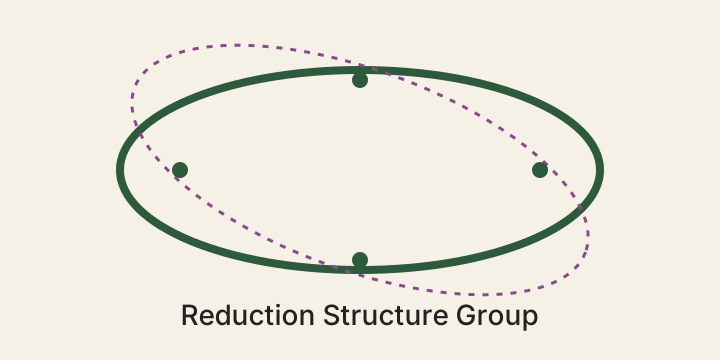
A Riemannian metric reduces the structure group from to .
Worked example [Beginner]
On any smooth manifold , the tangent bundle has structure group . A Riemannian metric on provides an inner product on each tangent space. The orthonormal frame bundle consists of frames with .
is a principal -bundle and sits inside the full frame bundle (a principal -bundle) as a reduction. The inclusion embeds into as a submanifold preserved by the restricted -action.
Conversely, a reduction of to is the same thing as a Riemannian metric. The metric is recovered by declaring the orthonormal frames to be orthonormal.
Check your understanding [Beginner]
Formal definition [Intermediate+]
Definition (Reduction of structure group). Let be a principal -bundle and a subgroup. A reduction of to is a principal -bundle together with an -equivariant bundle map covering the identity on , such that the induced map is an isomorphism.
Theorem (Reductions and sections). Reductions of to are in bijection with sections of the associated bundle .
Proof sketch. Given a section , define . This is a principal -subbundle. Conversely, given , the map for any is well-defined and gives a section of . These constructions are mutually inverse.
Definition (Reduction of a connection). A connection form on reduces to if is horizontal for the restriction and takes values in . Equivalently, the horizontal distribution is tangent to along .
Key theorem with proof [Intermediate+]
Theorem (Existence of reductions). A principal -bundle admits a reduction to if and only if the classifying map factors (up to homotopy) through .
Proof. The fibration gives a long exact sequence. A section of exists if and only if the obstruction in lifts to . The classifying map of is the homotopy class of a map , and the reduction exists iff lifts through . The obstruction classes live in the cohomology groups .
Bridge. The existence of a reduction is governed by the same classifying-space machinery that classifies principal bundles via homotopy classes of maps; the fibre of is , and the reduction problem translates to a section problem on the associated bundle . The Lie subgroup inclusion induces the map , and the obstruction to lifting the classifying map is measured by characteristic classes, specifically those that vanish when the structure group reduces. The reduction of a connection further requires that the connection form respect the reduced structure, imposing an algebraic condition on the curvature valued in the complement .
Exercises [Intermediate+]
Advanced results [Master]
G-structures. A -structure on an -manifold is a reduction of the frame bundle from to a subgroup . Examples: (Riemannian metric), (orientation), (volume form), (conformal class of metrics), (almost complex structure).
Obstruction theory for reductions. The obstruction to reducing from to lives in via the Postnikov tower of . For to : the obstruction is the first Stiefel-Whitney class . For to : the obstruction is .
Induced connections. If is a connection on that reduces to , the curvature of restricts to a -valued form on . The -component of the curvature vanishes on if and only if the connection reduces.
Synthesis. Reductions of structure group connect the topology of a bundle to the geometry of its fibres; a reduction constrains the transition functions to lie in a smaller subgroup, which corresponds geometrically to selecting extra structure (a metric, an orientation, a complex structure) on each fibre. The classifying space framework translates the reduction problem into a homotopy lifting problem, and the obstruction classes are the characteristic classes that detect when the bundle has more structure than its topology alone requires. The induced connection on a reduction ties the differential-geometric data of the connection to the algebraic data of the subgroup, with the curvature components in the complement measuring the failure of the connection to respect the reduced structure.
Full proof set [Master]
Proposition (Metric implies -reduction). Every Riemannian metric on determines a unique reduction of to .
Proof. Define where is the standard basis of . This is a closed submanifold of since the condition is smooth. The right action of preserves this condition: for . The action is free and transitive on each fibre of by the Gram-Schmidt process. Hence is a principal -bundle and a reduction of .
Proposition (Connection reduction criterion). A connection on reduces to if and only if the -component of vanishes.
Proof. If reduces to , then by definition takes values in , so the -component vanishes. Conversely, if takes values in , then the horizontal distribution is contained in for (since is the kernel of the -projection restricted to ). Hence is preserved by parallel transport, and is a connection form on .
Connections [Master]
The general fibre bundle 03.05.00 establishes the principal bundle framework; reductions select sub-bundles with smaller structure groups, corresponding to additional geometric structure on the fibres.
The vertical subbundle 03.05.06 and connection machinery 03.05.11 are prerequisites because a reduction of a connection requires the horizontal distribution to be tangent to the reduced sub-bundle.
Characteristic classes detect obstructions to reductions: the Stiefel-Whitney classes and are the obstructions to orientability and spin structure respectively 03.05.13.
Bibliography [Master]
@book{steenrod1951,
  author = {Steenrod, Norman},
  title = {The Topology of Fibre Bundles},
  publisher = {Princeton Univ. Press},
  year = {1951}
}

@book{kobayashi-nomizu,
  author = {Kobayashi, Shoshichi and Nomizu, Katsumi},
  title = {Foundations of Differential Geometry},
  volume = {1},
  publisher = {Wiley},
  year = {1963}
}

@book{husemoller,
  author = {Husemoller, Dale},
  title = {Fibre Bundles},
  edition = {3},
  publisher = {Springer},
  year = {1994}
}
Historical & philosophical context [Master]
The concept of reducing the structure group emerged naturally from the study of -structures in differential geometry. Weyl (1918) implicitly used the reduction from to when introducing the orthogonal group into metric geometry. Cartan's moving frame method (1920s) is fundamentally about working with reduced frame bundles.
Steenrod (1951) formalized the theory of reductions in the topological setting, establishing the correspondence between reductions and sections of associated bundles. The obstruction-theoretic viewpoint was developed by Serre, Borel, and others in the 1950s.
The philosophical point is that geometric structure on a manifold is encoded as a reduction of the frame bundle: a Riemannian metric reduces to , an almost complex structure to , a symplectic form to , and so on. Each reduction imposes constraints on what connections are possible, creating a hierarchy of geometric structures where each layer refines the previous one.