Associated bundle and induced connection
Anchor (Master): Husemoller Fibre Bundles Ch. 2-4; Steenrod Topology of Fibre Bundles 1951
Intuition [Beginner]
A principal -bundle is like a scaffolding: it carries the symmetry structure but no "payload" in its fibres. An associated bundle attaches a payload. Given a space on which acts, the associated bundle has fibres isomorphic to , twisted in the same way as .
Think of the frame bundle of a surface. The frame bundle itself has fibres made of coordinate frames (the scaffolding). The tangent bundle is an associated bundle: each frame and a vector together produce a tangent vector . The tangent bundle is .
An induced connection carries the connection from the principal bundle to the associated bundle. Since a connection on tells you how to parallel-transport frames, it also tells you how to parallel-transport vectors written in those frames. If you move the frame horizontally and keep the components constant, the resulting vector is parallel-transported.
This is how Riemannian geometry works in practice: you define the connection on the orthonormal frame bundle, and it induces the covariant derivative on vector fields, tensor fields, and all other associated bundles.
Visual [Beginner]
A principal bundle drawn as a cylinder (base circle times fibre circle). Next to it, the associated vector bundle drawn as a twisted ribbon. A frame at one point and a vector in combine to give a tangent vector in the ribbon.
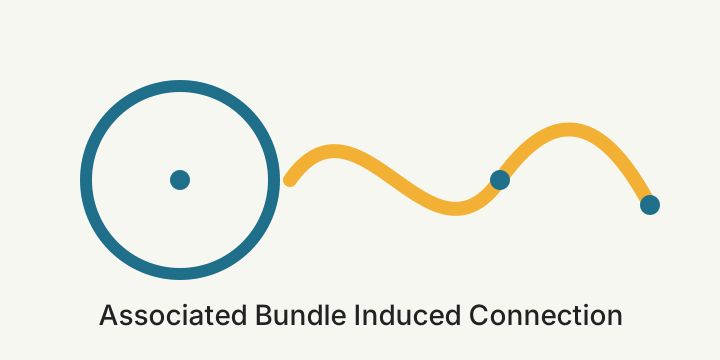
The induced connection moves the vector by moving the frame horizontally.
Worked example [Beginner]
Let be the frame bundle of the 2-sphere, a principal -bundle. The tangent bundle is the associated bundle , where acts on by matrix-vector multiplication.
A point in consists of a frame at some and a vector , subject to .
The Levi-Civita connection on induces parallel transport on : to transport a tangent vector along a curve, write it in terms of a parallel-transported frame and keep the components constant.
Check your understanding [Beginner]
Formal definition [Intermediate+]
Definition (Associated bundle). Let be a principal -bundle and a left -action on a manifold . The associated bundle is:
The projection makes a fibre bundle with fibre and structure group .
Definition (Induced connection). A connection on induces a covariant derivative on sections of . For a section and a tangent vector , write locally as for a local section of and a function . The covariant derivative is:
where is the derivative of .
Key theorem with proof [Intermediate+]
Theorem (Connections on and connections on ). Let be a vector bundle associated to a principal -bundle. There is a bijection between -connections on and linear connections on .
Proof. Given on , define on via the induced covariant derivative. This is well-defined (independent of the representative and the local section ) because changing to transforms both and by the adjoint and representation actions, which cancel. Conversely, given a linear connection on , define on by requiring that for a local frame . The equivariance of follows from the linearity of . These maps are mutually inverse.
Bridge. The associated bundle construction extends the principal bundle machinery to vector bundles and tensor bundles, carrying the connection data from the principal setting into the setting of sections and covariant derivatives; the induced covariant derivative on is the shadow of the horizontal distribution on , and the curvature of the induced connection is the image of the principal curvature under the representation. This correspondence is the mechanism by which a single connection on the frame bundle simultaneously determines covariant derivatives on all tensor bundles, unifying the treatment of vector fields, differential forms, and higher-rank tensors under one geometric operation. The reduction theory 03.05.12 enters because the associated bundle is the bundle whose sections classify reductions of the structure group.
Exercises [Intermediate+]
Advanced results [Master]
The adjoint bundle. The associated bundle plays a special role. The curvature form descends to a 2-form on with values in : . The Bianchi identity becomes , where is the covariant exterior derivative.
Tensor bundles. All tensor bundles are associated to the frame bundle. The Levi-Civita connection on induces covariant derivatives on all tensor bundles simultaneously, related by the Leibniz rule.
Representations and characteristic classes. The Chern-Weil homomorphism associates to each -invariant polynomial on a characteristic class , where is the curvature of any connection. This construction works because the curvature transforms equivariantly under .
Synthesis. The associated bundle construction is the translation layer between principal bundle geometry and the geometry of vector and tensor bundles; the induced connection carries the principal connection data into covariant derivatives on sections, while the curvature descends from the principal curvature form via the representation of the structure group. The adjoint bundle provides the natural home for the curvature as a form on the base, and the Chern-Weil homomorphism uses this descent to produce characteristic classes that are independent of the choice of connection. The reduction theory of the structure group enters as the selection of a preferred class of associated bundles corresponding to sub-representations, and the frame bundle example shows that every vector bundle arises as an associated bundle, making the principal bundle the universal object from which all geometric structures on the base are derived.
Full proof set [Master]
Proposition (Well-definedness of the induced covariant derivative). The covariant derivative is independent of the choice of local section of used to represent .
Proof. Let with for some . Then . Computing via :
Now and . Substituting and using , the terms involving cancel, yielding .
Proposition (Curvature of the induced connection). The curvature of the induced connection on is $\rho_(\Omega)\Omega\omegaP$.*
Proof. In a local section of , the connection matrix is and the curvature matrix is . The induced connection on has connection form , so its curvature is . The last equality uses that is a Lie algebra homomorphism: .
Connections [Master]
The general fibre bundle 03.05.00 provides the principal bundle from which associated bundles are constructed; the associated bundle extends the principal geometry to vector bundles, tensor bundles, and all other fibre types.
The vertical subbundle 03.05.06 and parallel transport 03.05.11 supply the connection machinery that induces covariant derivatives on sections of associated bundles.
The reduction of structure group 03.05.12 determines which associated bundles admit sections with special properties, such as the adjoint bundle of a reduced sub-bundle.
Bibliography [Master]
@book{kobayashi-nomizu,
  author = {Kobayashi, Shoshichi and Nomizu, Katsumi},
  title = {Foundations of Differential Geometry},
  volume = {1},
  publisher = {Wiley},
  year = {1963}
}

@book{steenrod1951,
  author = {Steenrod, Norman},
  title = {The Topology of Fibre Bundles},
  publisher = {Princeton Univ. Press},
  year = {1951}
}

@book{husemoller,
  author = {Husemoller, Dale},
  title = {Fibre Bundles},
  edition = {3},
  publisher = {Springer},
  year = {1994}
}
Historical & philosophical context [Master]
The associated bundle construction was present in Steenrod's 1951 monograph as the "induced bundle" via group representations. Its centrality became apparent with the development of gauge theory: in the Yang-Mills framework, matter fields are sections of associated vector bundles, and the gauge connection is the principal connection that induces covariant derivatives on those fields.
The correspondence between connections on a vector bundle and connections on its frame bundle was made explicit by Kobayashi and Nomizu (1963). This correspondence shows that the principal bundle is the "universal" setting: everything about the geometry of a vector bundle can be read off from the geometry of its frame bundle with the appropriate representation.
Chern and Weil (1940s-1950s) used the associated bundle machinery to construct characteristic classes via invariant polynomials on the Lie algebra, establishing the bridge between differential geometry (connections and curvature) and algebraic topology (cohomology classes).