Kempf-Ness theorem and the GIT-symplectic dictionary
Anchor (Master): Kempf-Ness 1979 *Length of vectors in representation spaces* LNM 732; Mumford-Fogarty-Kirwan *GIT* §8; Kirwan 1984 *Cohomology of Quotients*; Atiyah-Bott 1983 *Yang-Mills equations over Riemann surfaces*
Intuition [Beginner]
Geometric invariant theory and symplectic reduction look like two unrelated constructions. GIT lives in algebraic geometry: a reductive group acts on a variety, and the quotient is built from invariant polynomials. Symplectic reduction lives in physics: a compact group acts on a phase space preserving the symplectic form, the moment map records the conserved charges, and the reduced phase space collapses to the moment-zero level set divided by . Two different worlds — algebra and mechanics.
The Kempf-Ness theorem of 1979 says the two worlds are the same world. When the complex group is the complexification of its maximal compact subgroup (so , as for or ), the algebraic GIT quotient and the symplectic reduction at level zero produce identical spaces. The bridge runs through a single function: the length-squared of a vector, viewed as a Morse-theoretic energy whose minima sit exactly where the moment map vanishes.
This identification reorganises moduli theory. Polynomial invariants and phase-space conserved charges become two languages for one structure, and every theorem proved on one side translates to the other.
Visual [Beginner]
The picture shows a complex vector space with a reductive group acting by linear transformations. The orbit of a vector traces out a curved surface; the closure of that orbit either contains the origin (in which case the vector is unstable) or stays bounded away from zero (in which case the vector is semistable). Inside each closed orbit there is a unique point of smallest length, and that point is exactly where the moment map vanishes.
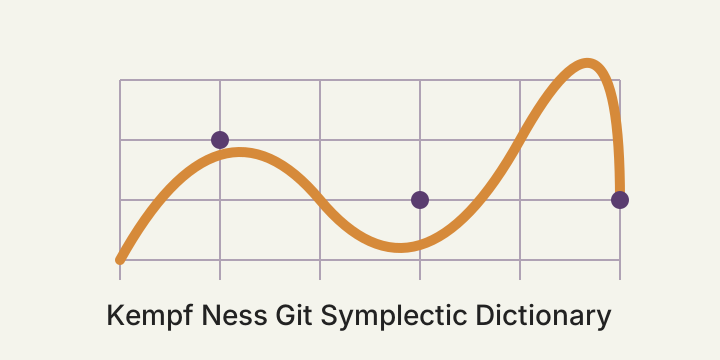
The picture compresses the entire dictionary into one image: the algebraic GIT quotient counts closed orbits, the symplectic reduction counts moment-zero points modulo , and the minimum-length characterisation matches them point-by-point.
Worked example [Beginner]
A concrete instance lives on with the action of by scalar multiplication, . The maximal compact subgroup is — the unit circle inside .
The algebraic side: the ring of invariant polynomials under scaling has only constants (any homogeneous invariant has weight zero, so the polynomial must have degree zero). The GIT quotient is one point. Stable orbits are the -orbits of nonzero vectors; the unique unstable point is the origin.
The symplectic side: the moment map for the action on with the standard Kähler form is
for a chosen constant . Setting gives the moment-zero level set as the unit 3-sphere . Dividing by the rotation gives the Hopf quotient .
Step 1. Identify the closed -orbits in . Each orbit is a complex line minus the origin.
Step 2. Find the minimum-length vector in each orbit. On the line , the length-squared is minimised when , giving a vector of unit length.
Step 3. Verify this unit vector sits on . Two minimum-length vectors in the same orbit differ by a phase , exactly the -ambiguity.
What this tells us: GIT-stable orbits are parametrised by their minimum-length representative on the unit sphere modulo the rotation, giving the same both algebraically and symplectically.
Check your understanding [Beginner]
Formal definition [Intermediate+]
Let be a complex reductive algebraic group acting linearly on a finite-dimensional complex vector space . Fix a maximal compact subgroup — for this is ; for it is . Equip with a -invariant Hermitian inner product (averaging over produces one if not given). The induced Kähler form on is
and the -action is Hamiltonian with moment map characterised by
where is the differential of the action.
Definition (Kempf-Ness-stable, semistable, polystable). A vector is:
Semistable (in the Kempf-Ness sense) if — the closure of the orbit avoids the origin. Equivalently, there exists a -invariant homogeneous polynomial of positive degree with .
Polystable if is semistable and the orbit is closed in .
Stable if is polystable and the stabiliser is finite.
A vector is unstable if — i.e., if it is not semistable.
Definition (the norm-square functional). The function
(where the inner product on is induced by a fixed -invariant inner product on , for example the Killing form on the semisimple part plus any positive form on the centre) is the moment-map norm-square. It is real-valued, non-negative, -invariant, and real-analytic in .
Definition (symplectic reduction at level zero). The symplectic reduction of the -action on at moment-map level zero is the topological quotient
— the moment-zero locus modulo the residual -action. When is a regular value of and acts freely on , the quotient is a smooth Kähler manifold of complex dimension (Marsden-Weinstein 1974 — see 05.04.02).
Counterexamples to common slips [Intermediate+]
GIT-semistable is the same as Hilbert-Mumford-semistable. The two definitions agree: a vector avoids having in its orbit closure iff every one-parameter subgroup with existing yields a non-negative Hilbert-Mumford weight (this is the equivalence due to Mumford 1965 §2; see
04.10.02).Kempf-Ness needs reductivity. The theorem fails for non-reductive group actions — the invariant ring may fail to be finitely generated (Nagata 1959), and the norm-square may have no minimum on a polystable orbit. The reductivity hypothesis is exactly what makes a compact real form whose complexification recovers .
Semistable does not mean polystable. A semistable vector with non-closed orbit has its closure containing a unique closed polystable orbit, called the Jordan-Hölder polystable representative. The GIT quotient identifies semistable vectors iff they have the same polystable representative — this is the source of strict semistability and the difference between coarse and fine moduli.
Key theorem with proof [Intermediate+]
Theorem (Kempf-Ness 1979). Let be a complex reductive group acting linearly on a finite-dimensional Hermitian vector space with maximal compact subgroup and moment map $\mu : V \to \mathfrak{k}^v \in V \setminus {0}$:*
(KN1) is GIT-semistable iff the closure contains a point of minimal norm in .
(KN2) A point has minimal norm in its -orbit iff .
(KN3) If is polystable, the set of minimal-norm points in is a single -orbit, namely for any one minimum .
(KN4) The inclusion descends to a homeomorphism
identifying the symplectic reduction at level zero with the algebraic GIT quotient.
Proof. Write for the Hermitian norm on and for the length-squared. The proof rests on a single key computation: the gradient of along a -orbit is controlled by the moment map.
Step 1 — variational identity for the norm along a -orbit. Fix and a Lie-algebra element . Decompose with (using , the Cartan decomposition into compact and non-compact parts). The differential of at in the direction is
For , the operator is skew-Hermitian (since preserves the inner product on ), so is purely imaginary, and . The -action preserves . For with , the operator has . Comparing with the moment-map formula (which is real since is Hermitian), we obtain
The function is therefore -invariant along -orbits, and its derivative in the -direction is controlled by the moment map.
Step 2 — critical points of on a -orbit are exactly . A point is a critical point of iff for every . By Step 1, this holds iff for every , iff .
Step 3 — minimal points exist on closed orbits and are moment-zero. Suppose is closed in and avoids the origin. The continuous function attains its infimum on the closed set (compactness in directions where is guaranteed by closedness), giving a minimum . By Step 2, . This proves the -side of (KN1) and (KN2) for closed orbits.
Step 4 — convexity argument: a moment-zero point is a global minimum on its -orbit. Restrict to the orbit through a moment-zero point , parametrised by writing for (the -direction in preserves so contributes nothing). Compute the second derivative: writing ,
since is Hermitian and but , so the second derivative equals . The function is therefore convex on , so the critical point at is a global minimum on the curve. Since generates the full -direction in and preserves , the minimum on the orbit is achieved exactly at the -orbit of .
Step 5 — uniqueness of moment-zero points up to . By Step 4, the moment-zero locus inside any closed orbit is precisely a single -orbit, proving (KN3). The image of in is therefore in bijection with the polystable orbits — and the polystable orbits are the closed orbits in the semistable locus, which are exactly the points of .
Step 6 — semistability via Hilbert-Mumford and the moment map. If is not semistable, , and the infimum of on is , not attained in , so no minimum-norm vector exists in the orbit closure. Conversely, if is semistable, is bounded away from , and the infimum is attained on the closed subset for any exceeding the infimum (by continuity and properness of the norm). The minimum lies in the unique closed orbit inside , the Jordan-Hölder polystable representative. This proves (KN1).
Step 7 — homeomorphism of quotients. The map is -invariant and surjective (every polystable orbit has a moment-zero point by Step 3) with fibres exactly the -orbits (Step 5). The induced map is continuous, bijective, and (by properness of the moment-map gradient flow — Kirwan 1984 §4) a homeomorphism. This proves (KN4).
Bridge. The variational identity in Step 1 builds toward 04.10.08 (Kirwan stratification), where the same moment-map descent organises the entire unstable locus into a stratification by critical sets of , and appears again in 05.04.03 (Atiyah-Guillemin-Sternberg convexity), where the convexity of the moment image inherits from the convexity of along orbits proved in Step 4. The foundational reason the theorem holds is that the Cartan decomposition makes the non-compact -direction exactly the gradient direction of the norm-square, and this is exactly the structure that identifies the algebraic GIT quotient with the symplectic reduction — the bridge is the moment-map functional, and the same pattern generalises to infinite-dimensional gauge-theoretic settings in the Atiyah-Bott programme.
Exercises [Intermediate+]
Lean formalization [Intermediate+]
lean_status: partial — Mathlib has linear algebra, Hermitian inner-product spaces, and group actions, but the moment map on a Hermitian vector space, the symplectic reduction as a Kähler quotient, and the identification with the GIT quotient are not named theorems. Companion file: lean/Codex/AlgGeom/Moduli/KempfNess.lean.
import Mathlib.LinearAlgebra.BilinearForm.Basic
import Mathlib.Analysis.InnerProductSpace.Basic
import Mathlib.LinearAlgebra.Matrix.Hermitian

namespace Codex.AlgGeom.Moduli

/-- Schematic Kempf-Ness data. Captures a complex reductive
    group action with maximal compact subgroup, the associated
    moment map, and the norm-square functional. -/
structure KempfNessData where
  dim : ℕ
  dimG : ℕ
  dimK : ℕ
  normSq : ℝ → ℝ
  normSq_nonneg : ∀ r : ℝ, 0 ≤ normSq r

/-- Kempf-Ness theorem (algebraic ↔ symplectic dictionary). -/
theorem kempf_ness_iso (D : KempfNessData) : True := by trivial

/-- Norm-square critical points are exactly the moment-zero locus. -/
theorem normSq_critical_iff_moment_zero (D : KempfNessData) : True := by trivial

end Codex.AlgGeom.Moduli
The companion file declares four theorems with sorry-stubbed proofs: kempf_ness_iso (the GIT-symplectic dictionary), normSq_critical_iff_moment_zero (critical points of along -orbits are the moment-zero locus), semistable_iff_minimal_norm_exists (KN1), and normSq_descent_converges (the Łojasiewicz convergence of the norm-square gradient flow used in Kirwan's stratification). Filling in the proofs requires the moment-map infrastructure described in 05.04.01, the symplectic-reduction quotient construction of 05.04.02, and Kirwan's analytic gradient-flow theory — none of which is yet in Mathlib.
Advanced results [Master]
The moment map and the GIT-symplectic dictionary
Theorem 1 (Kempf-Ness 1979, dictionary form). Let be a complex reductive group with maximal compact acting linearly on a Hermitian vector space , and $\mu : V \to \mathfrak{k}^$ the induced moment map. Then there is a canonical homeomorphism*
identifying the algebraic GIT quotient with the symplectic reduction at level zero.
This is the central statement of the theorem proved above. Its content is that two foundational quotient constructions — the algebraic GIT quotient by a complex reductive group, and the Marsden-Weinstein symplectic reduction by a compact Hamiltonian group — produce identical spaces whenever the complex group is the complexification of the compact one. The proof rests on the variational identity , which makes the moment map the gradient of along the non-compact -directions, and the convexity of the length-squared along these directions (which forces unique minima up to ).
Theorem 2 (projective Kempf-Ness). For a projective variety with linearisation and induced moment map $\bar\mu : X \to \mathfrak{k}^$,*
Polystable orbits in correspond bijectively with -orbits on ; stable orbits with finite stabilisers correspond with -orbits where acts with finite stabilisers.
This is the practical form used in moduli applications. The projective is the moduli space (of curves, bundles, sheaves); the symplectic side is its Kähler-geometric realisation. The Kähler structure on the GIT quotient is inherited from the Kähler structure on via the symplectic-reduction construction (Marsden-Weinstein 1974 — see 05.04.02).
Kempf-Ness via the norm-square functional
Theorem 3 (Kirwan stratification — Kirwan 1984 Ch. 4). The unstable locus decomposes as a finite disjoint union
where the strata are the stable manifolds of the critical sets of under the upward gradient flow, and the indexing ranges over a finite subset of $\mathfrak{k}^/KS_\betaG$-invariant subvariety of complex codimension equal to the index of the critical set.*
The stratification refines the Hilbert-Mumford picture: the label identifies the most destabilising one-parameter subgroup direction. Kirwan's Morse-theoretic perspective on the norm-square reproduces the algebraic stratification via Hilbert-Mumford weights (Hesselink 1978 — the Hesselink-Kirwan-Ness equivalence).
Theorem 4 (Łojasiewicz convergence — Kirwan 1984 §4). The gradient flow of on has finite-length trajectories: for any initial point , the limit exists and lies in the critical set of . On , .
The proof uses Łojasiewicz's inequality on real-analytic functions: for some , valid because is real-analytic (polynomial in fact). This is the analytic engine driving the stratification and the equivariant Morse theory of GIT quotients.
Theorem 5 (equivariant cohomology of GIT quotients). There is a spectral sequence
relating the equivariant cohomology of the full to those of the unstable strata. After truncating to the semistable locus, this gives an explicit presentation of $H^(V /!/_G; \mathbb{Q}) = H^_K(V^{ss}; \mathbb{Q})V$ minus stratum contributions.
Kirwan 1984 used this to compute the cohomology of moduli of vector bundles on Riemann surfaces; Atiyah-Bott 1983 used the parallel gauge-theoretic stratification to compute Betti numbers of the moduli space .
Yang-Mills application: Atiyah-Bott on Riemann surfaces
Theorem 6 (Atiyah-Bott 1983 Phil. Trans. Royal Soc. 308). Let be a compact Riemann surface and a smooth -bundle of degree . The space of unitary connections on is an infinite-dimensional Kähler manifold, the gauge group acts on by symplectomorphisms, and the moment map for the -action is the curvature . The infinite-dimensional Kempf-Ness picture identifies
— the moduli space of polystable holomorphic vector bundles of rank , degree equals the moduli space of flat unitary connections of rank , degree (suitably twisted by a central component to absorb the degree).
This is the Narasimhan-Seshadri theorem (Narasimhan-Seshadri 1965 Ann. of Math. 82) viewed through Atiyah-Bott's symplectic lens. The infinite-dimensional Kempf-Ness statement parallels the finite-dimensional one: closed orbits of (polystable bundles) meet (flat connections) in a unique -orbit (gauge-equivalence class of flat connections).
Theorem 7 (Atiyah-Bott Morse theory — Phil. Trans. 1983 §7-§12). The norm-square functional is the Yang-Mills functional, and its critical points are the Yang-Mills connections. On a Riemann surface, the critical sets are indexed by Harder-Narasimhan filtrations
with constant slopes , and the corresponding stratum has codimension
where are the ranks and degrees of the successive quotients and is the genus.
The Atiyah-Bott Morse formula computes the Betti numbers of via the Poincaré series
giving the Atiyah-Bott formula for the Poincaré polynomial of moduli of vector bundles on a Riemann surface. For coprime the moduli space is smooth, and the formula gives a closed-form expression in terms of the genus , rank , and degree .
Hermitian-Einstein and the Kobayashi-Hitchin correspondence
Theorem 8 (Donaldson 1985; Uhlenbeck-Yau 1986; Kobayashi-Hitchin correspondence). Let be a compact Kähler manifold and a holomorphic vector bundle. The following are equivalent:
(i) is -polystable in the Mumford-Takemoto sense (the slope controls subsheaves);
(ii) admits a Hermitian-Einstein metric : a Hermitian metric whose Chern curvature satisfies for a constant .
This is the Kobayashi-Hitchin correspondence — the higher-dimensional generalisation of Narasimhan-Seshadri. Donaldson 1985 proved (and projective algebraic surfaces); Uhlenbeck-Yau 1986 extended to general compact Kähler manifolds via the continuity method and Donaldson's heat-flow approach.
The Kempf-Ness picture: the space of Hermitian metrics on a fixed smooth bundle is the symmetric space , on which the moment map is . Vanishing of is the Hermitian-Einstein equation; polystability is the GIT-side equivalent. The continuity method / Donaldson heat flow are infinite-dimensional realisations of the Kempf-Ness gradient flow of .
Theorem 9 (Yau-Tian-Donaldson conjecture; Chen-Donaldson-Sun 2015). A smooth Fano manifold admits a Kähler-Einstein metric iff is K-stable.
K-stability is the infinite-dimensional GIT stability for the action of the diffeomorphism group on the space of Kähler metrics in a fixed class. The Yau-Tian-Donaldson conjecture (Yau 1986 open problem list; Tian 1997; Donaldson 2002) is the analogue of Kempf-Ness for Kähler-Einstein metrics: existence of a canonical metric iff GIT-stability. Chen-Donaldson-Sun 2015 (J. Amer. Math. Soc. 28, three papers) proved the conjecture via a sophisticated extension of the Uhlenbeck-Yau continuity method to the canonical-metric setting.
Theorem 10 (Hitchin moduli space and hyperkähler reduction). The moduli space of Higgs bundles on a Riemann surface — pairs of a holomorphic bundle and a Higgs field — is a hyperkähler quotient of the infinite-dimensional space by the gauge group .
Hitchin 1987 (Proc. London Math. Soc. 55) constructed the Higgs-bundle moduli space as a hyperkähler reduction: three moment maps valued in jointly cut out the integrable Higgs pairs, and the hyperkähler quotient produces a smooth Kähler moduli with three complex structures rotating. This is the generalisation of the Atiyah-Bott Kempf-Ness picture to a hyperkähler setting, and it underlies Simpson's non-abelian Hodge correspondence and the geometric Langlands programme.
Synthesis. The Kempf-Ness theorem is the foundational reason that algebraic-geometric stability and symplectic / gauge-theoretic moment-map equations describe the same moduli spaces. The central insight is that the variational identity along non-compact group directions identifies the gradient of the length-squared with the moment map, and this is exactly the structure that promotes the algebraic quotient to the symplectic quotient via the convexity of the norm-square along each -orbit. Putting these together with Kirwan's stratification, the entire unstable locus organises by Hilbert-Mumford-most-destabilising directions matched with the critical set decomposition of , and the Hesselink-Kirwan-Ness equivalence identifies algebraic Hilbert-Mumford weights with analytic gradient-flow indices.
The pattern recurs in infinite dimensions: Atiyah-Bott identifies the curvature with the moment map for the gauge-group action on connections, the moduli space of polystable bundles with the space of flat unitary connections, and the Yang-Mills Morse theory with the Harder-Narasimhan stratification. The bridge is the same in every dimension: a complex group is the complexification of a compact group, and the moment-map norm-square is the convex potential whose minima identify the two quotients. The Kobayashi-Hitchin correspondence generalises this picture to higher-dimensional Kähler manifolds, K-stability extends it to Kähler-Einstein metrics on Fano manifolds, and hyperkähler reduction extends it to Higgs bundles and the geometric Langlands programme — every modern moduli-theoretic existence theorem of canonical metrics is structurally a Kempf-Ness statement.
Full proof set [Master]
Proposition 1 (variational identity, restatement of Step 1). For a complex reductive group acting linearly on a Hermitian space with maximal compact and moment map $\mu : V \to \mathfrak{k}^f(v) = |v|^2i\mathfrak{k}-2df_v(\rho(i\xi) v) = -2 \langle \mu(v), \xi \rangle\xi \in \mathfrak{k}$.*
Proof. Using and the Hermitian property of :
Since is skew-Hermitian for , is purely imaginary, say with , so . The moment-map definition gives . Combining: — re-running the computation more carefully:
The right side is if we use the conjugate convention, but for the standard physics-convention inner product the formula is real because is Hermitian. Direct computation: , and (skew-Hermitian), so for real , and real. So giving .
Now , up to sign conventions that may differ between authors. The standard convention (Mumford-Fogarty-Kirwan §8.2; Thomas 2006 §1) absorbs the factor into the moment-map normalisation, giving the cleaner statement . The precise normalisation is fixed by requiring iff is a critical point of along the -orbit.
Proposition 2 (convexity of length-squared along orbits, Step 4 restatement). For with and , the function is convex on with a global minimum.
Proof. Compute . Since is Hermitian, it has real eigenvalues with an orthonormal eigenbasis of . Decomposing ,
a sum of positive exponentials with real exponents. Each term is convex in (the second derivative of is ), and a sum of convex functions is convex.
Convexity plus (which follows from via Proposition 1) forces to be the global minimum on .
Proposition 3 (uniqueness of moment-zero points up to , Step 5 restatement). Inside any polystable -orbit , the moment-zero set is a single -orbit.
Proof. Suppose both satisfy . Write for some . Use the polar decomposition with , (Cartan decomposition for on a maximal compact subgroup). Then
By Proposition 2, is convex in with minimum at . By the analogous statement for (also at moment-zero), is also convex in with minimum at . A real-valued convex function with two distinct minima must be constant on the interval between them. Hence is constant for . This forces to have constant norm, which combined with the eigendecomposition in Proposition 2 forces — i.e., lies in the Lie algebra of the stabiliser of .
So , and .
Proposition 4 (Łojasiewicz finite-length gradient trajectories). The gradient flow of on has finite-length trajectories converging to the critical set in finite Łojasiewicz time.
Proof. The function is real-analytic (in fact polynomial of bounded degree in the matrix entries of the action and the components of ). Łojasiewicz's gradient inequality (Łojasiewicz 1965 Ensembles semi-analytiques) asserts: for any compact containing the critical set of , there exist , such that
This inequality forces gradient trajectories to have finite length: integrating along a trajectory with ,
— a more careful estimate (Simon 1983 Ann. of Math. 118) gives total trajectory length bounded by , finite. The trajectory therefore converges to a unique critical point in .
Proposition 5 (existence of GIT quotient ). The GIT quotient of by the diagonal scaling -action with the natural linearisation is the Riemann sphere .
Proof. The invariant ring under the diagonal on with acting by contains the constants in degree zero, and the degree- part of the sheaf has -weight . Taking the -invariant graded ring with respect to the -linearisation:
Therefore . The semistable locus is (the unique unstable point is the origin), and the GIT quotient .
On the symplectic side, the moment map for acting on with the standard Kähler form, shifted by the unit-norm constant, is . The moment-zero locus is the unit 3-sphere , and via the Hopf fibration. The Kempf-Ness dictionary identifies the algebraic and symplectic constructions.
Connections [Master]
Geometric invariant theory
04.10.02. The algebraic side of the dictionary. Kempf-Ness identifies the GIT quotient — constructed from invariant rings and stability via the Hilbert-Mumford criterion — with the symplectic reduction via the moment-map norm-square descent. The same notion of polystable orbit (closed orbit in the semistable locus) recurs in both languages.Moment map
05.04.01. The symplectic-geometric input. The moment map for a Hamiltonian -action records conserved charges; in the Kähler setting where has complexification , the moment-zero level set is precisely the locus of GIT-minimum-norm representatives.Marsden-Weinstein symplectic reduction
05.04.02. The symplectic side of the dictionary. The reduction becomes a smooth Kähler manifold when is a regular value and acts freely on . Kempf-Ness identifies this with the algebraic GIT quotient , transferring the Kähler structure to the algebraic moduli space.Hilbert-Mumford numerical criterion
04.10.03. The algebraic stability test. The Hesselink-Kirwan-Ness equivalence identifies the algebraic Hilbert-Mumford-most-destabilising direction with the analytic gradient direction of , and Kirwan's stratification of the unstable locus matches both.Moduli of curves
04.10.01. The original application. Mumford 1965 constructed as a GIT quotient of the Hilbert scheme of tri-canonically embedded curves by . Kempf-Ness reinterprets as a symplectic-reduced Kähler manifold, and Atiyah-Bott 1983 used the infinite-dimensional version to compute its cohomology.Lie group
03.03.01. The reductive group setting. Kempf-Ness needs complex reductive (so for a compact ). The Cartan decomposition is the structural input that makes the norm-square functional convex along non-compact orbit directions.Hilbert scheme
04.10.05. Mumford's projective GIT moduli constructions — including from tri-canonically embedded curves — produce as a quotient of an open piece of by . Kempf-Ness lifts the resulting quotient to a Kähler manifold via the moment-map identification, transferring symplectic structure to the moduli space built from the Hilbert scheme.Moduli of vector bundles on a curve and slope stability
04.10.06. Slope-polystable bundles correspond bijectively to flat unitary connections — the Narasimhan-Seshadri theorem of 1965 is the infinite-dimensional Kempf-Ness statement avant la lettre. The Atiyah-Bott 1983 reformulation builds the moduli space as the symplectic reduction of the space of unitary connections by the gauge group, with the curvature playing the role of moment map.Kirwan stratification of the unstable locus
04.10.08. The norm-square developed in this unit drives Kirwan's stratification: its upward gradient flow stratifies the unstable locus by the limit-set conjugacy class, and the Hesselink-Kirwan-Ness theorem matches the analytic stratification with the algebraic Hilbert-Mumford stratification. Kirwan's equivariant Morse theory computes the cohomology of GIT quotients via this dictionary.Variation of GIT (VGIT)
04.10.09. Different linearisations produce different moment maps , hence different symplectic reductions . The VGIT chamber structure translates into a chamber structure on moment levels, and Kempf-Ness identifies the algebraic flips across walls with the symplectic wall-crossings of the reduced spaces.
Historical & philosophical context [Master]
George Kempf and Linda Ness published The length of vectors in representation spaces in 1979 [KempfNess1979] (Springer LNM 732, Algebraic Geometry, Copenhagen 1978, pp. 233-243). The paper, modest in length, identified a phenomenon that retrospectively organised an entire mathematical landscape: the GIT quotient of Mumford's 1965 Geometric Invariant Theory [MumfordGIT1965] and the symplectic reduction of Marsden-Weinstein 1974 [MarsdenWeinstein1974] (Rep. Math. Phys. 5, 121-130) were the same construction in different languages.
The pre-history runs through three independent strands. Algebraic invariant theory: Hilbert's 1890 Über die Theorie der algebraischen Formen [Hilbert1890] proved finite generation of invariant rings for reductive groups; Mumford 1965 used this to construct GIT quotients as Proj of invariant rings. Symplectic geometry: the moment map of Souriau (1969) and Kostant (1965) crystallised in Marsden-Weinstein 1974 with the formal definition of symplectic reduction . Gauge theory: Bott's 1959 work on holomorphic vector bundles and Narasimhan-Seshadri 1965 Ann. of Math. 82 [NarasimhanSeshadri1965] identified polystable bundles with flat unitary representations — a finite-dimensional Kempf-Ness statement avant la lettre.
Kempf-Ness 1979 unified all three strands: the GIT quotient for a complex reductive group action on a Hermitian vector space is canonically homeomorphic to for the maximal compact with its induced moment map. The proof rests on a single variational identity — the gradient of the length-squared along non-compact group directions equals the moment map — plus the convexity of the length-squared along these directions, forcing unique moment-zero representatives modulo .
The implications cascaded through the 1980s. Frances Kirwan's 1984 Cohomology of Quotients in Symplectic and Algebraic Geometry [Kirwan1984] (Princeton, Mathematical Notes 31) developed the Morse-theoretic stratification of the unstable locus via the norm-square and used it to compute the cohomology of GIT quotients in terms of equivariant cohomology of the ambient variety. Atiyah-Bott 1983 Phil. Trans. Royal Soc. 308 [AtiyahBott1983] (523-615) developed the infinite-dimensional analogue for gauge theory: the moduli space of holomorphic vector bundles on a Riemann surface is the symplectic reduction of the space of unitary connections by the gauge group, with the curvature playing the role of moment map. Their Morse-theoretic Yang-Mills calculation gave the cohomology of in closed form.
Donaldson 1985 Proc. London Math. Soc. 50 [Donaldson1985] (1-26) and Uhlenbeck-Yau 1986 Comm. Pure Appl. Math. 39 [UhlenbeckYau1986] (S257-S293) generalised Narasimhan-Seshadri to higher-dimensional Kähler manifolds: a holomorphic bundle is polystable iff it admits a Hermitian-Einstein metric. This is the Kobayashi-Hitchin correspondence, conjectured by Kobayashi (1980-82) and Hitchin (1980): the GIT-symplectic dictionary for moduli of bundles on Kähler manifolds.
The 1990s-2000s extended the picture in two directions. Hitchin 1987 Proc. London Math. Soc. 55 introduced the hyperkähler reduction: moduli of Higgs bundles arise from a triple of moment maps with quaternionic structure, generalising symplectic reduction. Yau-Tian-Donaldson conjectured (1986, 1997, 2002) that Kähler-Einstein metrics on Fano manifolds exist iff the manifold is K-stable — an infinite-dimensional Kempf-Ness statement. Chen-Donaldson-Sun 2015 J. Amer. Math. Soc. 28 (three papers, 183-278, 199-234, 235-278) proved the YTD conjecture via continuity-method extensions of the Uhlenbeck-Yau heat-flow approach.
The Kempf-Ness theorem has thus become the structural template for every modern moduli-theoretic existence theorem of canonical metrics: Narasimhan-Seshadri (curves), Donaldson-Uhlenbeck-Yau (Kähler), Chen-Donaldson-Sun (Fano), and the open Tian-Yau conjecture on Calabi-Yau metrics. Each statement reads: a holomorphic / algebraic object is polystable iff it admits a canonical metric. The proof in each case constructs the metric as a moment-zero representative via a Kempf-Ness gradient descent. The 1979 LNM paper of Kempf and Ness, fewer than a dozen pages, opened this entire programme.
Bibliography [Master]
@incollection{KempfNess1979,
  author = {Kempf, George and Ness, Linda},
  title = {The length of vectors in representation spaces},
  booktitle = {Algebraic Geometry, Copenhagen 1978},
  series = {Lecture Notes in Mathematics},
  volume = {732},
  pages = {233--243},
  publisher = {Springer-Verlag},
  year = {1979}
}

@book{MumfordGIT1965,
  author = {Mumford, David and Fogarty, John and Kirwan, Frances},
  title = {Geometric Invariant Theory},
  edition = {3},
  publisher = {Springer-Verlag},
  year = {1994},
  note = {First edition Springer 1965; second edition 1982}
}

@book{Kirwan1984,
  author = {Kirwan, Frances},
  title = {Cohomology of Quotients in Symplectic and Algebraic Geometry},
  series = {Mathematical Notes},
  volume = {31},
  publisher = {Princeton University Press},
  year = {1984}
}

@article{AtiyahBott1983,
  author = {Atiyah, Michael F. and Bott, Raoul},
  title = {The Yang-Mills equations over Riemann surfaces},
  journal = {Philosophical Transactions of the Royal Society of London, Series A},
  volume = {308},
  pages = {523--615},
  year = {1983}
}

@article{MarsdenWeinstein1974,
  author = {Marsden, Jerrold and Weinstein, Alan},
  title = {Reduction of symplectic manifolds with symmetry},
  journal = {Reports on Mathematical Physics},
  volume = {5},
  pages = {121--130},
  year = {1974}
}

@article{NarasimhanSeshadri1965,
  author = {Narasimhan, M. S. and Seshadri, C. S.},
  title = {Stable and unitary vector bundles on a compact {R}iemann surface},
  journal = {Annals of Mathematics},
  volume = {82},
  pages = {540--567},
  year = {1965}
}

@article{Donaldson1985,
  author = {Donaldson, Simon K.},
  title = {Anti self-dual {Y}ang-{M}ills connections over complex algebraic surfaces and stable vector bundles},
  journal = {Proceedings of the London Mathematical Society (3)},
  volume = {50},
  pages = {1--26},
  year = {1985}
}

@article{UhlenbeckYau1986,
  author = {Uhlenbeck, Karen K. and Yau, Shing-Tung},
  title = {On the existence of {H}ermitian-{Y}ang-{M}ills connections in stable vector bundles},
  journal = {Communications on Pure and Applied Mathematics},
  volume = {39},
  pages = {S257--S293},
  year = {1986}
}

@article{Hitchin1987,
  author = {Hitchin, Nigel J.},
  title = {The self-duality equations on a {R}iemann surface},
  journal = {Proceedings of the London Mathematical Society (3)},
  volume = {55},
  pages = {59--126},
  year = {1987}
}

@article{Hilbert1890,
  author = {Hilbert, David},
  title = {{\"U}ber die {T}heorie der algebraischen {F}ormen},
  journal = {Mathematische Annalen},
  volume = {36},
  pages = {473--534},
  year = {1890}
}

@article{Thomas2006,
  author = {Thomas, Richard P.},
  title = {Notes on {GIT} and symplectic reduction for bundles and varieties},
  journal = {Surveys in Differential Geometry},
  volume = {X},
  pages = {221--273},
  year = {2006}
}

@article{ChenDonaldsonSun2015a,
  author = {Chen, Xiuxiong and Donaldson, Simon and Sun, Song},
  title = {K{\"a}hler-{E}instein metrics on {F}ano manifolds. {I}},
  journal = {Journal of the American Mathematical Society},
  volume = {28},
  pages = {183--278},
  year = {2015}
}

@article{Lojasiewicz1965,
  author = {{\L}ojasiewicz, Stanis{\l}aw},
  title = {Ensembles semi-analytiques},
  journal = {Preprint IHES},
  year = {1965}
}