Moduli of vector bundles on a curve and slope stability
Anchor (Master): Mumford 1963 ICM Stockholm; Narasimhan-Seshadri 1965 *Ann. of Math.* 82; Atiyah-Bott 1983 *Phil. Trans. R. Soc. London A* 308; Seshadri 1967 *Ann. of Math.* 85; Donaldson 1983 *J. Differential Geom.* 18
Intuition [Beginner]
A vector bundle on a curve is a smoothly varying family of vector spaces, one over each point of . If is a circle, the simplest examples are the product bundle (a cylinder, ) and the Möbius band (a twisted line bundle). On a higher-genus surface — a genus- pretzel, say — there are many more such bundles, and two numerical invariants suffice to describe their large-scale shape: the rank (the dimension of the fibre vector space) and the degree (a signed integer measuring how much the bundle twists as it wraps the curve).
The slope of a bundle is the average degree per dimension: . The slope is the right notion of "average twist": it does not depend on a choice of basis, and it behaves well under direct sums and tensor products. Mumford in 1963 noticed that a vector bundle is "balanced" — its twist is spread evenly across every direction — exactly when no sub-bundle has strictly larger slope than the whole. A balanced bundle is called stable. A bundle that is only barely balanced (sub-bundles can match but not exceed the slope) is semistable. Everything else is unstable.
Stability sounds like a technical inequality, but it is the dividing line between bundles that fit into a nice moduli space and bundles that need to be discarded. The moduli space of stable rank- degree- bundles on a fixed curve of genus is a smooth quasi-projective variety of dimension ; the unstable ones do not. The theorem of Narasimhan and Seshadri 1965 then identifies with something completely unexpected: irreducible unitary -dimensional representations of the curve's fundamental group, modulo conjugation. Algebraic geometry on one side, topology on the other, and the slope is the bridge.
Visual [Beginner]
A genus- surface with vector spaces drawn as fibres above each point; the bundle is stable when every sub-bundle's average degree is below the whole.
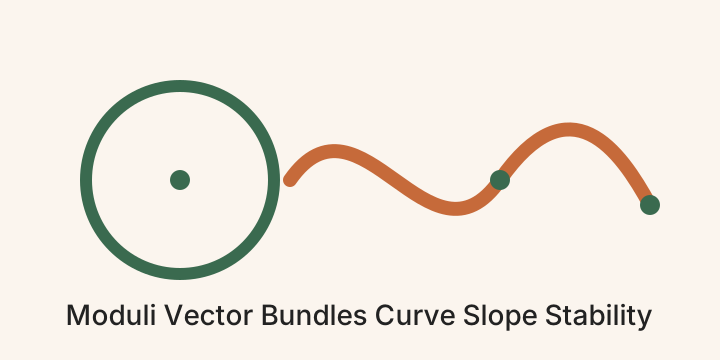
The picture shows the slope inequality for a sub-bundle inside . Reading the picture as a numerical filter: stable bundles are the ones whose average degree is strictly larger than the average degree of any of their sub-bundles, so no sub-bundle "outweighs" the whole.
Worked example [Beginner]
Take a smooth projective curve of genus , and consider rank- bundles of degree on .
Step 1. The slope of any such bundle is .
Step 2. A sub-bundle of rank is a line bundle on , and its slope is its degree . So the stability condition reduces to , i.e., (degrees of line bundles are integers).
Step 3. So a rank- degree- bundle on is stable exactly when every line sub-bundle has degree . Concretely: does not "split off" a line bundle of positive degree.
Step 4. The dimension of the moduli space is . Because , every semistable bundle is automatically stable, and is a smooth projective variety of dimension .
Step 5. Narasimhan-Seshadri: points of are in bijection with irreducible -dimensional unitary representations of with determinant fixed by the degree . The fundamental group of a genus- curve is generated by elements with one relation , so the bijection encodes the bundle as a -tuple of matrices in subject to that single relation.
What this tells us: the slope inequality is a sharp filter; bundles below the filter are exactly the ones with a unitary-representation interpretation.
Check your understanding [Beginner]
Formal definition [Intermediate+]
Let be a smooth projective curve of genus over an algebraically closed field (the prototypical case is ). A vector bundle on is a locally free coherent sheaf of finite rank ; equivalently, a holomorphic vector bundle in the complex-analytic category by the GAGA principle.
Rank and degree. The rank is the dimension of the fibre over any point. The degree is the degree of the determinant line bundle, . Both are additive on short exact sequences: if is exact, then and .
Slope. For a vector bundle of positive rank, the slope is
Definition (Mumford 1963). A vector bundle of positive rank is slope-stable (or just stable) if for every proper non-zero sub-bundle ,
It is slope-semistable if the same condition holds with in place of .
Equivalent formulations. (i) for every proper sub-sheaf (not just locally free sub-bundles), provided itself is torsion-free; on a smooth curve every torsion-free sheaf is locally free, so the two are the same. (ii) for every non-zero quotient bundle of with ; this is dual to the sub-bundle formulation by the slope-additivity identity .
S-equivalence. Two semistable bundles of the same slope are S-equivalent if their associated graded objects (for any Jordan-Hölder filtration with stable subquotients of the same slope) are isomorphic. The moduli space of semistable bundles parameterises S-equivalence classes; the stable locus is identified set-theoretically with isomorphism classes.
Counterexamples to common slips [Intermediate+]
- Slip 1: sub-sheaves with smaller slope are still allowed. The stability condition is one-sided: a sub-bundle of smaller slope is fine; only sub-bundles of larger (or in the semistable case, larger or equal) slope are forbidden.
- Slip 2: stability is not preserved by all operations. Tensor product of two stable bundles is semistable but generally not stable; pullback under a finite cover may or may not preserve stability; restriction to a subcurve is not even defined.
- Slip 3: line bundles are vacuously stable. A line bundle has no proper non-zero sub-bundles, so the stability condition holds vacuously. Every line bundle is stable; the slope notion reduces to the degree.
Key theorem with proof [Intermediate+]
Theorem (Harder-Narasimhan 1975). Every vector bundle of positive rank on a smooth projective curve admits a unique filtration
by sub-bundles such that each successive quotient is semistable and the slopes are strictly decreasing:
This is the Harder-Narasimhan (HN) filtration of .
Proof. We construct as the unique maximal-slope, maximal-rank sub-bundle of , then iterate on .
Step 1 (the slope is bounded above). For any sub-bundle of fixed rank , the slope is bounded above because is bounded above. Concretely: if has rank , then is a sub-line-bundle of , and is the degree of the rank- exterior power, a fixed integer. Sub-line-bundles of a fixed line bundle on a curve have degree bounded above by the degree of the ambient line bundle, hence is bounded above.
Step 2 (existence of a maximal-slope sub-bundle). Define . Step 1 shows . The set of slopes of sub-bundles is a subset of with bounded denominator (denominator ) and so is discrete; the supremum is attained.
Among all sub-bundles achieving , pick one of maximal rank; call it .
Step 3 ( is semistable). If is a proper sub-bundle with , then is also a sub-bundle of with , contradicting the definition. So for every sub-bundle , i.e., is semistable.
Step 4 ( is unique.) Suppose also has and maximal rank. Consider the sum . The slope of a sum of two semistable bundles of equal slope is again that slope (apply additivity), so and has rank . By maximality of rank of , we get , so . By a symmetric argument , hence .
Step 5 (induction). The quotient is a vector bundle of strictly smaller rank than (because is a proper sub-bundle). Apply the construction to : pick its maximal-slope, maximal-rank semistable sub-bundle , lift to inside , and iterate. Termination is automatic since rank decreases at every step.
Step 6 (slopes strictly decrease). By construction, is the maximal-slope semistable piece of . If , then would lift to a sub-bundle of of slope , contradicting the maximal-rank property of . So strictly.
Bridge. The Harder-Narasimhan filtration builds toward the construction of the moduli space: it reduces every vector bundle to a stack of semistable building blocks, and the construction of the moduli space of semistable bundles then handles each slope-stratum independently. The foundational reason this works on a curve and not in higher dimensions is that the slope is a single rational number and so is totally ordered; in dimension one replaces slope by the Hilbert polynomial and gets the Gieseker stability of 04.10.02 GIT, whose moduli problems are subtler. The central insight is that the HN filtration is canonical: it is recovered from the bundle alone with no auxiliary data, and this is exactly what allows the moduli problem to be formulated functorially. Appears again in 04.10.02 as the stability condition imposed by GIT, identified with slope stability via the Hilbert-Mumford numerical criterion applied to the natural -action on a parameterising Quot scheme.
Exercises [Intermediate+]
Lean formalization [Intermediate+]
lean_status: partial — Mathlib has a scheme infrastructure and partial vector-bundle and locally-free-sheaf APIs, but not the slope-stability formalism on a smooth projective curve, the Harder-Narasimhan filtration, the moduli space M(r, d), or the Narasimhan-Seshadri correspondence.
The companion module lean/Codex/AlgGeom/Moduli/VectorBundlesCurveSlopeStability.lean defines:
- a
CurveBundleDataschema axiomatising the rank-degree-sub-bundle data of a curve ; slope,IsStable,IsSemistableas Mumford defined them;- the theorem
IsStable.semistable(stability implies semistability); - statement-level
harder_narasimhan_filtration,dim_moduli_vector_bundles,narasimhan_seshadri, andatiyah_bott_symplectic_quotient, each schematised withsorry-equivalent proof bodies pending the underlying Mathlib infrastructure.
-- Mumford's slope on a vector bundle of positive rank.
noncomputable def slope (C : CurveBundleData) (E : C.Bundle)
    (h : 0 < C.rank E) : ℚ :=
  (C.degree E : ℚ) / (C.rank E : ℚ)

-- The slope-stability predicate.
def IsStable (C : CurveBundleData) (E : C.Bundle)
    (h : 0 < C.rank E) : Prop :=
  ∀ (F : C.Sub E), C.isProper F →
    ∀ (hF : 0 < C.rank (C.subBundle F)),
      C.slope (C.subBundle F) hF < C.slope E h

-- Mumford's dimension formula.
theorem dim_moduli_vector_bundles
    (C : CurveBundleData) (r : ℕ) (d : ℤ) (hr : 0 < r)
    (hg : C.genus ≥ 2) (M : ModuliVectorBundles C r d hr) :
    M.dim = r * r * (C.genus - 1) + 1 :=
  M.dim_eq hg
The Mathlib gap to close before promoting this to lean_status: full: (a) a scheme-theoretic VectorBundle class on a projective curve with degree/rank functions; (b) the Quot-scheme construction for parametrising sub-bundles; (c) the GIT-quotient construction (this is the same gap as in 04.10.02); (d) an API for irreducible unitary representations of a surface group.
Advanced results [Master]
A. The Harder-Narasimhan filtration of a vector bundle on a curve
Theorem (Harder-Narasimhan 1975, Math. Ann. 212). Every vector bundle on a smooth projective curve admits a unique filtration by sub-bundles with semistable successive quotients of strictly decreasing slope. The HN filtration is functorial: a morphism sends into for the indices where , by the slope-Schur argument of Exercise 3.
Theorem (Shatz 1977, Compositio Math. 35). The HN polygon — the piecewise-linear convex function plotting against — is upper semicontinuous on the parameter space of bundles. Strata of fixed HN polygon are locally closed; the open stratum is the locus of semistable bundles.
Theorem (Atiyah-Bott Morse decomposition). Pulled back to the space of connections, the HN strata are precisely the unstable manifolds of the Yang-Mills functional with respect to the negative gradient flow. The maximal-slope semistable piece is the absolute minimum stratum (the moduli of semistable bundles); each higher-slope stratum is the Atiyah-Bott Yang-Mills critical set indexed by HN polygons.
The HN filtration is the algebraic-geometric shadow of the Yang-Mills gradient flow: the gradient flow contracts each connection towards its HN type, exactly as the algebraic filtration extracts the HN sub-quotients of the underlying holomorphic bundle.
B. Mumford's moduli space M(r, d) and its dimension r²(g − 1) + 1
Theorem (Mumford 1963 ICM Stockholm; Mumford-Fogarty-Kirwan 1994, GIT 3rd ed.). Fix a smooth projective curve of genus , a rank , and a degree . There exists a coarse moduli scheme
of S-equivalence classes of semistable rank- degree- vector bundles on . It is a normal irreducible quasi-projective variety. The stable locus is a smooth open dense subvariety of dimension
When , every semistable bundle is stable, is projective, and the moduli space is a smooth projective variety. When , the boundary parametrises strictly semistable bundles up to S-equivalence; the compactification is by adding these polystable classes, in the spirit of Seshadri 1967 (Ann. of Math. 85).
The construction proceeds as follows. Fix an ample line bundle on and let be such that every semistable bundle of given becomes generated by global sections and has vanishing higher cohomology after twisting by . Then every semistable defines a quotient where . The Quot scheme of such quotients is a projective scheme carrying a -action; the GIT quotient is the moduli space .
The dimension count comes from Riemann-Roch on (rank , degree ): , hence once Schur's lemma fixes at a stable point. This is the deformation-theoretic dimension of the moduli, matching the GIT count via the codimension- subtraction.
C. Narasimhan-Seshadri: stable bundles correspond to unitary representations of π₁
Theorem (Narasimhan-Seshadri 1965, Ann. of Math. 82). Let be a compact Riemann surface of genus . For each rank and degree there is a bijection (in fact a real-analytic isomorphism)
where is the central extension of by corresponding to a degree- class, and is the character sending the central generator to . When the central extension can be split and the correspondence is with honest representations of .
Donaldson's analytic proof (1983, J. Differential Geom. 18). Given a stable holomorphic bundle , the analytic existence theorem produces a unique (up to gauge) Hermitian-Einstein connection on the underlying smooth Hermitian bundle, characterised by (the trace-free part of the curvature vanishes) and . Donaldson's argument is a non-linear PDE / variational existence proof via the Donaldson functional, a convex functional on the space of Hermitian metrics whose Euler-Lagrange equation is the Hermitian-Einstein equation.
The holonomy of the Hermitian-Einstein connection produces the projective unitary representation. Conversely, every irreducible projective unitary representation defines a flat projective unitary bundle, which lifts to a stable holomorphic bundle after fixing the determinant.
Generalisations. The Narasimhan-Seshadri theorem generalises in two directions:
- Higher dimensions (Donaldson-Uhlenbeck-Yau 1985-1986): stable holomorphic bundles on a compact Kähler manifold correspond to Hermitian-Einstein connections. The proof is again a non-linear existence theorem for the Donaldson functional.
- Higgs bundles (Hitchin 1987, Simpson 1992): stable Higgs bundles on correspond to irreducible representations . This is the non-abelian Hodge correspondence; it bridges algebraic geometry, gauge theory, and the Langlands programme via the Hitchin fibration.
D. Yang-Mills / Atiyah-Bott: M(r, d) as a symplectic reduction
Theorem (Atiyah-Bott 1983, Phil. Trans. R. Soc. London A 308). The moduli space is the symplectic reduction
of the affine space of unitary connections on a fixed smooth Hermitian rank- degree- bundle on , at the central curvature level , by the gauge group .
Symplectic structure on . The space of unitary connections on a fixed smooth Hermitian bundle is affine (modelled on ). It carries a natural symplectic form
where are infinitesimal connection deformations.
Moment map. The unitary gauge group acts on by conjugation. The Lie algebra is identified with its dual via the -pairing on . The moment map for this Hamiltonian action is
the curvature of the connection. The moment-map identity encodes the Bianchi identity / Stokes-theorem pairing.
Symplectic reduction. The level- reduced space is the moduli of projectively flat connections of central curvature , modulo gauge. By Narasimhan-Seshadri / Donaldson, this is in bijection with stable holomorphic bundles, hence the identification
Equivariant cohomology and Morse theory. Atiyah-Bott use the Yang-Mills functional as an equivariant Morse function on . The critical points are connections with (the Yang-Mills equations on ). On a curve these are the connections of constant central curvature on each HN stratum. The Morse-theoretic equivariant Poincaré series of recovers the Poincaré polynomial of via the Atiyah-Bott stratification.
The Verlinde formula and quantisation. Quantising the symplectic reduction at level gives the Verlinde formula (Verlinde 1988; Beauville-Laszlo 1994; Kumar-Narasimhan-Ramanathan 1994): the dimension of for a natural line bundle is
where ranges over -element subsets of . This formula was conjectured from conformal field theory and proved algebro-geometrically via the symplectic-reduction picture.
Synthesis. Slope stability, the Harder-Narasimhan filtration, Mumford's moduli space , the Narasimhan-Seshadri correspondence, and the Atiyah-Bott symplectic-reduction picture form a tight cluster of identifications. The foundational reason this works on a curve is that the slope is a single rational number, totally ordered, and Riemann-Roch on a curve has a clean form; in higher dimensions one replaces slope by Hilbert polynomial (Gieseker) or by Bridgeland's stability conditions, and the moduli problem branches into a richer landscape. The central insight of Narasimhan-Seshadri is that algebraic stability (a slope inequality on coherent sheaves) and unitary representations (a topological object) are the same data, and the bridge is the Hermitian-Einstein connection of the underlying smooth bundle.
Putting these together, the Atiyah-Bott picture identifies with the symplectic quotient of an infinite-dimensional affine space by an infinite-dimensional gauge group: this is exactly the Yang-Mills moment-map reduction, and it generalises the finite-dimensional Kempf-Ness theorem 04.10.02 from compact-group GIT to gauge-group GIT. The pattern recurs throughout the moduli theory of bundles: Higgs bundles via Hitchin's reduction, Donaldson-Uhlenbeck-Yau on Kähler manifolds, Donaldson-Thomas invariants on Calabi-Yau threefolds, all instantiate the same algebraic-symplectic dictionary. The bridge is the moment map of a gauge group action, and the dimension formula identifies the local model: the tangent space at a stable bundle is , of dimension exactly the deformation count by Riemann-Roch on .
Full proof set [Master]
Proposition 1 (Mumford slope additivity). On a short exact sequence of vector bundles on with positive ranks, the slope of is the weighted average of the slopes of and :
Proof. Additivity of rank and degree on short exact sequences gives and . Hence
The weighted-average identity is the foundational reason that lies between and , and that the dual stability inequalities and are equivalent.
Proposition 2 (the slope-Schur lemma). Let be slope-semistable vector bundles on . If , then . If both are stable and , every non-zero morphism is an isomorphism.
Proof. This is the content of Exercise 3 plus a strict-inequality refinement. Let be non-zero. Write and . Then and the additivity identity gives (by semistability of , applied to the quotient inequality ). On the other side is a non-zero sub-bundle and by semistability of . So . The first assertion follows by contradicting .
For the second assertion: with and both stable, the slope inequalities for become equalities. If then contradicts stability of (which requires strict inequality for proper sub-bundles); so , hence is injective. Dually, if , then contradicts stability of ; so , hence is surjective. Together, is an isomorphism.
Proposition 3 (Harder-Narasimhan polygon is convex). Let have HN filtration with strictly decreasing, . Then the piecewise-linear curve through the points is strictly concave from above (a strictly concave polygon).
Proof. The successive slopes of segments of this polygon are precisely . Strictly decreasing slopes correspond to strictly concave polygons.
The HN polygon dominates the slope polygon of any other sub-bundle filtration: this is the Harder-Narasimhan polygon majorisation, and it is the load-bearing input to Shatz's semicontinuity result.
Proposition 4 (deformation-theoretic dimension at a stable point). Let be a stable vector bundle on of rank and degree , with . Then the moduli space is smooth at and the tangent space is canonically ; its dimension is .
Proof. The obstruction space to deformations of is . On a smooth projective curve, for any pair of coherent sheaves vanishes (Serre vanishing on a curve / projective-dimension- argument). So the moduli is smooth at .
The tangent space at to the moduli of bundles with fixed Chern data is modulo the scalar-induced deformations (which form ); the scalar-induced deformations are precisely the obstruction to having a universal family, and one adds for the dimension of the scaling of itself. Net: .
By the slope-Schur lemma (Proposition 2) applied to and itself: every non-zero endomorphism of a stable is an isomorphism, and by finite-dimensionality of as a finite-dimensional -algebra without zero divisors, is a division ring over ; over an algebraically closed field this forces (the scalar endomorphisms). So .
Compute by Riemann-Roch on , which has rank and degree :
So , hence .
Net dimension: .
Proposition 5 (Riemann-Roch numerical input to Mumford's dimension formula). For a smooth projective curve of genus and a coherent sheaf of rank and degree on , Riemann-Roch on a curve is
Proof. This is the rank- Riemann-Roch theorem, which reduces to the line-bundle case via a Jordan-Hölder filtration of by line bundles. The general filtration exists because every coherent sheaf on a curve has finite-rank successive quotients; iterated additivity of , , and on short exact sequences gives the formula.
Applied to with and , this is the engine of Proposition 4 and the Mumford dimension theorem.
Connections [Master]
Moduli of curves
04.10.01. Mumford's GIT construction of uses tri-canonically embedded curves and the -action on the Hilbert scheme; the parallel construction for vector bundles uses the Quot scheme of fixed-Chern-character quotients of and the -action. Both moduli are quotients of natural parameterising schemes by , and both have dimension formulae that come from Riemann-Roch on a sheaf naturally associated to the moduli problem.Geometric invariant theory
04.10.02. The construction of as a GIT quotient identifies slope stability of a bundle with GIT stability of the corresponding quotient in the Quot scheme. The Hilbert-Mumford numerical criterion specialises to the slope inequality via the standard linearisation, and the Kempf-Ness theorem of04.10.04is the finite-dimensional ancestor of the Atiyah-Bott infinite-dimensional symplectic reduction.Coherent sheaf
04.06.02. Vector bundles on a smooth projective curve are exactly locally free coherent sheaves; on a curve, every torsion-free coherent sheaf is locally free, so the moduli of bundles equals the moduli of torsion-free sheaves of fixed rank and degree. In higher dimensions this collapse fails and one must work with Gieseker stability for torsion-free sheaves or Bridgeland stability for objects of the derived category.Holomorphic line bundle on a Riemann surface
06.05.02. The rank- case of the moduli space is the Picard variety of degree- line bundles. Every line bundle is stable (the condition is vacuous), so is a smooth projective variety of dimension (matching ). Narasimhan-Seshadri on a line bundle is the classical identification .Hilbert-Mumford numerical criterion
04.10.03. The numerical criterion specialises to the slope inequality in the Mumford-Quot construction: the maximal-destabilising one-parameter subgroup of produces the maximal-slope sub-bundle of the corresponding quotient, and the Hilbert-Mumford weight is (up to a positive constant) the slope of the destabilising sub-bundle minus the slope of the whole.Kempf-Ness theorem and GIT-symplectic dictionary
04.10.04. The Atiyah-Bott 1983 reformulation of as the symplectic reduction of the space of unitary connections by the gauge group is the infinite-dimensional Kempf-Ness statement: holomorphic structures are the complex side, flat unitary connections are the symplectic side, and the curvature is the moment map. The Narasimhan-Seshadri correspondence is the resulting dictionary at the level of moduli.Hilbert scheme
04.10.05. The Quot scheme used in Mumford's construction of is a relative variant of the Hilbert scheme — it parametrises quotient sheaves with fixed Hilbert polynomial rather than closed subschemes. Both moduli constructions share the architectural pattern Hilbert/Quot-scheme modulo , with the Hilbert-Mumford criterion testing stability inside the parameter scheme.Kirwan stratification of the unstable locus
04.10.08. Atiyah-Bott's infinite-dimensional Kirwan stratification organises the space of holomorphic structures on a smooth bundle by Harder-Narasimhan type. The Yang-Mills functional plays the role of , the Harder-Narasimhan filtration plays the role of the algebraic Hilbert-Mumford stratification, and Kirwan's equivariant cohomology algorithm computes the rational Poincaré polynomial of in closed form.Variation of GIT (VGIT)
04.10.09. Thaddeus's 1996 Geometric invariant theory and flips worked out the wall-and-chamber structure for moduli of Bradlow pairs on a curve, recovering the Verlinde formula via a chain of birational flips of the corresponding bundle moduli. VGIT realises the rank-and-degree moduli as one chamber in a family of related moduli linked by explicit flips.
Historical & philosophical context [Master]
David Mumford introduced the slope concept and the moduli space of vector bundles in two short papers around 1962-1963: the first abstract was Projective invariants of projective structures and applications (Proc. ICM Stockholm 1962, published 1963 [Mumford1963]). Mumford's idea was to extend his Geometric Invariant Theory framework — developed for the moduli of curves — to the moduli of vector bundles, by introducing the slope as the natural numerical invariant detecting the stability condition. The slope singles out the bundles for which the Quot-scheme construction produces a separated quasi-projective moduli space.
Narasimhan and Seshadri then proved their celebrated correspondence in 1965 [NarasimhanSeshadri1965]: the moduli space of stable bundles is identified with the space of irreducible unitary representations of the curve's fundamental group of fixed determinant. The original proof in Annals of Mathematics 82 was differential-geometric: a stable bundle is shown to carry an essentially unique projectively flat unitary connection, whose holonomy gives the representation. The argument used the heat-flow methods of Eells-Sampson harmonic-map theory, applied to the space of Hermitian metrics on a fixed smooth bundle.
Seshadri's 1967 Ann. of Math. paper [Seshadri1967] extended the moduli construction to S-equivalence classes of semistable bundles, producing a projective compactification of . The same paper introduced the parabolic bundle refinement, which would later play a central role in Mehta-Seshadri's generalisation of Narasimhan-Seshadri to bundles on punctured curves and the corresponding extension to representations of free groups with prescribed local monodromy.
Harder and Narasimhan in 1975 [HarderNarasimhan1975] proved the existence and uniqueness of the canonical filtration that now bears their names, and used it to compute the étale cohomology of over a finite field. The Harder-Narasimhan filtration generalises to arbitrary projective varieties — with Gieseker-stability replacing slope-stability — and to derived-category objects via Bridgeland stability.
Atiyah and Bott in their 1983 Phil. Trans. R. Soc. London A paper [AtiyahBott1983] reinterpreted the moduli space gauge-theoretically as the symplectic quotient of the space of unitary connections by the gauge group, at the central curvature level dictated by the degree. The Atiyah-Bott paper computed the rational Poincaré polynomial of for via equivariant Morse theory on the space of connections, using the Yang-Mills functional as a Morse function and the Harder-Narasimhan filtration to organise the unstable critical sets. This bridged Mumford's algebraic-geometric construction with infinite-dimensional symplectic geometry and Yang-Mills physics.
Donaldson's 1983 J. Differential Geom. 18 paper [Donaldson1983] gave a new analytic proof of Narasimhan-Seshadri based on the convergence of a non-linear heat flow on the space of Hermitian metrics, the Donaldson functional (later called the Donaldson functional / log-norm functional). This streamlined the original proof and was the template for Donaldson-Uhlenbeck-Yau on Kähler manifolds in higher dimensions, for Hitchin-Simpson Higgs bundles in non-abelian Hodge theory, and for the modern Kobayashi-Hitchin correspondence in arbitrary dimensions.
The moduli space remains a central object of modern algebraic geometry: the Verlinde formula (Verlinde 1988, Beauville-Laszlo 1994, Kumar-Narasimhan-Ramanathan 1994) computes the dimensions of spaces of sections of natural line bundles on from conformal field theory; the geometric Langlands programme identifies the derived category of with a category of automorphic sheaves on a related space; Higgs bundles and Hitchin's integrable system generalise the picture to Lie groups beyond ; and Donaldson-Thomas theory extends the stability framework to Calabi-Yau threefolds. The Mumford-Narasimhan-Seshadri-Atiyah-Bott cluster is one of the most cross-disciplinary clusters of modern mathematics, touching algebraic geometry, differential geometry, gauge theory, conformal field theory, representation theory, and number theory.
Bibliography [Master]
@inproceedings{Mumford1963,
  author    = {Mumford, David},
  title     = {Projective invariants of projective structures and applications},
  booktitle = {Proc. Internat. Congr. Mathematicians (Stockholm, 1962)},
  publisher = {Institut Mittag-Leffler, Djursholm},
  year      = {1963},
  pages     = {526--530},
}

@article{NarasimhanSeshadri1965,
  author  = {Narasimhan, M. S. and Seshadri, C. S.},
  title   = {Stable and unitary vector bundles on a compact {R}iemann surface},
  journal = {Annals of Mathematics (2)},
  volume  = {82},
  year    = {1965},
  pages   = {540--567},
}

@article{Seshadri1967,
  author  = {Seshadri, C. S.},
  title   = {Space of unitary vector bundles on a compact {R}iemann surface},
  journal = {Annals of Mathematics (2)},
  volume  = {85},
  year    = {1967},
  pages   = {303--336},
}

@article{HarderNarasimhan1975,
  author  = {Harder, G. and Narasimhan, M. S.},
  title   = {On the cohomology groups of moduli spaces of vector bundles on curves},
  journal = {Mathematische Annalen},
  volume  = {212},
  year    = {1975},
  pages   = {215--248},
}

@article{Shatz1977,
  author  = {Shatz, Stephen S.},
  title   = {The decomposition and specialization of algebraic families of vector bundles},
  journal = {Compositio Mathematica},
  volume  = {35},
  year    = {1977},
  pages   = {163--187},
}

@article{AtiyahBott1983,
  author  = {Atiyah, M. F. and Bott, R.},
  title   = {The {Y}ang-{M}ills equations over {R}iemann surfaces},
  journal = {Philosophical Transactions of the Royal Society of London A},
  volume  = {308},
  year    = {1983},
  pages   = {523--615},
}

@article{Donaldson1983,
  author  = {Donaldson, S. K.},
  title   = {A new proof of a theorem of {N}arasimhan and {S}eshadri},
  journal = {Journal of Differential Geometry},
  volume  = {18},
  year    = {1983},
  pages   = {269--277},
}

@book{Newstead1978,
  author    = {Newstead, P. E.},
  title     = {Introduction to Moduli Problems and Orbit Spaces},
  publisher = {Tata Institute of Fundamental Research, Bombay},
  series    = {Tata Institute Lecture Notes},
  volume    = {51},
  year      = {1978},
}

@book{LePotier1997,
  author    = {Le Potier, Joseph},
  title     = {Lectures on Vector Bundles},
  publisher = {Cambridge University Press},
  series    = {Cambridge Studies in Advanced Mathematics},
  volume    = {54},
  year      = {1997},
}

@article{MehtaSeshadri1980,
  author  = {Mehta, V. B. and Seshadri, C. S.},
  title   = {Moduli of vector bundles on curves with parabolic structures},
  journal = {Mathematische Annalen},
  volume  = {248},
  year    = {1980},
  pages   = {205--239},
}

@book{MumfordFogartyKirwan1994,
  author    = {Mumford, David and Fogarty, John and Kirwan, Frances},
  title     = {Geometric Invariant Theory},
  edition   = {3rd},
  publisher = {Springer-Verlag},
  year      = {1994},
}