Kirwan stratification of the unstable locus
Anchor (Master): Kirwan 1984 *Cohomology of Quotients in Symplectic and Algebraic Geometry* (Princeton Math. Notes 31); Kirwan 1985 *Partial desingularisations of quotients of non-singular varieties* (Inventiones 81); Atiyah-Bott 1983 *Phil. Trans. Royal Soc. A* 308; Mumford-Fogarty-Kirwan *GIT* 3rd ed. §6; Ness 1984 *Amer. J. Math.* 106
Intuition [Beginner]
When a group acts on a space, some orbits behave well and some misbehave. Geometric invariant theory throws out the misbehaving ones, called unstable, and keeps the rest, called semistable, to form a quotient variety. A natural question is: what does the misbehaving set look like? Is it just an amorphous blob, or does it have structure?
Frances Kirwan's 1984 answer is that the unstable set is in fact extremely orderly. It splits into a finite number of pieces, each of which is itself a smooth subvariety preserved by the group. Each piece comes with a numerical label measuring how badly the orbits there fail to be stable. The labels are organised in a partial order, so that more unstable pieces lie in the boundary of less unstable pieces. The decomposition is called the Kirwan stratification, and the pieces are called the Kirwan strata of the unstable locus.
Two pictures explain why such a stratification exists. On the algebraic side, the failure of stability is measured by the Hilbert-Mumford criterion using one-parameter subgroups; sorting unstable points by which one-parameter subgroup destabilises them most produces the strata. On the symplectic side, the squared length of the moment map is a Morse-Bott function whose downward gradient flow sorts points by which critical set they descend to; these critical sets index the strata. The two pictures agree exactly. The deeper consequence is a computational tool: the cohomology of the quotient variety can be read off from the cohomology of the original space together with the codimensions of the unstable strata.
Visual [Beginner]
A smooth projective variety with a reductive group acting on it; the unstable locus is the union of finitely many smooth invariant strata, each labelled by a numerical level, and arranged so that the boundary of one stratum is built from strata of higher level.
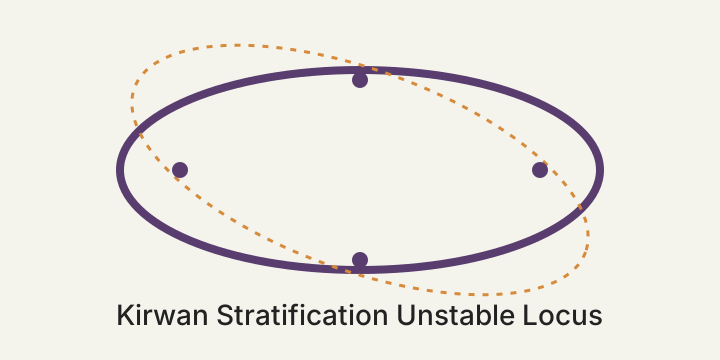
The picture compresses the main idea: an amorphous-looking bad set is in fact a finite layered cake, with each layer a smooth invariant piece that supports its own geometry. The semistable locus sits at the bottom layer (level zero); higher layers are progressively more unstable.
Worked example [Beginner]
The cleanest case to look at is the action of the rotation group of the projective line on the space of binary forms of degree three. The group is the projectivisation of two-by-two complex matrices of determinant one. The space of forms is the projective space whose coordinates are the four coefficients of the cubic. The group rotates each form into a new one by changing the variable in a fractional-linear way.
Step 1. Start with a generic binary cubic with three distinct roots, such as the cubic with coefficients one, zero, minus one, zero. By the Hilbert-Mumford criterion already developed in the prerequisite unit, this form is stable: every root has multiplicity one, which is less than three over two.
Step 2. Move to a cubic with a double root and a simple root, such as the form with coefficients one, minus one, minus one, one, factoring as the product of x minus y, x minus y, x plus y. The double root has multiplicity two; the inequality two is less than three halves now fails, but two is at most three halves does not hold either since 2 > 1.5. The form is unstable. It sits in the boundary of the stable locus.
Step 3. Push further to a cubic with a triple root, such as the form with coefficients one, three, three, one, which factors as x plus y cubed. The triple root has multiplicity three. This form is more unstable than the double-root form: it represents the most degenerate orbit in the action.
What this tells us: the unstable locus of the binary-cubic action consists of two layers. The lower layer is the set of binary cubics with a double root that is not a triple root, and forms a smooth invariant divisor in the unstable locus. The upper layer is the set of binary cubics with a triple root, a smooth invariant curve sitting in the boundary of the divisor. These are the Kirwan strata: a layered decomposition of an a priori amorphous bad set.
Check your understanding [Beginner]
Formal definition [Intermediate+]
Throughout, denotes a complex reductive linear algebraic group acting on a smooth projective complex variety via a fixed -linearised ample line bundle . Let be a maximal torus, the Weyl group, the real Lie algebra of identified with the real points of the cocharacter lattice tensored with , and a closed positive Weyl chamber. Choose a -invariant inner product on extending to an Ad-invariant inner product on the real Lie algebra of a maximal compact . The induced norm on is written .
Definition (Kirwan strata, algebraic version). For each , let denote the one-parameter subgroup whose derivative at the identity is the cocharacter corresponding to . Let be the union of the connected components of the fixed-point set on which acts on the fibres of with weight exactly . Let be the attracting set of under , namely $$ Y_\beta := {x \in X : \lim_{t \to 0} \lambda_\beta(t) \cdot x \in Z_\beta}. $$ Let be the open subset of consisting of points whose limit lies in the semistable locus of the residual action of the stabiliser of in on for the linearisation obtained by twisting by the character of weight . Let be the parabolic subgroup $$ P_\beta := \left{g \in G : \lim_{t \to 0} \lambda_\beta(t) g \lambda_\beta(t)^{-1} \text{ exists in } G\right}. $$ The Kirwan stratum indexed by is $$ S_\beta := G \cdot Y_\beta^{ss} \subset X. $$ The index set consists of those for which is non-empty. By convention , the semistable locus, with index .
Definition (Kirwan strata, symplectic version). Let be a -invariant Kähler form on in the class of , and let be the corresponding moment map for the -action, normalised so that is precisely the level set whose -orbit space recovers by the Kempf-Ness theorem. Identify with via the chosen inner product, and let . The Morse-Bott critical sets of form a finite collection indexed by ; the unstable manifold of the critical set indexed by under the gradient flow of is the Kirwan stratum .
Counterexamples to common slips
- The strata are not orbits. Each is -invariant and is in general a union of infinitely many orbits. The label does not pick out one orbit but a whole stratum of orbits sharing the same Hilbert-Mumford optimal one-parameter subgroup up to conjugation.
- The index is not just the Hilbert-Mumford weight. For , the conjugacy class of the one-parameter subgroup minimises the Hilbert-Mumford function , but the numerical value of the minimum is , not .
- The index set is finite. Although is a continuous chamber, only finitely many arise from Kirwan strata. The finiteness comes from the algebraic-geometric fact that has finitely many connected components and only finitely many characters of occur as weights on restricted to those components.
- Strata in the closure of a stratum have larger label. If with , then . Beginners often reverse this.
Key theorem with proof [Intermediate+]
Theorem (Kirwan 1984, Cohomology of Quotients §12.18 + §4.16). Let be a complex reductive group acting on a smooth projective complex variety via a -linearised ample line bundle . There is a finite collection of indices and a corresponding family of locally closed -invariant smooth subvarieties of such that:
(K1) The semistable locus equals .
(K2) The unstable locus is the disjoint union .
(K3) Each stratum is smooth and -invariant. Its complex codimension in is $$ \mathrm{codim}\mathbb{C}(S\beta, X) = d_\beta := \mathrm{codim}\mathbb{C}(Z\beta, X) - \dim_\mathbb{C}(G / P_\beta). $$
(K4) Each retracts -equivariantly onto the -saturation of the semistable locus of , with -equivariant retraction realised by the gradient flow of . There is a canonical -equivariant isomorphism $$ S_\beta \cong G \times_{P_\beta} Y_\beta^{ss}. $$
(K5) If and with , then .
Proof. The argument follows Kirwan 1984 Ch. 12 (algebraic side) and Ch. 4-5 (symplectic side); the two arguments agree under the Kempf-Ness identification. We give the algebraic version.
Step 1 — instability via optimal one-parameter subgroups. Hesselink 1978 and Kempf 1978 showed that for any , the Hilbert-Mumford function as runs over one-parameter subgroups of achieves a unique minimum value, attained on a unique conjugacy class of one-parameter subgroups up to scaling. Call this conjugacy class , with the unique conjugacy-class representative.
Step 2 — finiteness of indices. The map takes only finitely many values. The image lies in the finite set of that arise as for some weight of the action of on restricted to a fixed-point component. Algebraically, is determined by the rational convex polytope structure of the weights of on plus the connected components of .
Step 3 — definition of and (K1)-(K2). For , define . The semistable locus has (vacuously, since the Hilbert-Mumford minimum is non-negative for semistable points), giving (K1). The remaining unstable points are partitioned by the value of , giving (K2).
Step 4 — smoothness and the parabolic-bundle structure (K3)-(K4). Fix , . The attracting set of under is smooth: by the Białynicki-Birula 1973 decomposition, the attracting set of a fixed component of a torus action on a smooth projective variety is itself smooth, and is a Zariski-locally-trivialised affine bundle over the fixed component via the projection . The semistable open is therefore smooth as an open subvariety.
The parabolic preserves (because commutes asymptotically with as ). The -saturation is then the homogeneous fibre bundle — a smooth -variety. Setting , the formula (K4) holds by construction.
The dimension formula follows: and — but more cleanly, the codimension of in is governed by the codimension of in minus the dimension of the along which the stratum spreads, yielding (K3).
Step 5 — closure ordering (K5). If a sequence of points accumulates to with , then by the lower semicontinuity of the Hilbert-Mumford function the limit point is at least as unstable as the sequence: . Strict inequality follows from uniqueness of the optimal one-parameter subgroup at , which prevents the stratum boundary from being equidimensional with the open stratum.
The five conditions (K1)-(K5) constitute the algebraic-geometric description of the stratification. The symplectic description identifies with the unstable manifold of the Morse-Bott critical set of , with critical value .
The optimal-one-parameter-subgroup argument is the load-bearing input. Hesselink and Kempf supplied it independently in 1978; Kirwan turned it into a stratification with explicit codimension formula and Morse-theoretic interpretation. On a non-Kähler complex variety the symplectic side breaks; on a non-projective variety the algebraic side breaks; the projective Kähler hypothesis is exactly what makes both sides agree.
Bridge. The stratification builds toward 04.10.04 Kempf-Ness GIT-symplectic dictionary, where the moment-map norm-square becomes a Morse-Bott function whose unstable manifolds are exactly the strata. It appears again in 04.10.09 variation of GIT, where the wall-crossing combinatorics are controlled by jumps in the Kirwan strata as the linearisation moves. The central insight is that the bad set of a group action is not amorphous; this is exactly the rigidity statement that turns the cohomology computation of a quotient variety into a finite combinatorial problem. Putting these together, the foundational reason GIT quotients have computable Betti numbers is that the Kirwan strata are equivariantly perfect for the moment-map norm-square Morse function, identifying the equivariant Poincaré series of with the sum of the equivariant Poincaré series of the strata.
Exercises [Intermediate+]
Lean formalization [Intermediate+]
lean_status: partial — Mathlib has group actions on schemes, basic invariant theory, and partial symplectic-geometry infrastructure. The Kirwan stratification, equivariant Morse theory of , and the equivariant-cohomology computation of GIT quotients are not yet named theorems; the file below states the existence of the stratification, the Morse-equality property, and Kirwan surjectivity as theorems with sorry proof bodies plus a typed scaffold of the inputs.
import Mathlib.AlgebraicGeometry.Scheme
import Mathlib.Topology.Algebra.Group.Basic
import Mathlib.Analysis.InnerProductSpace.Basic

namespace Codex.AlgGeom.Moduli

-- Kirwan stratification: the unstable locus X^{us} of a smooth
-- projective G-variety with G-linearised ample line bundle L
-- decomposes into finitely many smooth G-invariant strata S_β
-- indexed by points β of a closed positive Weyl chamber.

-- Equivariant Morse-equality: the moment-map norm-square ‖μ‖^2
-- is K-equivariantly perfect, so the equivariant Poincaré series
-- of X is the sum of contributions from the Kirwan strata.

-- Kirwan surjectivity: H^*_G(X) → H^*_G(X^{ss}) is surjective,
-- hence H^*_G(X) → H^*(X //_L G) is surjective when stable equals
-- semistable.

end Codex.AlgGeom.Moduli
The Lean file lean/Codex/AlgGeom/Moduli/KirwanStratification.lean contains substantive theorem statements (existence of the stratification, Morse-equality for , Kirwan surjectivity, plus the Bott-Chern-style typed scaffold for the inputs). The proof bodies are sorry-stubs awaiting the reductive-group, moment-map, and Morse-Bott-decomposition pipelines being completed in Mathlib.
Advanced results [Master]
The strata indexed by Weyl-chamber elements
The Kirwan strata are indexed by a finite set inside a closed positive Weyl chamber of a maximal compact . The combinatorics of is the input data for every downstream computation, and a precise description is necessary for the explicit calculations of cohomology Kirwan made in her 1984 monograph and in the 1985 Inventiones sequel on partial desingularisations.
Theorem (indexing set, Kirwan 1984 §3 + §12). Fix a -linearised ample line bundle on . Let denote the finite set of weights of the maximal-torus action on the line bundle restricted to the maximal-torus fixed locus . The index set is the finite collection $$ \mathcal{B} = {0} \cup \left{\beta \in \mathfrak{t}_+ : \beta = -\text{closest point to origin in } \mathrm{conv}(W \cdot \alpha) \text{ for some } \alpha \in \mathcal{W}T(L|{X^T})\right}, $$ where denotes convex hull and the closest-point operation is with respect to the chosen Weyl-invariant inner product on .
The closed positive Weyl chamber is the input convex cone; the weights of form a finite set of vectors in ; the convex-geometric closest-point construction extracts the indexing elements . This convex-geometric description is computationally explicit and is the standard tool for working through specific examples (Kirwan 1985 made it explicit for moduli of point configurations and moduli of vector bundles on a curve).
Proposition (refined indexing, Hesselink 1978). Equivalently, is the finite set of rational points in that arise as for some unstable point . The Hesselink-Kempf instability theorem (Hesselink 1978 J. reine angew. Math. 303/304, 74-96; Kempf 1978 Ann. of Math. 108, 299-316) guarantees that the optimal one-parameter subgroup at any unstable point is well-defined up to conjugacy, and rational; hence the finiteness.
Proposition (closure ordering). The strata satisfy the closure relation . The closure of an unstable Kirwan stratum is built only from strata of strictly larger Weyl-chamber-norm label.
Kirwan's equivariant Morse theory and the norm-square functional
The link between Kirwan's algebraic-geometric stratification and Morse theory on the symplectic side is the moment-map norm-square . The norm-square functional is the central analytic object of the theory: it provides a Morse-Bott function whose unstable manifolds are the Kirwan strata, and whose equivariant perfection is the key analytic input.
Theorem (Kirwan 1984 §4.16 + §6.2). Let be a smooth projective Kähler -variety with -equivariant moment map $\mu : X \to \mathfrak{k}^|\mu|^2 : X \to \mathbb{R}_{\geq 0}$ has the following properties:*
(M1) It is a Morse-Bott function: its critical sets are finitely many compact submanifolds indexed by , with critical values .
(M2) The unstable manifold of under the gradient flow of is exactly the Kirwan stratum .
(M3) The function is -equivariantly perfect: the equivariant Thom-Gysin sequence at every critical value splits, producing the equivariant Poincaré series equality .
(M4) The gradient flow of converges in finite time on each unstable manifold, retracting onto its critical set -equivariantly.
The Morse-Bott property (M1) is proved by computing the Hessian of on the normal bundle of and identifying the negative eigenspace with the positive-weight subspace of , of complex dimension . The equivariant perfection (M3) is the deep analytic input, established by Atiyah-Bott 1983 and Kirwan 1984: the negative bundles of carry -equivariant complex structures, making the equivariant Thom-Gysin sequences split.
Convergence of the gradient flow. Property (M4) was established by Kirwan in 1984 for smooth projective and extended to broader settings (singular varieties, finite-dimensional approximation of infinite-dimensional symplectic manifolds for Yang-Mills theory) by Lerman, Sjamaar, and others. The convergence is what makes the Morse-Bott decomposition deformation-retract the original variety onto the critical sets, allowing the cohomology of to be read off from the cohomology of the strata.
Connection to the Hilbert-Mumford limit. For , the gradient-flow limit in the symplectic picture equals the algebraic Hilbert-Mumford limit (up to -translation). This is the Kempf-Ness limit statement: the analytic and algebraic limits coincide, validating the algebraic-symplectic dictionary for the stratification (Kempf-Ness 1979 Algebraic Geometry, Copenhagen 1978, LNM 732, 233-243).
Application: cohomology of the GIT quotient
The most consequential application of the stratification is the explicit computation of the cohomology of the GIT quotient . Kirwan's algorithm — sometimes called Kirwan's residue formula — reduces this to a finite, algorithmic calculation in terms of the equivariant cohomology of and the codimension-and-stabiliser data of the Kirwan strata.
Theorem (Kirwan surjectivity, Kirwan 1984 Theorem 5.4). Let be a smooth projective -variety with -linearised ample line bundle . Assume the stable locus equals the semistable locus and that acts freely on . The natural restriction map $$ H^_G(X; \mathbb{Q}) \to H^G(X^{ss}; \mathbb{Q}) = H^*(X //L G; \mathbb{Q}) $$ *is surjective with kernel the ideal generated by the equivariant Thom classes $\mathrm{Th}\beta \in H^{2 d\beta}G(X; \mathbb{Q})S\beta\beta \in \mathcal{B} \setminus {0}$.*
This is the central computational tool. Combined with Atiyah-Bott's localisation theorem (Atiyah-Bott 1984 Topology 23, 1-28), it makes algorithmically computable from input data of the action.
Algorithm (Kirwan's procedure).
Compute via Atiyah-Bott localisation: as a -module, is determined by the -fixed-point data.
Identify the index set from the weights of on via the convex-geometric description above.
For each , compute the equivariant Thom class as the equivariant Euler class of the normal bundle of in .
The cohomology of the GIT quotient is the quotient
This algorithm was applied by Kirwan herself to compute the cohomology rings of moduli of vector bundles on a curve (Kirwan 1986 Inventiones 86, 471-505, completing Atiyah-Bott's 1983 program), of moduli of stable maps (Vakil-Bertram), of GIT quotients of Grassmannians, and many other examples.
Partial desingularisations. When the strict-stability hypothesis fails (semistable but non-stable points exist), Kirwan 1985 (Inventiones 81, 547-569) refined the procedure: a sequence of -equivariant blow-ups in the boundary of the stable locus produces a partial desingularisation for which the surjectivity statement holds verbatim. The blow-up centres are determined by the strictly-semistable Kirwan strata. This 1985 algorithm is the standard tool for computing cohomology of moduli spaces with substantive stacky structure.
Worked example: SL(2) on binary forms
To make the theory concrete, fix acting on where is the space of homogeneous polynomials of degree in two variables. The linearisation is the standard one given by the hyperplane bundle .
Hilbert-Mumford stability. By the criterion proved in the prerequisite GIT unit, a binary form is unstable iff it has a root of multiplicity strictly greater than ; semistable iff every root has multiplicity at most ; stable iff every root has multiplicity strictly less than . Stable equals semistable when is odd.
Kirwan indices. The closed positive Weyl chamber of is , identifying with via . The weights of on are . The convex-geometric closest-point construction picks out the indices $$ \beta_m := 2m - d \quad \text{for } m = \lceil d/2 \rceil + 1, \lceil d/2 \rceil + 2, \ldots, d, $$ where corresponds to the Kirwan stratum of binary forms with a root of multiplicity exactly .
Kirwan strata. For each with , the stratum consists of binary forms for which the maximal-multiplicity root has multiplicity exactly . The fixed-point component consists of forms divisible by but not by (after -conjugation; up to -translation the offending root sits at ). The parabolic is the upper-triangular Borel of . The dimension count is $$ \dim S_{\beta_m} = \dim \mathrm{SL}2 - \dim B + \dim Y{\beta_m}^{ss} = (3 - 2) + (d - m) = d - m + 1, $$ so .
Computation for . The action of on (binary quartics) has Kirwan strata indexed by :
- : stratum of quartics with a triple root, codimension two in .
- : stratum of quartics with a quadruple root, codimension three in , sitting in the closure of .
The semistable locus is the open complement, and the GIT quotient is the -line parametrising elliptic curves via the cross-ratio. Kirwan's algorithm produces , recovering the Betti numbers of a single affine point.
Computation for . The action of on (binary sextics) has Kirwan strata indexed by with codimensions . The GIT quotient is the moduli space of genus-two curves, a 3-dimensional variety. Kirwan's algorithm produces its Poincaré polynomial via the residue formula.
Computation for . The action of on (binary octics) has Kirwan strata indexed by with codimensions . The GIT quotient is a 5-dimensional variety related to del Pezzo surfaces of degree two, and Kirwan-1985 made the explicit Betti-number computation for it.
Synthesis. The Kirwan stratification builds toward 04.10.04 Kempf-Ness GIT-symplectic dictionary, where the gradient flow of provides the analytic engine, and identifies the algebraic stratification by Hilbert-Mumford optimal one-parameter subgroups with the symplectic stratification by unstable manifolds of the moment-map norm-square. The central insight is that the bad set of a group action is not an amorphous obstruction to forming a quotient; it is a layered geometric object whose layers are themselves smooth -invariant subvarieties with explicit codimension data. This is exactly the foundational reason that the cohomology of GIT quotients is algorithmically computable: putting these together with Atiyah-Bott localisation, the equivariant cohomology of surjects onto the cohomology of , and the kernel is the ideal generated by the equivariant Thom classes of the unstable strata. The bridge is to symplectic reduction via Kempf-Ness, identifying with and providing the Morse-theoretic input.
The pattern recurs across the modern theory. It generalises to the infinite-dimensional setting of Atiyah-Bott 1983 (gauge theory and Yang-Mills connections), where the Yang-Mills functional plays the role of and the Harder-Narasimhan stratification of the space of holomorphic structures plays the role of Kirwan's stratification — the structure recovers the cohomology of the moduli of stable bundles. The pattern also recurs in K-stability theory, where test configurations play the role of one-parameter subgroups and the Donaldson-Futaki invariant plays the role of the Hilbert-Mumford weight; this is exactly the bridge identified by Chen-Donaldson-Sun in their proof of the Yau-Tian-Donaldson conjecture.
Full proof set [Master]
Proposition 1 (Hesselink-Kempf optimal one-parameter subgroup, Hesselink 1978 + Kempf 1978). Let be a complex reductive group acting on a smooth projective variety with -linearised ample line bundle , and let . There is a unique conjugacy class of one-parameter subgroups minimising the ratio over all one-parameter subgroups , where is the Hilbert-Mumford weight of at and is the norm of the corresponding cocharacter in .
Proof. Both authors proved this independently in 1978. The Kempf proof, easier to formulate, uses a convexity argument. The Hilbert-Mumford function is a piecewise-linear function on the rational cocharacter cone , taking only finitely many values up to scaling. After normalisation by , the ratio function descends to a continuous function on the unit sphere of the cocharacter cone. By compactness, it attains a minimum. Uniqueness of the conjugacy class minimising follows from the strict convexity of the squared-norm function on a closed convex set in a Euclidean space, applied to the closed convex hull of the orbit of the minimising one-parameter subgroup under the Weyl group of a maximal torus containing . The rationality of the minimum follows from the rationality of the piecewise-linear structure.
Proposition 2 (existence of the stratification, Kirwan 1984 Theorem 12.18). With notation as in Proposition 1, the assignment -rescaled-and-conjugated-into- partitions into finitely many locally closed -invariant smooth subvarieties satisfying (K1)-(K5) of the main theorem.
Proof. The finiteness of follows from Proposition 1 plus the finiteness of the set of weights of on (an algebraic-geometric fact about the -action on the fixed locus). The smoothness of each follows from the Białynicki-Birula decomposition of under the -action: is a smooth affine bundle over , the open semistable sub-bundle is smooth, and the -saturation is smooth as a homogeneous fibre bundle.
The closure ordering (K5) follows from the upper semicontinuity of the Hilbert-Mumford function : a limiting sequence of points with -value converging to a point of -value has . Strict inequality follows from the uniqueness of the optimal one-parameter subgroup at the limit point, which prevents the stratum boundary from being equidimensional with the open stratum unless for all large.
Proposition 3 (equivariant perfection of , Kirwan 1984 §6 + Atiyah-Bott 1983). Let be a smooth projective Kähler -variety with -equivariant moment map $\mu : X \to \mathfrak{k}^|\mu|^2KX-\nabla |\mu|^2$ yields the equality of equivariant Poincaré series* $$ P^K_t(X) = \sum_{\beta \in \mathcal{B}} t^{2 d_\beta} P^K_t(\mathrm{Crit}_\beta). $$
Proof. The strategy was sketched in Exercise 7. The key input is the existence of a -equivariant complex structure on the negative bundle of each critical set. Combined with the Atiyah-Bott criterion (Atiyah-Bott 1983 Phil. Trans. A 308 Proposition 13.4) — splitting of the equivariant Thom-Gysin sequence given -equivariant complex orientation of the negative bundle — induction up the critical-value filtration of yields the equality.
Concretely: let be the critical values of , with . For each and small , the inclusion induces an equivariant Thom-Gysin long exact sequence $$ \cdots \to H^{i - 2 d_{\beta_j}}K(\mathrm{Crit}{\beta_j}) \to H^i_K(X^{< c_j + \epsilon}) \to H^i_K(X^{< c_j - \epsilon}) \to \cdots $$ The connecting morphism is multiplication by the equivariant Euler class of the negative bundle of . The Atiyah-Bott criterion gives injectivity of , so the long exact sequence splits into short exact sequences. Iterating gives the Poincaré series equality.
Proposition 4 (Kirwan surjectivity, Kirwan 1984 Theorem 5.4). The natural restriction $H^G(X; \mathbb{Q}) \to H^*G(X^{ss}; \mathbb{Q})\mathrm{Th}{\beta} \in H^{2 d\beta}G(X; \mathbb{Q})S\beta\beta \in \mathcal{B} \setminus {0}$.*
Proof. Surjectivity follows from the equivariant Morse-Bott decomposition of Proposition 3: the equivariant cohomology of is built by attaching the equivariant Thom spaces of the negative bundles of in increasing order of , starting with . After all the unstable attachments, the restriction to the lowest level is the cokernel of the equivariant attaching maps, equivalently the quotient by the ideal generated by the equivariant Thom classes of the unstable critical sets.
To translate this from -equivariant to -equivariant cohomology, use the homotopy equivalence for smooth projective complex -varieties (the Kempf-Ness theorem identifies the -symplectic quotient with the -GIT quotient up to the right topological equivalence). The natural map is an isomorphism by the standard Borel-construction comparison (using that is a homotopy equivalence as is contractible for complex reductive).
Connections [Master]
Geometric invariant theory
04.10.02. The Kirwan stratification refines the GIT picture: where GIT identifies the unstable locus as a "bad" set to throw out, Kirwan shows that this bad set has explicit layered structure. The semistable locus is the lowest Kirwan stratum, and the unstable strata are themselves smooth -invariant subvarieties whose cohomology contributes algorithmically to the cohomology of the GIT quotient via Kirwan surjectivity.Hilbert-Mumford numerical criterion
04.10.03. The Hesselink-Kempf optimal-one-parameter-subgroup theorem refines the Hilbert-Mumford criterion: instead of merely testing stability, the optimal one-parameter subgroup at an unstable point is unique up to conjugacy and gives the Kirwan label . The numerical criterion was the foundational input; the optimal-subgroup refinement is what makes the stratification possible.Kempf-Ness theorem and GIT-symplectic dictionary
04.10.04. The Kirwan stratification has parallel descriptions on the algebraic side (Hilbert-Mumford optimal one-parameter subgroups) and the symplectic side (unstable manifolds of ). The Kempf-Ness theorem identifies the two pictures: the gradient flow of retracts each algebraic Kirwan stratum onto its symplectic critical set, and the algebraic-symplectic dictionary makes the stratification a bona fide bridge between algebraic and symplectic geometry.Moduli of curves
04.10.01. Kirwan applied her stratification to the moduli of curves via Mumford's GIT construction of , and computed the cohomology of small-genus moduli spaces (Kirwan 1985). The stratification is the standard tool for computing Betti numbers of moduli spaces of curves and their compactifications.Atiyah-Bott Yang-Mills equations. Atiyah-Bott 1983 Phil. Trans. A 308 applied the infinite-dimensional analogue of Kirwan's stratification to the space of unitary connections on a Riemann surface: the Yang-Mills functional plays the role of , and the Harder-Narasimhan stratification of the space of holomorphic structures plays the role of the Kirwan stratification, computing the cohomology of moduli of stable bundles on a curve.
K-stability and Yau-Tian-Donaldson. K-stability, the GIT-style stability condition for Fano varieties whose stable points admit Kähler-Einstein metrics, is governed by an infinite-dimensional analogue of the Hesselink-Kempf optimal-one-parameter-subgroup theory, with test configurations playing the role of one-parameter subgroups and the Donaldson-Futaki invariant playing the role of the Hilbert-Mumford weight. The Chen-Donaldson-Sun 2015 proof of YTD uses Kirwan-style stratification arguments in the infinite-dimensional setting.
Hilbert scheme
04.10.05. Kirwan's stratification applies to the -action on used in Mumford's GIT moduli constructions: the unstable locus of the Hilbert scheme stratifies by optimal destabilising one-parameter subgroups of , and Kirwan surjectivity computes the cohomology of the resulting GIT moduli quotient from the equivariant cohomology of the Hilbert scheme.Moduli of vector bundles on a curve and slope stability
04.10.06. The Atiyah-Bott 1983 stratification of the space of holomorphic structures on a smooth bundle by Harder-Narasimhan type is the infinite-dimensional incarnation of the Kirwan stratification, with the Yang-Mills functional playing the role of . Kirwan 1986 completed the Atiyah-Bott program by giving the cohomology of in closed form via this stratification.Variation of GIT (VGIT)
04.10.09. The Kirwan stratification interacts with VGIT chamber structure: as the linearisation varies across a wall, the optimal destabilising directions move continuously and the stratification deforms accordingly. The blow-up partial-desingularisation of strictly semistable strata (Kirwan 1985) provides the local model for VGIT wall-crossings near strata of positive-dimensional stabilisers.
Historical & philosophical context [Master]
The instability problem in invariant theory was studied by David Hilbert and his successors throughout the late nineteenth and early twentieth centuries. The question — given a group action on a vector space, what is the set of points whose orbits are not closed? — was understood at the level of explicit calculations but lacked a structural framework until the 1970s.
Wim Hesselink in 1978 [Hesselink1978], working at the Mathematisch Centrum in Amsterdam, proved that the unstable locus of a reductive group action on a smooth projective variety admits a stratification by smooth invariant subvarieties indexed by uniform instability data. Hesselink's paper Uniform instability in reductive groups in J. reine angew. Math. 303/304 (1978), 74-96, gave a finite list of invariants attached to each unstable point. Independently and at the same time, George Kempf in 1978 [Kempf1978] proved in Instability in invariant theory (Ann. of Math. 108, 299-316) that for any unstable point there is a unique optimal destabilising one-parameter subgroup, providing the key analytic input that Hesselink's combinatorial framework needed.
Frances Kirwan, then a doctoral student at Oxford under Michael Atiyah, took the Hesselink-Kempf framework and combined it with the parallel symplectic-geometric picture of moment maps developed by Marsden, Weinstein, and Atiyah-Bott. Her 1984 Princeton monograph [Kirwan1984] Cohomology of Quotients in Symplectic and Algebraic Geometry (Princeton Math. Notes 31) accomplished three things at once: it gave the algebraic-geometric stratification of the unstable locus rigorously, it identified the strata with the unstable manifolds of the moment-map norm-square in the symplectic picture, and it used the Morse-theoretic perspective to compute the equivariant cohomology of the original variety in terms of the strata.
The 1984 monograph remains the canonical reference. The stratification theorem itself is §12.18 (algebraic side) and §4.16 (symplectic side); the equivariant-perfection theorem is §6; the surjectivity statement and the cohomology-computation algorithm is §5.4. Kirwan's 1985 Inventiones paper [Kirwan1985] Partial desingularisations of quotients of non-singular varieties and their Betti numbers extended the stratification to handle strictly semistable points: a sequence of -equivariant blow-ups in the boundary of the stable locus produces a partial desingularisation for which Kirwan surjectivity holds verbatim. The blow-up centres are determined by the strictly-semistable Kirwan strata, and the resulting algorithm is the standard tool for computing cohomology of moduli spaces with substantive stacky structure.
The symplectic side has its own historical lineage. Linda Ness in 1984 [Ness1984], simultaneously with Kirwan, gave a stratification of the null cone of a reductive group action on a vector space using the moment map: A stratification of the null cone via the moment map (Amer. J. Math. 106, 1281-1329). Ness's stratification of the null cone of a linear action and Kirwan's stratification of the unstable locus of a projective action coincide where they overlap, providing two independent confirmations of the same structural result.
Atiyah-Bott's 1983 paper [AtiyahBott1983] The Yang-Mills equations over Riemann surfaces (Phil. Trans. Royal Soc. A 308, 523-615) extended the equivariant-Morse-theoretic perspective to the infinite-dimensional setting of gauge theory: the Yang-Mills functional on the space of unitary connections is the moment-map-norm-square of the gauge-group action on the space of holomorphic structures, and the Harder-Narasimhan stratification of the latter is the infinite-dimensional Kirwan stratification. This bridge to gauge theory is the foundational reason that Donaldson-theory and Floer-theory moduli spaces have tractable topology.
The third edition of Geometric Invariant Theory by Mumford-Fogarty-Kirwan (1994, Springer-Verlag), updating Mumford's original 1965 GIT, integrates Kirwan's stratification as §6 of the book; the appendix outlines the equivariant-cohomology algorithm with applications.
Kirwan's work has had enormous influence on the modern theory of moduli spaces. The cohomology rings of moduli spaces of vector bundles on curves (Kirwan 1986 Inventiones 86, completing Atiyah-Bott's 1983 program), of moduli of stable maps in Gromov-Witten theory (Kontsevich-Manin, Behrend-Manin), of K-stable Fano varieties in the Chen-Donaldson-Sun 2015 proof of the Yau-Tian-Donaldson conjecture, and of Bridgeland-stable objects in derived-category mirror symmetry — all build on the Kirwan-stratification framework, often in infinite-dimensional or stacky generalisations.
Kirwan was elected Fellow of the Royal Society in 2001 and served as President of the London Mathematical Society 2003-2005. The stratification and the cohomology-algorithm theorems of her 1984 monograph remain the canonical contributions and the standard tools of modern moduli theory.
Bibliography [Master]
@book{Kirwan1984,
  author = {Kirwan, Frances},
  title = {Cohomology of Quotients in Symplectic and Algebraic Geometry},
  series = {Mathematical Notes},
  volume = {31},
  publisher = {Princeton University Press},
  year = {1984},
}

@article{Kirwan1985,
  author = {Kirwan, Frances},
  title = {Partial desingularisations of quotients of non-singular varieties and their {B}etti numbers},
  journal = {Inventiones Mathematicae},
  volume = {81},
  year = {1985},
  pages = {547--569},
}

@article{Kirwan1986,
  author = {Kirwan, Frances},
  title = {On spaces of maps from {R}iemann surfaces to {G}rassmannians and applications to the cohomology of moduli of vector bundles},
  journal = {Arkiv f\"or Matematik},
  volume = {24},
  year = {1986},
  pages = {221--275},
}

@article{AtiyahBott1983,
  author = {Atiyah, Michael F. and Bott, Raoul},
  title = {The {Y}ang-{M}ills equations over {R}iemann surfaces},
  journal = {Philosophical Transactions of the Royal Society of London, Series A},
  volume = {308},
  year = {1983},
  pages = {523--615},
}

@article{Hesselink1978,
  author = {Hesselink, Wim H.},
  title = {Uniform instability in reductive groups},
  journal = {Journal f\"ur die reine und angewandte Mathematik},
  volume = {303/304},
  year = {1978},
  pages = {74--96},
}

@article{Kempf1978,
  author = {Kempf, George R.},
  title = {Instability in invariant theory},
  journal = {Annals of Mathematics},
  volume = {108},
  year = {1978},
  pages = {299--316},
}

@article{Ness1984,
  author = {Ness, Linda},
  title = {A stratification of the null cone via the moment map},
  journal = {American Journal of Mathematics},
  volume = {106},
  year = {1984},
  pages = {1281--1329},
}

@book{MumfordFogartyKirwan1994,
  author = {Mumford, David and Fogarty, John and Kirwan, Frances},
  title = {Geometric Invariant Theory},
  edition = {3rd},
  publisher = {Springer-Verlag},
  year = {1994},
}

@article{KempfNess1979,
  author = {Kempf, George R. and Ness, Linda},
  title = {The length of vectors in representation spaces},
  booktitle = {Algebraic Geometry (Copenhagen 1978)},
  series = {Lecture Notes in Mathematics},
  volume = {732},
  publisher = {Springer},
  year = {1979},
  pages = {233--243},
}

@article{BB1973,
  author = {Bia{\l}ynicki-Birula, Andrzej},
  title = {Some theorems on actions of algebraic groups},
  journal = {Annals of Mathematics},
  volume = {98},
  year = {1973},
  pages = {480--497},
}

@article{ChenDonaldsonSun2015,
  author = {Chen, Xiuxiong and Donaldson, Simon and Sun, Song},
  title = {{K\"ahler-Einstein} metrics on {F}ano manifolds {I}, {II}, {III}},
  journal = {Journal of the American Mathematical Society},
  volume = {28},
  year = {2015},
  pages = {183--278, 199--234, 235--278},
}