Hilbert scheme Hilb^P(X)
Anchor (Master): Grothendieck 1962 *Les schémas de Hilbert*, Séminaire Bourbaki 221; Mumford *Lectures on Curves on an Algebraic Surface* 1966; Fogarty 1968; Nakajima *Hilbert Schemes of Points on Surfaces* 1999; Hartshorne *Deformation Theory* 2010; Fantechi-Göttsche-Illusie-Kleiman-Nitsure-Vistoli *FGA Explained* 2005
Intuition [Beginner]
The Hilbert scheme is a single algebraic-geometric object whose points are subschemes of a fixed ambient space . Pick the ambient space — say projective space — and a "size invariant" called the Hilbert polynomial . The Hilbert scheme then parametrises every closed subscheme of whose Hilbert polynomial equals . A point of the Hilbert scheme is one such subscheme; a path is a continuous deformation from one subscheme to another.
Grothendieck introduced the Hilbert scheme in 1962 as a tool to give every classical moduli problem a rigorous geometric home. Before Grothendieck, families of curves, surfaces, or finite point sets were studied informally. With the Hilbert scheme, families become honest morphisms from a parameter scheme into a single fixed object that knows every subscheme of of the given size at once.
The simplest case is the Hilbert scheme of points on the plane . A point of this Hilbert scheme is a configuration of points, but it also allows "fat points" where several ordinary points have collided into a single thickened point. Fogarty in 1968 proved that this Hilbert scheme is a smooth -dimensional manifold, which makes it one of the most-studied moduli spaces in modern algebraic geometry.
Visual [Beginner]
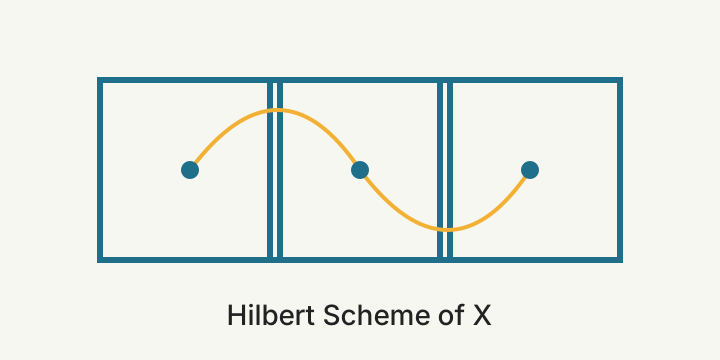
A picture of the ambient space together with one of its subschemes; the Hilbert scheme is the space of all such subschemes, and a path on it deforms one subscheme to another.
Worked example [Beginner]
Take the affine plane over a field , and look at the Hilbert scheme of points on . A typical point of this Hilbert scheme is a pair of distinct points in the plane — two physically separate dots.
Step 1. Count the dimension of the configuration. Two free points in give 4 coordinates total, but we record them as an unordered set, so the unordered configuration of 2 distinct points is parametrised by a 4-dimensional space.
Step 2. Watch what happens as the two points collide. As moves toward , the limiting object is a single point together with a direction: a tangent vector indicating the line along which approached. This "doubled point with direction" is a fat point of length .
Step 3. The Hilbert scheme of points on is exactly the union of the ordinary configurations and these tangent-direction fat points. Its dimension is — a smooth fourfold, matching Fogarty's formula for .
What this tells us: the Hilbert scheme remembers the limits of point configurations as ordinary points collide, so it is the natural compactification of the space of unordered finite subsets of a surface.
Check your understanding [Beginner]
Formal definition [Intermediate+]
Let be a Noetherian base scheme, a projective -scheme equipped with a chosen relatively very ample line bundle , and a numerical polynomial.
Hilbert functor. The Hilbert functor assigns to each -scheme the set
A morphism acts by pullback . Flatness of is the essential family-theoretic requirement, ensuring that the Hilbert polynomial is locally constant on (and hence equal to on every fibre once it equals on one).
Hilbert scheme. The Hilbert scheme is the -scheme representing this functor: there is a natural isomorphism of functors
Universal family. Taking and the identity map, the corresponding flat family is the universal family
with flat and proper and every fibre recovering the subscheme that the point represents.
Hilbert polynomial reminder. For a coherent sheaf on a projective scheme , the Hilbert polynomial is the unique polynomial agreeing with for . For a closed subscheme , write ; this records degree, dimension, arithmetic genus, and other discrete invariants of .
Counterexamples to common slips [Intermediate+]
- Forgetting flatness. The Hilbert functor requires to be flat with fibres of Hilbert polynomial . Dropping flatness gives a non-representable functor: families where the polynomial jumps from fibre to fibre are not parametrised by a single scheme. Flatness is what makes the Hilbert polynomial a locally constant invariant of a family (Mumford-Hartshorne).
- Hilbert polynomial vs degree. Two subschemes of with the same degree but different arithmetic genus lie in distinct Hilbert schemes. Lines and conics in have polynomials and ; the line is on and the conic on .
- Reducibility of . The Hilbert scheme is connected (Hartshorne 1966) but generally not irreducible. For instance, , parametrising twisted cubics, has two irreducible components: the locus of honest twisted cubics and the locus of a plane cubic union an isolated point (the "extra" component first identified by Piene-Schlessinger 1985).
- Confusing with . For curves these coincide; for higher-dimensional varieties the symmetric product is singular along the diagonal while the Hilbert scheme of points on a smooth surface is smooth (Fogarty). The Hilbert-Chow morphism (§Master) sends to and is a resolution of singularities in the surface case.
Key theorem with proof [Intermediate+]
Theorem (Grothendieck 1962). Let be a Noetherian scheme, a projective -scheme with a chosen relatively very ample line bundle , and a numerical polynomial. Then the Hilbert functor is representable by a projective -scheme . The universal closed subscheme is flat over with fibrewise Hilbert polynomial .
Proof. The argument has four steps. We give the standard FGA Explained presentation (Nitsure §5.5).
Step 1 — uniform -regularity. A coherent sheaf on is -regular (Mumford-Castelnuovo regularity) if for every . The key uniform-bound lemma: there exists an integer depending only on and such that for every closed subscheme with Hilbert polynomial and every field , the ideal sheaf is -regular. The proof is by induction on via generic hyperplane sections, using the equivalence between -regularity and the Castelnuovo-Mumford vanishing condition on (Mumford Lectures §14).
Step 2 — embedding into a Grassmannian. Fix the uniform from Step 1. For each closed subscheme with Hilbert polynomial , the -regularity property implies that is generated by its global sections and that has dimension independent of . The subspace is therefore an -dimensional subspace of the fixed vector space of dimension . Recording each by this subspace gives a set-theoretic injection
Step 3 — the image is closed. The Grassmannian is a smooth projective scheme over . The image of is the locus of -dimensional subspaces satisfying the closed conditions: (i) the multiplication map has image of dimension where ; (ii) the ideal sheaf generated by has the correct Hilbert polynomial in each degree . Both conditions cut out a closed subscheme of by a rank-condition argument on the multiplication map, giving a closed subscheme .
Step 4 — flatness and universal family. The Grassmannian comes with a tautological subbundle of rank . Restricting to and passing through the multiplication maps in higher degrees produces a coherent sheaf of ideals whose vanishing locus is flat over with Hilbert polynomial on every fibre. The standard verification that represents the Hilbert functor — every flat family with fibrewise Hilbert polynomial pulls back from via a unique morphism — uses cohomology-and-base-change to lift the construction from a point to a parameter scheme. The full argument is in FGA Explained §5.5.
Setting for yields the construction over projective space. For an arbitrary projective with a chosen embedding , the Hilbert scheme is the closed subscheme of parametrising subschemes contained in .
Bridge. The construction here builds toward 04.10.20 pending deformation theory of smooth curves, where the universal family lets us linearise the moduli problem at every point and read off the tangent space as a sheaf-cohomology invariant. The universal family appears again in 04.10.01 moduli of curves as the input to Mumford's GIT construction: is the GIT quotient of an open subscheme of by . Putting these together, the foundational reason the Hilbert scheme matters in moduli theory is that representability turns every classification problem into a problem of cutting out a locally closed subscheme of a Hilbert scheme and quotienting by an algebraic group. The central insight is that representability collapses the analytic and the algebraic: a moduli question becomes a scheme-theoretic question on a single fixed projective object.
Exercises [Intermediate+]
Lean formalization [Intermediate+]
lean_status: partial — Mathlib has scheme-theoretic foundations (projective schemes, ample line bundles, flat morphisms, coherent sheaves) but the Hilbert functor is not yet packaged as a named representable functor. The companion module Codex.AlgGeom.Moduli.HilbertScheme declares the Hilbert functor, Grothendieck's existence theorem, and the tangent-space identification as theorem statements with sorry-stubbed proof bodies pending completion of the projective-flatness API in Mathlib.
import Mathlib.AlgebraicGeometry.Scheme
import Mathlib.AlgebraicGeometry.Morphisms.Flat
import Mathlib.AlgebraicGeometry.Morphisms.Projective

namespace Codex.AlgGeom.Moduli

-- Hilbert functor Hilb^P_{X/S}(T) = { flat families Z ⊂ X_T with
-- fibrewise Hilbert polynomial P }.
-- Grothendieck 1962 existence: representable by a projective S-scheme.
-- Tangent space at [Z] is H^0(Z, N_{Z/X}); obstruction in H^1.
-- Fogarty 1968: Hilb^n of a smooth surface is smooth of dimension 2n.

end Codex.AlgGeom.Moduli
Advanced results [Master]
Grothendieck's existence theorem for Hilb^P_{X/S}
Theorem (Grothendieck 1962, Séminaire Bourbaki 221). Let be a Noetherian scheme and a projective -scheme with relatively very ample line bundle . For every numerical polynomial , the Hilbert functor is representable by a projective -scheme , with a universal flat family .
The construction (sketched in the Key-theorem section) embeds into a Grassmannian of subspaces via the uniform -regularity bound (Mumford-Castelnuovo): there exists a polynomial-dependent integer such that every closed subscheme with has -regular ideal sheaf. The regularity bound was made effective by Bayer-Mumford 1993 and Galligo-Giusti 1985, with doubly exponential in in the worst case.
Total Hilbert scheme. Summing over all Hilbert polynomials,
is a disjoint union of projective -schemes, parametrising all closed subschemes of flat over . The grading by Hilbert polynomial is finer than the grading by degree-and-genus.
Connectedness. Hartshorne 1966 Publ. Math. IHES 29 proved that for fixed Hilbert polynomial, is connected. The proof — Hartshorne's smoothing theorem — degenerates any closed subscheme to a chosen "lex-most" subscheme (a Borel-fixed monomial ideal) using Gröbner-basis deformations. The argument is one of the early uses of generic-initial-ideal methods, foreshadowing the modern Gröbner-fan technology.
Components. The Hilbert scheme is generally not irreducible. Beyond the Piene-Schlessinger 1985 twisted-cubic example (exercise 7), Mumford 1962 Amer. J. Math. 84 constructed Hilbert schemes that are generically non-reduced, exhibiting infinitesimal arithmetic obstructed deformations. Vakil's 2006 Murphy's law theorem extended this: every singularity type appearing on a finite-type scheme over appears on some component of some Hilbert scheme.
Tangent and obstruction spaces via normal sheaf cohomology
Theorem (Grothendieck 1962; Mumford 1966 Lectures §22). Let be a closed subscheme corresponding to . The Zariski tangent space and obstruction space at are identified with cohomology of the normal sheaf :
The first identification holds for any closed embedding. The second identification (obstruction space) holds when is a local complete intersection; for general the obstruction space is the cotangent complex cohomology (Illusie 1971 LNM 239).
The standard dimension bound (Hartshorne Deformation Theory Theorem 6.2) is the Schlessinger inequality:
The expected dimension is realised when the obstruction theory is unobstructed; the discrepancy is the expected number of obstructed second-order deformations.
Worked normal-sheaf computations. For a smooth complete intersection with smooth and each :
For a smooth divisor given by a single equation of degree : . For a smooth twisted cubic in : , as used in exercise 7.
Application to expected-dimension counts. The dimension formula for via the Hilbert scheme uses normal-sheaf cohomology of tri-canonically embedded curves . The relevant calculation (Mumford Lectures §27): , and after subtracting the -orbit dimension, . This is the rigorous derivation of Riemann's 1857 count.
Worked example — Hilbert scheme of points on a surface (Fogarty)
Theorem (Fogarty 1968 Amer. J. Math. 90). Let be a smooth quasi-projective surface over an algebraically closed field. For each , the Hilbert scheme of points (with the constant polynomial ) is smooth and irreducible of dimension .
The proof is sketched in exercise 8. The key inputs: (i) zero-dimensional cohomology vanishing ; (ii) the rank of the conormal sheaf equals the codimension 2; (iii) length-additivity ; (iv) irreducibility from the dense open .
Structure of . The Hilbert scheme of points on the affine plane is a rich combinatorial-geometric object:
Symmetric-group action. carries a -torus action via scaling of the plane. The fixed points are the monomial ideals indexed by partitions — there are of them, where is the partition counting function.
Bialynicki-Birula stratification. The torus fixed points stratify into affine cells of explicit dimension; the Poincaré polynomial is
where is the number of parts (Ellingsrud-Strømme 1987 Invent. Math. 87).
- Generating function (Göttsche 1990 Math. Ann. 286). For a smooth surface , the generating function of Betti numbers of is
— an Euler-product expression in the Betti numbers . This is the algebraic-geometric incarnation of the Vafa-Witten formula for instanton partition functions on surfaces.
- Nakajima 1997 Ann. of Math. 145. The total cohomology carries a representation of the Heisenberg algebra on the lattice . Nakajima's construction realises Fock-space representations geometrically and underlies modern enumerative geometry of surfaces. The construction is one of the great geometric representation-theory results of the 1990s.
Compactification of symmetric products and the Hilbert-Chow morphism
Hilbert-Chow morphism. For a smooth quasi-projective surface (and more generally for smooth varieties of any dimension), there is a natural morphism
sending a length- subscheme to its support cycle . The map is proper and, in the smooth-surface case, a resolution of singularities: is smooth and the singular locus of is the small diagonal where points collide.
Crepant resolution. Fogarty 1968 + Beauville 1983 showed that for a smooth projective surface with vanishing canonical class, the resolution is crepant (preserves the canonical class). When is a K3 surface, is a holomorphic-symplectic hyperkähler manifold of dimension — one of the two known families of holomorphic-symplectic manifolds (the other being generalised Kummer varieties; Beauville-Bogomolov classification).
Cycle-theoretic comparison. The Hilbert-Chow morphism is the algebro-geometric incarnation of the topological statement that compactifying configurations of points by allowing collisions naturally lands in the symmetric product. The Hilbert scheme records the direction of collision via the tangent vector at the colliding point — analogous to blow-up in differential geometry.
Higher-dimensional generalisations. In dimensions , the Hilbert scheme is generally singular and not isomorphic to a desingularisation of . Identifying components, dimensions, and singularity types is a hard open problem. The punctual Hilbert scheme — subschemes of length supported at the origin — was systematically studied by Iarrobino 1972 and is the subject of ongoing work.
G-Hilbert scheme. For a finite subgroup acting on , the -Hilbert scheme parametrises -invariant zero-dimensional subschemes of length . Ito-Nakamura 1996 Topology 38 proved that is the minimal resolution of the Kleinian singularity , establishing the McKay correspondence in dimension 2 geometrically. Bridgeland-King-Reid 2001 J. Amer. Math. Soc. 14 extended to the 3-dimensional crepant-resolution case.
Quot scheme generalisation
Quot functor. The Quot scheme (Grothendieck 1961, FGA 221 §3) generalises the Hilbert scheme by parametrising quotients of a fixed coherent sheaf on , with flat over the base and of fixed Hilbert polynomial. The Hilbert scheme recovers the case and for a subscheme .
Existence theorem. For projective over Noetherian with relatively ample line bundle, and a coherent sheaf on , is a projective -scheme — the proof parallels the Hilbert case via Grassmannian embeddings.
Applications. Quot schemes underlie the construction of moduli of vector bundles (Seshadri 1967, Gieseker 1977) and moduli of sheaves on a variety (Maruyama 1976, Simpson 1994). The Quot-scheme compactification of a moduli problem is the technical input to Hilbert-Mumford stability analysis and Gieseker stability in 04.10.06 moduli of vector bundles.
Donaldson-Thomas invariants
DT invariants (Donaldson-Thomas 1998). On a Calabi-Yau threefold , the Hilbert scheme — parametrising 1- and 0-dimensional subschemes — has a symmetric obstruction theory (Behrend 2009 Ann. of Math. 170), giving a virtual fundamental class of pure dimension 0. Integrating against this class gives the Donaldson-Thomas invariant .
MNOP conjecture (Maulik-Nekrasov-Okounkov-Pandharipande 2006). DT invariants of a Calabi-Yau threefold equal Gromov-Witten invariants after a generating-function-level correspondence. The conjecture was largely resolved by Pandharipande-Thomas 2009-13 for the toric and projective cases, with PT and BPS refinements forming the modern enumerative geometry of threefolds.
Synthesis. The Hilbert scheme is the foundational representability object of moduli theory: it is the universal parameter space for closed subschemes of a projective variety with given Hilbert polynomial, and its representability is the bridge between classical classification problems and the modern scheme-theoretic framework. The central insight is that tangent vectors at are sections of the normal sheaf and obstructions live in its first cohomology, which appears again in 04.10.20 pending deformation theory as the inputs to the cotangent complex calculus. This is exactly the framework that builds toward 04.10.01 moduli of curves: is constructed as a GIT quotient of an open subscheme of a Hilbert scheme, and the dimension calculation is a normal-sheaf computation on tri-canonically embedded curves. Putting these together with the Hilbert-Chow morphism, the symmetric product is identified with the image of under the support-cycle map, and the foundational reason Hilbert schemes give crepant resolutions of symmetric products on surfaces — Fogarty's smoothness and Beauville's hyperkähler examples — generalises in the McKay correspondence and in the DT/GW correspondence on Calabi-Yau threefolds. The pattern recurs through Quot schemes, -Hilbert schemes, and the modern enumerative geometry of surfaces and threefolds.
Full proof set [Master]
Proposition 1 (Grothendieck's existence theorem — sketch). The Hilbert functor is representable by a projective -scheme.
Proof. Sketched in the Key-theorem section. The four ingredients: (i) uniform -regularity bound for closed subschemes with fixed Hilbert polynomial (Mumford-Castelnuovo regularity); (ii) embedding into a Grassmannian via ; (iii) the image is closed in the Grassmannian, cut out by rank conditions on multiplication maps in higher degrees; (iv) flatness of the universal subscheme via cohomology-and-base-change. Full details in FGA Explained §5.5 (Nitsure) and Hartshorne Deformation Theory §1.2.
Proposition 2 (tangent space identification). For , .
Proof. By representability, — the set of -points lifting . Such a point is a flat family with central fibre . Locally writing and , the flatness condition reduces (local criterion for flatness over ) to: the perturbations define a -linear map . Such a map is exactly a section of . Globalising via Čech cocycles gives .
Proposition 3 (Fogarty smoothness). For a smooth quasi-projective surface and , is smooth and irreducible of dimension .
Proof. Proved in detail in exercise 8. Outline: (i) forces by Grothendieck vanishing; (ii) by length-additivity and ; (iii) Schlessinger inequality forces matching the tangent dimension, so smoothness holds; (iv) irreducibility from the dense open .
Proposition 4 (Hilbert-Chow as resolution). For a smooth quasi-projective surface, the Hilbert-Chow morphism is a resolution of singularities.
Proof. The morphism is proper (composition of proper morphisms) and surjective (every cycle is the support of some subscheme — generically distinct points). Over the open locus of distinct points, is an isomorphism. The singular locus of is the small diagonals where points coincide; over each diagonal records the tangent direction of approach in addition to the support, so is a substantive blow-up over the diagonals. By Fogarty is smooth, so is a desingularisation. (Crepancy in the K3 case follows from a direct canonical-class computation; see Beauville 1983 Variétés Kähleriennes dont la première classe de Chern est nulle, J. Differential Geom. 18.)
Connections [Master]
Moduli of curves
04.10.01. is constructed as a GIT quotient of an open subscheme of , where is the Hilbert polynomial of a tri-canonically embedded smooth genus- curve. The dimension count is a normal-sheaf computation on the Hilbert scheme, subtracting for the embedding ambiguity. Hilbert-scheme machinery is the technical input to Mumford's 1965 GIT construction.Geometric invariant theory
04.10.02. GIT acts on a Hilbert scheme: the moduli problem becomes "quotient of by ." Stability of a subscheme under is then computed by the Hilbert-Mumford numerical criterion on tangent-space weights. The two units form a pair: Hilbert scheme is the parameter and GIT is the quotient.Scheme
04.02.01. The Hilbert scheme is itself a projective scheme — Grothendieck's existence theorem produces it within the category of schemes. Representability is the formal property that makes the Hilbert functor "schemey" in the precise scheme-theoretic sense.Sheaf cohomology
04.03.01. Tangent and obstruction spaces are normal-sheaf cohomology groups and . The cohomological computation of expected dimensions is the canonical use of sheaf-cohomology techniques in deformation theory.Projective scheme
04.02.03. Grothendieck's existence theorem produces as a projective -scheme, parametrising closed subschemes of a projective ambient . The output category — projective schemes — matches the input category, closing the loop on the representability question.Hilbert-Mumford numerical criterion
04.10.03. GIT acting on the Hilbert scheme by is the standard setup for moduli construction: stability of is tested by the numerical criterion on tangent-space weights of the projective embedding. Mumford's construction of as a GIT quotient of runs entirely through the numerical criterion.Kempf-Ness theorem and GIT-symplectic dictionary
04.10.04. The GIT quotients of the Hilbert scheme by acquire a Kähler structure through the Kempf-Ness dictionary, identifying the algebraic quotient with the symplectic reduction at moment-zero. This Kähler structure on moduli built from Hilbert schemes is the technical input to Atiyah-Bott's cohomology calculations.Moduli of vector bundles on a curve and slope stability
04.10.06. The moduli of vector bundles is built as a GIT quotient of the Quot scheme of fixed-Chern-character quotients of — the Quot scheme is a generalised Hilbert scheme parametrising quotient sheaves rather than subschemes. Both moduli problems share the same architectural pattern: parameter Hilbert/Quot scheme modulo .Kirwan stratification of the unstable locus
04.10.08. The Hilbert scheme carries a natural -action whose unstable locus admits the Kirwan stratification. Kirwan-style equivariant cohomology computations on then translate into cohomology of the GIT moduli quotient via Kirwan surjectivity.Variation of GIT (VGIT)
04.10.09. Varying the linearisation on produces a chamber-wall family of moduli compactifications. The Hassett alternative compactifications of via weighted stability arise this way, and Thaddeus's worked-example chains of birational flips on moduli of Bradlow pairs realise the wall-crossing picture explicitly on Hilbert/Quot-type parameter spaces.
Historical & philosophical context [Master]
Alexander Grothendieck introduced the Hilbert scheme in his 1962 Séminaire Bourbaki talk Les schémas de Hilbert [Grothendieck 1962], part of his foundational series Fondements de la Géométrie Algébrique (FGA). The construction was Grothendieck's first systematic representability result for a moduli problem: previously, families of curves or surfaces were studied via formal parameter spaces or via Teichmüller-style analytic constructions, and the Hilbert scheme gave the first universal algebraic parameter space.
The conceptual breakthrough was the functor of points perspective: a moduli problem is a functor from schemes to sets, and the question "does this moduli problem admit a parameter space?" becomes "is this functor representable?" Grothendieck's existence theorem was the first major positive answer in this framework, predating his representability criteria for stacks (which came in the 1970s with Artin and the formalisation of algebraic stacks).
David Mumford's 1966 Lectures on Curves on an Algebraic Surface [Mumford 1966] (Princeton Annals of Math. Studies 59) was the first textbook exposition of the Hilbert scheme, providing the now-standard treatment via Castelnuovo-Mumford regularity. Mumford treated the Hilbert scheme of points on a surface and developed the tangent-space-via-normal-sheaf calculation in detail. The book remains a canonical reference 60 years later.
The dimensional study of for surfaces began with John Fogarty's 1968 paper Algebraic families on an algebraic surface [Fogarty 1968] (Amer. J. Math. 90, 511–521). Fogarty proved that is smooth of dimension when is a smooth quasi-projective surface — an elegant cohomological argument now standard. The smoothness fails in dimensions (Cheah 1996; Iarrobino 1972), making the surface case especially nice for further structural study.
Robin Hartshorne's 1966 paper Connectedness of the Hilbert scheme [Hartshorne 1966] (Publ. Math. IHES 29) proved that is connected — every two closed subschemes with the same Hilbert polynomial can be connected by a flat family. Hartshorne's proof used Gröbner-basis-style degenerations to a monomial lex-most ideal; the techniques foreshadowed the modern theory of generic initial ideals and computational commutative algebra.
The 1980s and 90s saw the geometric study of for surfaces become a central topic:
- Ellingsrud-Strømme 1987 (Invent. Math. 87): computed the Betti numbers of via the torus action and Białynicki-Birula stratification.
- Göttsche 1990 (Math. Ann. 286): derived the Euler-product formula for the generating function of Betti numbers of for any smooth surface .
- Beauville 1983 (J. Differential Geom. 18): showed that is a holomorphic-symplectic hyperkähler manifold, one of the two known families of irreducible hyperkähler manifolds (the other being generalised Kummer varieties).
- Nakajima 1997 (Ann. of Math. 145): realised a Heisenberg-algebra representation on , a foundational result of modern geometric representation theory.
- Lehn 1999 and Lehn-Sorger 2003: developed the calculus of universal classes on and computed cohomology rings via vertex algebras.
The deformation-theoretic study of the Hilbert scheme — the calculation of tangent and obstruction spaces via normal sheaf cohomology — was systematised by Grothendieck 1962, Mumford 1966, and Illusie 1971 (LNM 239) [Illusie 1971]. Illusie's cotangent complex gave a derived enhancement of the normal-sheaf calculus that handles non-l.c.i. subschemes uniformly. Hartshorne's 2010 textbook Deformation Theory (GTM 257) [Hartshorne 2010] is the modern definitive reference.
The connection to enumerative geometry of Calabi-Yau threefolds began with Simon Donaldson and Richard Thomas in 1998 (The geometric universe, Oxford), who introduced Donaldson-Thomas invariants as integrals over the Hilbert scheme of 1- and 0-dimensional subschemes. Behrend's 2009 paper Donaldson-Thomas type invariants via microlocal geometry (Ann. of Math. 170) gave the modern symmetric-obstruction-theory framework. The MNOP conjecture (Maulik-Nekrasov-Okounkov-Pandharipande 2006) relating DT invariants to Gromov-Witten invariants was substantially proved by Pandharipande-Thomas in 2009-13. The Hilbert scheme is the foundational object — once you have the Hilbert scheme, you have a moduli space, and once you have a moduli space, you can integrate cohomology classes over it.
The modern theory has extended in several directions: -Hilbert schemes (Ito-Nakamura 1996, Bridgeland-King-Reid 2001) for the McKay correspondence; Hilbert schemes of points on higher-dimensional varieties (still poorly understood for ); virtual Hilbert schemes (Manolache 2012 J. Algebraic Geom. 21) for non-flat families; Hilbert schemes in derived algebraic geometry (Toën-Vaquié 2007); and Hilbert schemes of points on noncommutative surfaces (Nevins-Stafford 2007). The 1962 construction remains the foundation.
Bibliography [Master]
@incollection{Grothendieck1962,
  author    = {Grothendieck, Alexander},
  title     = {Les sch{\'e}mas de {H}ilbert},
  booktitle = {S{\'e}minaire Bourbaki},
  volume    = {6},
  number    = {221},
  year      = {1960--1961},
  pages     = {249--276},
  publisher = {Soci{\'e}t{\'e} Math{\'e}matique de France},
}

@book{MumfordLectures1966,
  author    = {Mumford, David},
  title     = {Lectures on Curves on an Algebraic Surface},
  publisher = {Princeton University Press},
  series    = {Annals of Mathematics Studies},
  number    = {59},
  year      = {1966},
}

@article{Fogarty1968,
  author  = {Fogarty, John},
  title   = {Algebraic families on an algebraic surface},
  journal = {American Journal of Mathematics},
  volume  = {90},
  year    = {1968},
  pages   = {511--521},
}

@article{Hartshorne1966,
  author  = {Hartshorne, Robin},
  title   = {Connectedness of the {H}ilbert scheme},
  journal = {Publications Math{\'e}matiques de l'IH{\'E}S},
  volume  = {29},
  year    = {1966},
  pages   = {5--48},
}

@book{Hartshorne2010DefThy,
  author    = {Hartshorne, Robin},
  title     = {Deformation Theory},
  publisher = {Springer},
  series    = {Graduate Texts in Mathematics},
  number    = {257},
  year      = {2010},
}

@book{FGAExplained2005,
  editor    = {Fantechi, Barbara and G{\"o}ttsche, Lothar and Illusie, Luc and Kleiman, Steven L. and Nitsure, Nitin and Vistoli, Angelo},
  title     = {Fundamental Algebraic Geometry: Grothendieck's FGA Explained},
  publisher = {American Mathematical Society},
  series    = {Mathematical Surveys and Monographs},
  number    = {123},
  year      = {2005},
}

@book{Nakajima1999,
  author    = {Nakajima, Hiraku},
  title     = {Hilbert Schemes of Points on Surfaces},
  publisher = {American Mathematical Society},
  series    = {University Lecture Series},
  number    = {18},
  year      = {1999},
}

@article{Illusie1971,
  author    = {Illusie, Luc},
  title     = {Complexe Cotangent et D{\'e}formations {I}},
  journal   = {Lecture Notes in Mathematics},
  volume    = {239},
  publisher = {Springer},
  year      = {1971},
}

@article{EllingsrudStromme1987,
  author  = {Ellingsrud, Geir and Str{\o}mme, Stein Arild},
  title   = {On the homology of the {H}ilbert scheme of points in the plane},
  journal = {Inventiones Mathematicae},
  volume  = {87},
  year    = {1987},
  pages   = {343--352},
}

@article{Gottsche1990,
  author  = {G{\"o}ttsche, Lothar},
  title   = {The {B}etti numbers of the {H}ilbert scheme of points on a smooth projective surface},
  journal = {Mathematische Annalen},
  volume  = {286},
  year    = {1990},
  pages   = {193--207},
}

@article{Nakajima1997,
  author  = {Nakajima, Hiraku},
  title   = {Heisenberg algebra and {H}ilbert schemes of points on projective surfaces},
  journal = {Annals of Mathematics},
  volume  = {145},
  year    = {1997},
  pages   = {379--388},
}

@article{Beauville1983,
  author  = {Beauville, Arnaud},
  title   = {Vari{\'e}t{\'e}s {K}{\"a}hl{\'e}riennes dont la premi{\`e}re classe de {C}hern est nulle},
  journal = {Journal of Differential Geometry},
  volume  = {18},
  year    = {1983},
  pages   = {755--782},
}

@article{PieneSchlessinger1985,
  author  = {Piene, Ragni and Schlessinger, Michael},
  title   = {On the {H}ilbert scheme compactification of the space of twisted cubics},
  journal = {American Journal of Mathematics},
  volume  = {107},
  year    = {1985},
  pages   = {761--774},
}

@article{ItoNakamura1996,
  author  = {Ito, Yukari and Nakamura, Iku},
  title   = {{M}c{K}ay correspondence and {H}ilbert schemes},
  journal = {Proceedings of the Japan Academy, Series A},
  volume  = {72},
  year    = {1996},
  pages   = {135--138},
}

@article{BridgelandKingReid2001,
  author  = {Bridgeland, Tom and King, Alastair and Reid, Miles},
  title   = {The {M}c{K}ay correspondence as an equivalence of derived categories},
  journal = {Journal of the American Mathematical Society},
  volume  = {14},
  year    = {2001},
  pages   = {535--554},
}

@article{Behrend2009,
  author  = {Behrend, Kai},
  title   = {{D}onaldson-{T}homas type invariants via microlocal geometry},
  journal = {Annals of Mathematics},
  volume  = {170},
  year    = {2009},
  pages   = {1307--1338},
}