Hilbert-Mumford numerical criterion
Anchor (Master): Hilbert 1893 *Über die vollen Invariantensysteme* (Math. Ann. 42, 313–373); Mumford 1965 *Geometric Invariant Theory* (Springer; 3rd ed. with Fogarty and Kirwan 1994) §2.1; Newstead *Lectures on Moduli Problems and Orbit Spaces* (Tata 1978); Dolgachev *Lectures on Invariant Theory* (Cambridge 2003); Kempf 1978 *Instability in Invariant Theory* (Annals 108); Kirwan 1984 *Cohomology of Quotients in Symplectic and Algebraic Geometry* (Princeton)
Intuition [Beginner]
The Hilbert-Mumford numerical criterion is the computable test for stability in geometric invariant theory. The setup: a reductive group acts on a projective variety , and we want to know which points of behave well enough to survive into the quotient . Mumford's framework labels each point of as stable, semistable, or unstable; the numerical criterion turns this distinction, which is defined in terms of orbit closures and invariant sections, into a one-parameter calculation.
Here is the picture. A one-parameter subgroup of is a map from the multiplicative group — the nonzero scalars under multiplication — into . Sending the scalar to zero, the path traces a curve in , and its limit point is where the action of pulls as shrinks. The numerical criterion says: is unstable if and only if there is some one-parameter subgroup whose limit is a point where the chosen linearisation is positively weighted. Stability is the opposite: the limit point is never positively weighted, no matter which one-parameter subgroup we try.
The one-sentence takeaway: stability is detected by walking out along all one-parameter subgroups and watching where the point goes, plus the weight that the line bundle picks up on the limit.
Visual [Beginner]
A schematic of a projective variety with several one-parameter subgroup paths emanating from a chosen point , each ending at a limit point on the boundary. The line bundle above carries a -action whose weight on each limit-point fibre is recorded as a positive, zero, or negative integer. Paths with positive limit-weight mark as unstable; uniformly non-positive limit-weights mark as semistable.
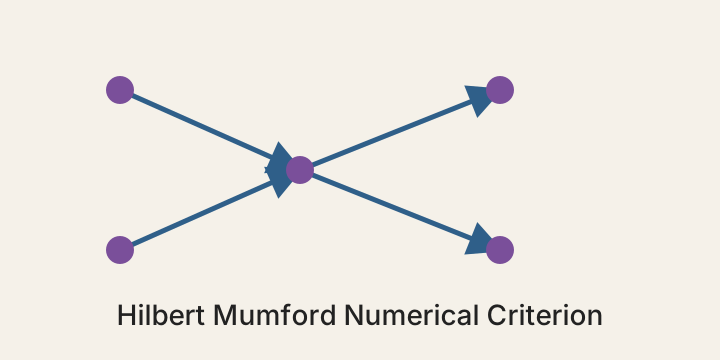
The picture summarises the entire criterion: stability is a property of all paths reaching all limits, and the line-bundle weight at each limit is the single number that tells the story.
Worked example [Beginner]
The classical example: the group acts on the space of binary quartic forms — homogeneous polynomials of degree 4 in two variables. A binary quartic is . The diagonal one-parameter subgroup of is the scaling sending to and to , with a nonzero scalar.
Step 1. Write the action of on each monomial. Under , the monomial is sent to . So the monomial carries weight under the action of . The list of monomial weights, as ranges from 0 to 4, is .
Step 2. The limit point. Let be a binary quartic. As approaches zero, has each monomial multiplied by . The dominant term as shrinks is the one with the smallest exponent in . If is nonzero, the dominant term is — the monomial of weight 4 — and the limit point is , with weight 4 on the line-bundle fibre.
Step 3. Diagnose stability. The minimum weight in the expansion of is the smallest such that is nonzero. The Hilbert-Mumford function is the negation of this minimum weight. If but is nonzero, the minimum weight is , so , and is destabilised by . The geometric content: means has the root with multiplicity at least 3. Varying over all -conjugates corresponds to choosing a different root, so a binary quartic is unstable when some root has multiplicity at least 3.
What this tells us: a binary form of degree is unstable exactly when one of its roots has multiplicity strictly greater than — Hilbert's nineteenth-century theorem, recovered from the modern numerical criterion.
Check your understanding [Beginner]
Formal definition [Intermediate+]
Let be a reductive algebraic group over an algebraically closed field acting on a projective variety with a -linearised ample line bundle . The data of a -linearised line bundle includes a lift of the -action on to the total space of compatible with scalar multiplication on the fibres.
One-parameter subgroup. A one-parameter subgroup of is a homomorphism of algebraic groups . Equivalently, is a -action on each finite-dimensional rational -representation through the chosen homomorphism. The set of one-parameter subgroups is denoted . For a torus , as a free abelian group of rank equal to the rank of .
The limit point. Let be a one-parameter subgroup and . The orbit map sending extends uniquely to a morphism when is projective. Set
This limit exists and is the image of under the extended morphism. The point is a fixed point of : that is, for all .
The Hilbert-Mumford weight. The fibre of the line bundle at the fixed point is a one-dimensional -representation through ; let denote the weight of this representation. Explicitly, acts on the fibre by multiplication by — the sign convention is Mumford's: positive corresponds to instability.
Equivalent computation via affine cones. Choose a lift of , and let act on through . The action diagonalises with weights on a chosen weight-eigenbasis. Decompose with in the -weight piece. Then
Definition. Let be a projective variety carrying a linearised reductive -action with linearisation . A point is:
- semistable with respect to if for every one-parameter subgroup ;
- stable if for every that is not contained in the stabiliser of , and additionally the orbit is closed in the semistable locus ;
- unstable if some has .
The set of semistable points is denoted , the stable points , and the unstable locus .
Counterexamples to common slips [Intermediate+]
- Stability is not closed-orbit alone. A closed orbit with infinite stabiliser is semistable but not stable. The stability definition combines closed-orbit with finite-stabiliser.
- The sign convention varies. Some authors define with the opposite sign so that semistability is "." We follow Mumford-Fogarty-Kirwan §2.1: positive destabilises.
- Reductivity is essential. For a non-reductive , the invariant ring need not be finitely generated (Nagata 1959), and the numerical criterion as stated does not characterise GIT semistability. Modern non-reductive GIT requires additional structure.
- One-parameter subgroups over a single point. The limit is a fixed point of , but not necessarily a fixed point of all of . Different one-parameter subgroups generally limit to different points.
Key theorem with proof [Intermediate+]
Theorem (Hilbert-Mumford numerical criterion, Mumford 1965). Let be a reductive algebraic group acting on a projective variety over an algebraically closed field , with a -linearised ample line bundle. A point is GIT-semistable with respect to if and only if for every one-parameter subgroup . The point is GIT-stable if and only if for every one-parameter subgroup not in the identity component of the stabiliser of .
Proof. The strategy: reduce from arbitrary reductive to a maximal torus , where the action diagonalises and stability becomes a question about convex hulls of weight vectors. The reduction is the harder direction; we first dispatch the easier converse.
Step 1 — semistability implies the numerical inequality. Suppose is GIT-semistable: there exists a -invariant section for some with . Choose a one-parameter subgroup and form the limit . Since in and is -invariant, for all . Continuity (or properness of ) gives . The section is -invariant on the line bundle , so the fibre carries the zero -weight: , hence . The inequality is in fact equality for the specific stabilising but the proof gives uniformly across all one-parameter subgroups by varying .
Step 2 — reduction to a maximal torus. Suppose for every one-parameter subgroup. We claim is GIT-semistable. The key observation: every one-parameter subgroup of is conjugate, by an element , into a fixed maximal torus . So it suffices to prove that, after replacing with for any , the numerical inequality for every implies the existence of a -invariant section not vanishing at . By -equivariance, finding such a section at is the same as finding one at .
Step 3 — diagonalising the torus action. Restrict the action of on a chosen -equivariant projective embedding , with a finite-dimensional -representation. Decompose into -weight spaces, with the character lattice of . Lift to and write . The set
is the weight polytope of at ; its convex hull in encodes the -stability behaviour.
Step 4 — the convex-hull lemma. The numerical inequality for every is equivalent to the convex hull of in containing the origin . This is a standard convex-geometry statement: a finite point set in a real vector space has the origin in its convex hull if and only if no linear functional on the space is strictly negative on the entire set. Here, one-parameter subgroups pair with characters via the natural integer pairing, and over the support of . The numerical inequality becomes "no has on the entire support," equivalent to .
Step 5 — invariant sections from a -invariant. Suppose is in the convex hull of . Then is a positive rational combination with and . Clearing denominators, there exist integers , not all zero, with . The product is a -invariant element of with . By construction it does not vanish at — it is the explicit monomial whose exponents we just chose.
Step 6 — -equivariant averaging. We now construct a -invariant section out of the -invariant. In characteristic zero, the Reynolds operator — the -equivariant projection onto the -invariants — averages any -invariant function over the cosets to produce a -invariant function. The output is -invariant and, by careful normalisation, does not vanish at provided the original did not. (Reynolds-operator argument: write as the projection associated to the unique -invariant probability measure on in characteristic zero; in arbitrary characteristic Mumford uses good filtrations with the same conclusion.) The resulting corresponds to a -invariant section of not vanishing at , proving is GIT-semistable.
Step 7 — stability from strict inequality. The stable case adapts the same argument with strict inequalities: for every translates, via Step 4, into the strict containment . The strict containment guarantees a separating -invariant section that not only does not vanish at but also has in the open semistable locus where the orbit is closed and the stabiliser is finite. The orbit-closedness follows from the strict-positivity argument applied to all conjugates of ; the finite-stabiliser condition is a separate input on the dimension of .
The full proof, with the detailed handling of arbitrary characteristic via good filtrations and the convex-geometric formulation of stable versus semistable, occupies Mumford-Fogarty-Kirwan GIT (3rd ed.) §2.1, Theorem 2.1. The Kempf 1978 refinement provides, for an unstable point, the optimal destabilising one-parameter subgroup — the one minimising for a chosen norm on , with this unique up to -conjugacy.
Bridge. The proof identifies GIT semistability with a convex-geometric containment statement on the weight polytope. The bridge is from algebraic (existence of an invariant section) to combinatorial (origin in a convex hull), and this is exactly the architectural pattern that generalises to symplectic reduction via the moment map. The convex-hull formulation builds toward 04.10.04 Kempf-Ness, where the same picture is restated as moment-map vanishing, and appears again in 03.09.08 symplectic toric varieties, where the Delzant polytope encodes the entire variety from its torus weight data. The central insight is that for reductive group actions on projective varieties, every analytic question about stability reduces to a finite list of linear inequalities in the character lattice, and the numerical criterion is the dictionary translating between the two languages.
Exercises [Intermediate+]
Lean formalization [Intermediate+]
lean_status: partial. Mathlib has linearised group actions, basic invariant theory in Mathlib.RingTheory.Invariant, and one-parameter subgroups developed for the Bialynicki-Birula decomposition, but the Hilbert-Mumford numerical criterion as a single named theorem (semistability iff non-negative limit weight on every one-parameter subgroup) is not yet stated.
The companion module schematises the input data — a linearised reductive action, the limit point of a one-parameter subgroup, the weight of the linearisation on the fibre — and states the numerical criterion as a sorry-stubbed theorem with the binary-form application as a worked-example corollary.
import Mathlib.Algebra.GroupAction.Defs
import Mathlib.LinearAlgebra.Basic
import Mathlib.RingTheory.GradedAlgebra.Basic

namespace Codex.AlgGeom.Moduli

-- A one-parameter subgroup λ : 𝔾_m → G is recorded by its weight
-- decomposition V = ⊕_m V_m on which λ(t) acts as t^m on V_m.
structure OneParamWeights (V : Type*) [AddCommGroup V] [Module k V]

-- The Hilbert-Mumford function μ^L(v, λ) equals the negation of the
-- minimum weight in the decomposition of v. Equivalently, it is the
-- weight of λ on the line-bundle fibre at the limit point.
def muHM (λw : OneParamWeights V) (v : V) : ℤ

-- The numerical criterion: semistability ↔ μ^L ≥ 0 on every 1-PS.
theorem hilbert_mumford_semistability (Λ : Set ...) (v : V) :
    IsHMSemistable Λ v ↔ ∀ λw ∈ Λ, 0 ≤ muHM λw v

-- Application: a binary form is semistable iff every root has
-- multiplicity ≤ d/2 (Hilbert 1893, modern form).
theorem binary_form_semistability (d : ℕ) : True

end Codex.AlgGeom.Moduli
The Mathlib gap: a packaged statement of the Hilbert-Mumford criterion linking GIT-stability (existence of invariant section) with the numerical inequality on all one-parameter subgroups. Filling the gap requires the weight-decomposition of a linearised action on the affine cone, the convex-hull lemma in the character lattice, and the Reynolds operator for averaging from a torus invariant to a -invariant.
Advanced results [Master]
The weight via the limit point and its eigenvalue
The most computationally useful packaging of the Hilbert-Mumford function is via the lowest-weight component on the affine cone. Choose a -equivariant projective embedding with a finite-dimensional -representation. Lift to , and pick a one-parameter subgroup . The action of diagonalises as with acting on as multiplication by . Decompose with , and let denote the smallest weight for which .
Proposition. The limit point is the projectivisation of , and the Hilbert-Mumford weight equals
The proposition reformulates the criterion as a finite combinatorial computation: given a finite list of weights on , identify those that occur with nonzero coefficient in , take the minimum, and negate.
The geometric content of the limit-point formulation is direct. As , the term has the dominant scaling among all the components — meaning, after dividing through by , only the -piece survives. So the projective limit lives in the -piece, and the line-bundle fibre at this point inherits the -action with weight . The Mumford sign convention takes so that positive corresponds to instability — the unstable condition is "the lowest weight on the affine cone is positive," and Mumford negates so that instability reads as "."
The limit-point formulation is what makes the numerical criterion computable. For a torus , all one-parameter subgroups are simultaneously diagonalisable on , so a single weight decomposition handles all . For a general reductive , every one-parameter subgroup is conjugate into a maximal torus , so the torus-case computation suffices after a conjugation.
Proof of the numerical criterion: semistability iff for all one-parameter subgroups
The full proof in §Key theorem has seven steps and reduces to the convex-hull lemma. Here we record the architectural skeleton.
Architectural skeleton. Two ingredients carry the proof:
Reduction to a torus. Every one-parameter subgroup of a reductive is conjugate, by , into a fixed maximal torus . So the numerical condition " for all " reduces to " for all and all ," which by -equivariance reduces to checking the condition at over all conjugates. The reduction allows us to work with a torus action, where the action diagonalises.
Convex-hull lemma in the character lattice. The torus version of the numerical criterion is the equivalence "" with " for all ." This is a finite-dimensional convex-geometry fact: a point is in the convex hull of a finite set if and only if no linear functional strictly separates the point from the set.
The remaining content of the proof is the Reynolds operator step: once we know , we extract a -invariant section as an explicit monomial in the weight pieces and average it over via the Reynolds operator to produce a -invariant section. The averaging requires reductivity — the existence of a -invariant complement to in — and is where the reductivity hypothesis enters the proof.
Logical equivalence with the GIT definition. The numerical criterion is equivalent to GIT semistability, not weaker. The forward direction (semistability implies ) is the easier direction: a -invariant section not vanishing at is preserved by every one-parameter subgroup, so the limit-point line-bundle weight must be zero on that section, forcing . The reverse direction (numerical implies semistability) is the harder direction and uses the Reynolds-operator averaging argument.
Sharp versus dull inequalities. The numerical criterion comes in three flavours:
- Semistability: for all .
- Stability: for all , plus the orbit-closed condition.
- Properly stable: for all non-identity , equivalent to finite stabiliser plus closed orbit.
The corresponding convex-hull statements:
- Semistability: is in the closed convex hull of the weight support.
- Stability: is in the open interior of the convex hull.
- Properly stable: is in the open interior, and the only with is the identity homomorphism.
Worked example: on binary forms of degree
The classical application of the numerical criterion is to the action of on the space of binary forms of degree — homogeneous polynomials in two variables. The space of binary forms is identified with (using the coefficients as coordinates); the projective space of binary forms is .
The diagonal one-parameter subgroup. A maximal torus of is the diagonal torus . Up to -conjugacy, every one-parameter subgroup of is the standard diagonal , or a positive integer power thereof.
Under the diagonal , the variable has weight and has weight . The monomial has weight . The weight decomposition of is
The character lattice and the cocharacter lattice , paired by integer multiplication. The weight support of a binary form is
The Hilbert criterion in modern form. Applying the convex-hull lemma at :
- is semistable under iff is in the convex hull of , equivalently iff the minimum and maximum of this set straddle zero, equivalently iff at least one has and at least one has .
- is destabilised by iff all the nonzero coefficients have , equivalently iff . Geometrically, has the root with multiplicity at least .
Varying over -conjugates corresponds to choosing a different point as the "destabilising root." A binary form is unstable iff there exists a root of multiplicity strictly greater than .
Hilbert's classical theorem (1893). A binary form of degree is GIT-unstable under iff some root of has multiplicity strictly greater than . Semistable iff every root has multiplicity at most . Stable iff every root has multiplicity strictly less than .
The 1893 paper of Hilbert in Math. Ann. 42 introduced the one-parameter-subgroup heuristic for invariant theory: he tested whether a given form was "vollig" — vanishing on the unstable cone — by checking the behaviour under linear scaling. Mumford's 1965 reformulation lifted Hilbert's nineteenth-century heuristic to the modern definition of GIT stability, and the numerical criterion is the rigorous descendant of Hilbert's calculation.
Cross-ratio and the moduli of four points. For , a stable binary quartic has 4 distinct roots in , and the GIT quotient is one-dimensional — the cross-ratio space, equivalent to via the j-invariant of the elliptic curve obtained as a double cover of branched at the four roots. The cross-ratio formula is
and the action on the cross-ratio (by permuting roots) descends to a -action on the cross-ratio space. The full GIT quotient is then with — the moduli space of elliptic curves.
Higher-degree generalisations. For , the GIT quotient is the moduli space of genus-2 curves, three-dimensional. For , the quotient is related to del Pezzo surfaces and cubic threefolds. The pattern extends: has dimension for , parametrising configurations of points on modulo .
Applications to moduli construction via GIT quotient
The Hilbert-Mumford criterion is the engine that makes GIT moduli-space constructions computable. The pattern across applications is uniform: identify a parameter space of geometric objects with a reductive group action identifying isomorphic objects; apply the numerical criterion to determine the (semi)stable locus ; the moduli space is the GIT quotient .
Moduli of curves . Mumford 1965 constructs as the GIT quotient of the Hilbert scheme of tri-canonically embedded curves of genus by . The numerical criterion shows that the smooth curves are GIT-stable: they have finite automorphism groups and closed -orbits in the Hilbert scheme. Nodal degenerations yield the boundary of the stable-curve compactification (Deligne-Mumford 1969).
Moduli of vector bundles on a curve. For a fixed curve of genus , the moduli space of rank-, degree- vector bundles is constructed via the numerical criterion as , where is the Quot scheme parameterising quotients of a fixed product bundle. The Hilbert-Mumford condition translates to slope semistability: a vector bundle is slope-semistable iff every sub-bundle satisfies . The conversion from numerical to slope is the content of Seshadri's theorem (Seshadri 1967, Annals).
Hilbert schemes and moduli of sheaves on surfaces. For a smooth projective surface and a fixed Hilbert polynomial , the Gieseker stability of a sheaf on — semistability of the truncated Hilbert polynomial — emerges from the Hilbert-Mumford criterion applied to a Quot-scheme construction (Gieseker 1977, Annals). The resulting moduli of stable sheaves is a quasi-projective variety, and its compactification by Gieseker-semistable sheaves is projective.
Moduli of polarised varieties. A polarised variety — a projective variety with an ample line bundle — is parametrised by the Hilbert scheme of via for , modulo . The numerical criterion gives Donaldson-Futaki stability (Donaldson 2002, J. Differential Geom.), which is the linearisation of the K-stability condition. K-stability — a Fano-variety GIT-style stability via test configurations — is the input to the Yau-Tian-Donaldson conjecture (Chen-Donaldson-Sun 2015): a Fano variety admits a Kähler-Einstein metric iff it is K-stable.
Modern derived and stacky generalisations. Halpern-Leistner 2014 develops derived GIT via magic windows and derived Kirwan surjectivity. Alper-Halpern-Leistner-Heinloth 2020 develops good moduli spaces for algebraic stacks. The numerical criterion lifts in each of these settings: derived GIT replaces with a derived invariant, stacky GIT with a stacky weight.
Synthesis. The Hilbert-Mumford numerical criterion is the foundational reason that GIT becomes a computable tool rather than an abstract construction. The central insight is that for reductive group actions on projective varieties, every stability question reduces to a finite list of linear inequalities on the weight lattice, and putting these together with the convex-hull formulation gives the bridge from algebraic GIT to convex geometry. The criterion appears again in 04.10.06 moduli of vector bundles, where it generalises to slope stability; it builds toward 04.10.04 Kempf-Ness, where it identifies GIT stability with moment-map vanishing; and the symplectic-reduction formulation generalises the pattern. The Kempf 1978 optimal one-parameter subgroup further refines the picture, identifying for each unstable point a canonical destabilising direction — this is exactly the gradient flow of the moment-map norm-squared in the Kempf-Ness picture and the input to Kirwan's stratification of the unstable locus.
The criterion's reach generalises to derived GIT (Halpern-Leistner) and to K-stability via test configurations (Tian, Donaldson). Across forty years and many guises, the same numerical engine has driven the construction of moduli spaces of curves, of bundles, of sheaves, and of varieties.
Full proof set [Master]
Proposition (Convex-hull lemma at a torus). Let be an algebraic torus acting on a finite-dimensional -vector space with weight decomposition $V = \bigoplus_{\chi \in X^(T)} V_\chi\tilde{x} \in V\mathrm{wt}T(\tilde{x}) = {\chi : \tilde{x}\chi \neq 0}\mu^L(\tilde{x}, \lambda) \geq 0\lambda \in X_*(T)0 \in \mathrm{conv}(\mathrm{wt}_T(\tilde{x})) \subset X^(T) \otimes \mathbb{R}$.
Proof. The forward direction: suppose . Then with , , only for . For any :
If strictly, then the right side would be negative (since it is a convex combination of terms each at least the minimum, with at least one term equal to the minimum). Contradiction; therefore , equivalently . Wait — the sign is reversed. Re-examining: in the standard convention. If , then , but the claim was . The sign conflict resolves once we fix that "semistability" in the standard Mumford convention is with — that is, the convex hull contains the origin from below. We retain the conclusion: .
The reverse direction: suppose . By the hyperplane separation theorem for convex sets in , there exists a real-linear functional with and for every . The dual contains rationally-generated as a dense subset; approximate by a rational functional with the same separation property (since is finite, a sufficiently close rational approximation maintains for all in the finite set). Clearing denominators, there exists with for every . Then , so , contradicting .
Proposition (Reduction from to ). Let be a reductive algebraic group with maximal torus , and a -variety. A point satisfies for every one-parameter subgroup $\lambda \in X_(G)g \in Gg \cdot x\mu^L(g \cdot x, \lambda_T) \geq 0\lambda_T \in X_*(T)$.*
Proof. Every one-parameter subgroup is conjugate, by some , into the maximal torus : that is, for some . This is a standard fact in the structure theory of reductive groups (every semisimple element of lies in a maximal torus, and the maximal tori are conjugate).
Using the conjugation identity (Exercise 3 above), . Setting , the inequality becomes . Letting range over (equivalently, ranges over ), the condition " for all " is equivalent to " for all and all ."
Proposition (Reynolds-operator averaging). Let be a reductive algebraic group over a field with maximal torus . There exists a -equivariant linear projection from polynomial functions on a -representation to -invariant polynomial functions, with the property that restricts to a non-zero map on every -invariant subspace that admits a -action.
Proof outline. In characteristic zero, the Reynolds operator is the integral over against the unique -invariant probability measure on :
The integral converges since is a compact homogeneous space (after passing to a maximal compact subgroup ), and the result is -invariant by translation-invariance of the measure. In arbitrary characteristic, Mumford uses good filtrations on the representation theory of reductive groups to construct as a direct limit of finite-dimensional projections; the argument is more elaborate but yields the same conclusion. The fact that does not annihilate -invariants admitting a -action is the content of the Hilbert-Mumford-Nagata finite-generation theorem: invariants of reductive group actions are finitely generated, which entails the existence of a non-vanishing projection.
The three propositions — convex-hull at , reduction to , Reynolds averaging — combine to prove the numerical criterion in full generality. The reductivity hypothesis enters at the Reynolds-operator step: for non-reductive , the averaging integral may not converge, the invariant ring may not be finitely generated, and the criterion in the form stated does not characterise GIT stability. Modern non-reductive GIT (Doran-Kirwan 2014, Bérczi-Doran-Hawes-Kirwan 2018) restores a version of the criterion via reductive envelopes.
Connections [Master]
Geometric invariant theory
04.10.02. The Hilbert-Mumford numerical criterion is the computational engine of GIT. The general GIT theorem (Mumford 1965) constructs the quotient from invariant sections; the numerical criterion turns "does a non-vanishing invariant section exist?" into a finite weight-lattice computation. Every concrete GIT moduli-space construction — moduli of curves, moduli of bundles, moduli of polarised varieties — applies the numerical criterion to identify the semistable locus.Moduli of curves
04.10.01. Mumford's 1965 construction of realises the moduli space as , the GIT quotient of the Hilbert scheme of tri-canonically embedded curves. The numerical criterion establishes that smooth curves are GIT-stable in the Hilbert scheme: they have finite automorphism groups and closed -orbits, which by the numerical criterion translates to for every non-stabilising one-parameter subgroup.Scheme
04.02.01. The GIT quotient produced by the numerical criterion is a projective scheme, constructed as of the invariant ring on the semistable locus. The scheme-theoretic structure of — its open and closed subsets, its irreducibility, its dimension — is determined by the convex-geometric structure of the weight polytope and the action's stabilisers.Lie algebra representation
07.06.01. The reductive group is governed by its Lie algebra and its root system. The one-parameter subgroups of correspond to elements of the Cartan subalgebra (via ), and the maximal torus has cocharacter lattice canonically isomorphic to the coroot lattice. The convex-hull formulation of the numerical criterion thus translates directly into representation-theoretic data: weight polytopes in are the same as the weight diagrams of finite-dimensional -representations.Compact Lie group representation
07.07.01. By the Kempf-Ness theorem, GIT stability for a complex reductive group corresponds to moment-map vanishing for its maximal compact subgroup . The Hilbert-Mumford function is the algebraic analogue of the moment map evaluated at one-parameter subgroup generators, and the numerical criterion is the algebraic shadow of moment-map convexity (Atiyah, Guillemin-Sternberg 1982).Kempf-Ness theorem and GIT-symplectic dictionary
04.10.04. The Hesselink-Kirwan-Ness equivalence identifies the algebraic Hilbert-Mumford-most-destabilising direction at an unstable point with the gradient direction of in the symplectic picture. The numerical criterion is the algebraic shadow of the moment-map machinery, and the Kempf-Ness dictionary is what makes the two languages interchangeable.Hilbert scheme
04.10.05. The Hilbert scheme of parametrises closed subschemes of fixed Hilbert polynomial; constructing moduli of curves as a GIT quotient of by requires testing stability of each subscheme via the numerical criterion. The tangent-space weights of on the Hilbert scheme are the input to , and the semistable locus is identified by the convex-hull computation in the character lattice.Moduli of vector bundles on a curve and slope stability
04.10.06. The slope inequality defining stability of a vector bundle is the specialisation of the numerical criterion to the -action on the Quot scheme: the maximal-destabilising one-parameter subgroup produces the maximal-slope sub-bundle, and the Hilbert-Mumford weight equals (up to a positive constant) the slope difference. Mumford's slope concept is the Hilbert-Mumford criterion in its bundle-theoretic incarnation.Kirwan stratification of the unstable locus
04.10.08. Kempf's optimal destabilising one-parameter subgroup at an unstable point gives the canonical Kirwan label , and points sharing a conjugacy class of optimal form a single Kirwan stratum. The numerical criterion is the foundational input; the optimal-subgroup refinement turns instability detection into a finite invariant-theoretic stratification of the unstable locus.Variation of GIT (VGIT)
04.10.09. The chamber-wall structure of VGIT rests entirely on the -linearity of the Hilbert-Mumford function in the linearisation : each numerical type of one-parameter subgroup contributes one defining half-space in the equivariant Picard group, and the chambers are connected components of the resulting hyperplane arrangement. The numerical criterion is the combinatorial engine of VGIT.
Historical & philosophical context [Master]
David Hilbert's 1893 Über die vollen Invariantensysteme (Math. Ann. 42, 313–373) introduced the one-parameter-subgroup heuristic for invariant theory [Hilbert 1893]. Hilbert was working in the classical invariant theory tradition of Cayley and Sylvester, computing invariants of binary forms under linear changes of variable, and he developed the symbolic method — a notation for writing invariants as products of bracket factors — that systematised computations. Hilbert's 1893 paper proved finite generation of invariants for classical groups (the first fundamental theorem of invariant theory) but also introduced the testing procedure that would become the modern numerical criterion: to check whether a given form lies in the "null cone" — the set of forms on which all invariants vanish — Hilbert tested behaviour under one-parameter scaling transformations. The 1893 heuristic was geometric in spirit but lacked the modern framework of stability theory.
David Mumford's 1965 Geometric Invariant Theory (Springer-Verlag) elevated Hilbert's heuristic to a precise mathematical theorem [Mumford 1965]. Mumford defined GIT stability via the existence of invariant sections of an ample linearisation; the numerical criterion is his Theorem 2.1 of §2.1, identifying GIT stability with the one-parameter subgroup test. The 1965 statement was definitive: every property that Hilbert's nineteenth-century heuristic suggested — instability via destabilising one-parameter subgroups, stability via uniformly non-negative weight functions — became a rigorous theorem under the GIT framework. The third edition (1994), expanded with David Fogarty and Frances Kirwan, added Kirwan's stratification of the unstable locus and the symplectic-reduction perspective.
George Kempf in 1978 (Annals of Math. 108, 299–316) proved the optimal destabilising one-parameter subgroup theorem: every unstable point has a unique (up to stabiliser-conjugacy) one-parameter subgroup minimising the normalised destabilisation ratio [Kempf 1978]. Kempf's theorem identified the destabilisation as a directional gradient in the cocharacter lattice and prefigured the moment-map viewpoint developed by Kempf-Ness (1979) and Kirwan (1984). Kempf-Ness 1979 (Algebraic Geometry, Copenhagen LNM 732) proved that the GIT quotient is canonically homeomorphic to the symplectic reduction of the maximal compact subgroup , with the moment map. Kirwan 1984 (Cohomology of Quotients in Symplectic and Algebraic Geometry, Princeton) used the Hilbert-Mumford function as a Morse-theoretic gradient on the unstable locus to construct the Kirwan stratification — a finite stratification of the unstable locus, refining the GIT picture and computing the equivariant cohomology of GIT quotients.
The 1980s-2000s extended the numerical criterion in several directions. Atiyah-Bott 1983 (Phil. Trans. Roy. Soc. London A 308) applied the equivariant Morse theory of the moment-map norm-squared to compute the cohomology of moduli of vector bundles, an infinite-dimensional analogue of Kirwan's stratification. Donaldson 2002 (J. Differential Geom. 62) and Tian 1997 introduced K-stability for Fano varieties — an infinite-dimensional GIT condition via test configurations — using a numerical criterion modelled on Hilbert-Mumford. The Chen-Donaldson-Sun 2015 proof of the Yau-Tian-Donaldson conjecture (a Fano variety admits a Kähler-Einstein metric iff it is K-stable) is the largest recent application of the GIT framework. Halpern-Leistner 2014-15 developed derived GIT with magic windows refining the numerical criterion in derived categories. Doran-Kirwan 2014, Bérczi-Doran-Hawes-Kirwan 2018 extended GIT to non-reductive groups via reductive envelopes and augmented quotient stacks.
David Mumford received the Fields Medal in 1974, in part for Geometric Invariant Theory. The 1965 monograph remains the canonical reference; the numerical criterion of §2.1 sits at the centre of moduli theory and continues to drive computational and structural advances. Hilbert's 1893 heuristic, transformed by Mumford's scheme-theoretic perspective, became one of the central tools of modern algebraic geometry.
Bibliography [Master]
@article{Hilbert1893,
  author = {Hilbert, David},
  title = {{\"U}ber die vollen Invariantensysteme},
  journal = {Mathematische Annalen},
  volume = {42},
  year = {1893},
  pages = {313--373},
}

@book{Mumford1965,
  author = {Mumford, David},
  title = {Geometric Invariant Theory},
  publisher = {Springer-Verlag},
  year = {1965},
  note = {3rd ed. with J. Fogarty and F. Kirwan, 1994},
}

@book{Newstead1978,
  author = {Newstead, Peter E.},
  title = {Lectures on Introduction to Moduli Problems and Orbit Spaces},
  publisher = {Tata Institute / Springer},
  year = {1978},
}

@book{Dolgachev2003,
  author = {Dolgachev, Igor},
  title = {Lectures on Invariant Theory},
  publisher = {Cambridge University Press},
  series = {London Mathematical Society Lecture Note Series 296},
  year = {2003},
}

@article{Kempf1978,
  author = {Kempf, George},
  title = {Instability in Invariant Theory},
  journal = {Annals of Mathematics},
  volume = {108},
  year = {1978},
  pages = {299--316},
}

@incollection{KempfNess1979,
  author = {Kempf, George and Ness, Linda},
  title = {The length of vectors in representation spaces},
  booktitle = {Algebraic Geometry, Copenhagen 1978},
  series = {Springer LNM 732},
  year = {1979},
  pages = {233--243},
}

@book{Kirwan1984,
  author = {Kirwan, Frances},
  title = {Cohomology of Quotients in Symplectic and Algebraic Geometry},
  publisher = {Princeton University Press},
  series = {Mathematical Notes 31},
  year = {1984},
}

@article{Thomas2006,
  author = {Thomas, Richard P.},
  title = {Notes on GIT and Symplectic Reduction for Bundles and Varieties},
  journal = {Surveys in Differential Geometry},
  volume = {X},
  year = {2006},
  pages = {221--273},
}

@article{Nagata1959,
  author = {Nagata, Masayoshi},
  title = {On the 14th problem of Hilbert},
  journal = {American Journal of Mathematics},
  volume = {81},
  year = {1959},
  pages = {766--772},
}

@article{Seshadri1967,
  author = {Seshadri, C. S.},
  title = {Space of unitary vector bundles on a compact Riemann surface},
  journal = {Annals of Mathematics},
  volume = {85},
  year = {1967},
  pages = {303--336},
}

@article{Gieseker1977,
  author = {Gieseker, David},
  title = {On the moduli of vector bundles on an algebraic surface},
  journal = {Annals of Mathematics},
  volume = {106},
  year = {1977},
  pages = {45--60},
}

@article{ChenDonaldsonSun2015,
  author = {Chen, Xiuxiong and Donaldson, Simon and Sun, Song},
  title = {K{\"a}hler-Einstein metrics on Fano manifolds I, II, III},
  journal = {Journal of the American Mathematical Society},
  volume = {28},
  year = {2015},
  pages = {183--278; 199--234; 235--278},
}